By
By 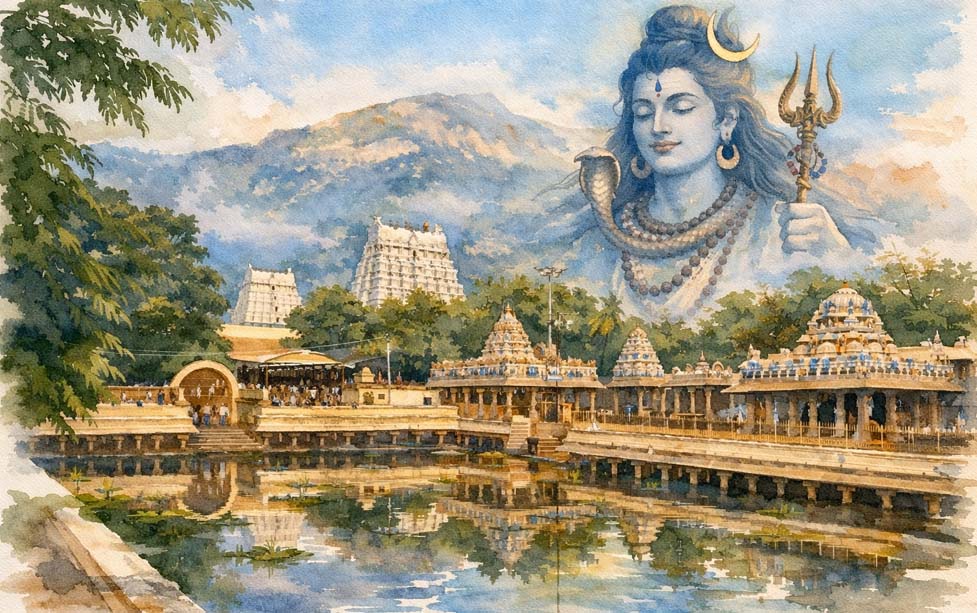
No time for reading the blog? Give it a listen on Spotify.

Arunachala of Tiruvannamalai is not merely a sacred hill but a living embodiment of Shiva, where every step around it becomes a journey into the deepest layers of the Self.
In the sacred town of Tiruvannamalai, rising quietly yet irresistibly from the earth, stands Arunachala Hill. In Shaiva tradition, Arunachala is not a symbol of Shiva. It is Shiva. Manifest. Still. Unmoving.
Among the Panchabhutas, Arunachala represents Agni, the fire element. Yet this fire does not burn outward. It burns inward, consuming ignorance, ego, and restlessness. Unlike other sacred sites where Shiva is worshipped within a sanctum, here the hill itself is the sanctum. The form is the formless made visible.
Arunachala does not speak. It does not instruct. And yet, it transforms.
Giri Pradakshina: Walking Around the Absolute
The most sacred way to engage with Arunachala is Giri Pradakshina, the circumambulation of the hill. The path is about 14 kilometers and traditionally walked barefoot, often in silence, often at night or on full moon days.
This walk is not undertaken to reach somewhere. It is undertaken to dissolve something.
Here’s the thing: the hill remains still while the seeker moves. But inwardly, as the walk progresses, something reverses. The seeker begins to settle, and the world begins to move around them. Giri Pradakshina is a meditation in motion, where effort slowly gives way to awareness.
The yatra always begins and ends at the Arunachaleswara Temple. That circularity is essential. You start where you end. Just as the spiritual journey begins and ends in the Self.
The Ashtalingams: Eight Inner States of Awareness
Scattered along the pradakshina path are eight sacred Shiva lingams known as the Ashtalingams. Each corresponds to a direction, a cosmic guardian, and more importantly, a stage of inner transformation within the sadhak.
The hill itself is sthira (absolute stillness). The Ashtalingams represent the movement of consciousness toward that stillness.
Indra Lingammarks the beginning. It represents the mind and the senses. This is where distraction is first observed rather than indulged.
Agni Lingam follows. It is the inner fire purified through tapas. Discipline sharpens intention.
Yama Lingam governs death and karma. Here, fear of mortality begins to loosen its grip.
Niruti Lingam removes tamasic qualities. Inertia, ignorance, and heaviness fall away.
Varuna Lingam represents water and emotion. Emotional turbulence settles into clarity.
Vayu Lingam signifies prana shakti rising upward. Awareness becomes subtle and expansive.
Kubera Lingam teaches how to live in the material world without being bound by it. Possession without attachment.
Finally, Ishanya Lingam offers the experience of Shivatva. No striving. No becoming. Only being.
To complete this yatra is to walk through the inner anatomy of awakening.
Arunachala as a Living Presence
There is a belief shared quietly among long-time devotees and sadhaks that Arunachala is not just conscious as a whole, but alive in its smallest details. According to this understanding, the rocks of Arunachala are not inert matter. They are entities absorbed in deep meditation.
The hill is seen as a field of condensed consciousness. The massive boulders scattered across its slopes are believed to be ancient beings in tapas, held in stillness by realization itself. In Shaiva thought, consciousness does not lose awareness when it takes form. It simply becomes silent.
Pilgrims who have walked the hill for decades speak of something even more mysterious. Some claim that rocks they distinctly remember at certain locations were later found subtly shifted. Not displaced by landslides. Not moved by human effort. Simply… relocated. As though the hill had breathed.
Arunachala does not demand belief. It invites perception. Whether one sees stone or awareness depends not on the hill, but on the stillness of the observer.
Ramana Maharshi and Arunachala: Guru as Mountain
No reflection on Arunachala is complete without Ramana Maharshi.
At the age of sixteen, Ramana Maharshi experienced a spontaneous and irreversible awakening. Shortly afterward, he was drawn to Arunachala without knowing why. He later said the hill called him, and he obeyed.
For the next 54 years, he lived at its base, in caves and later at Sri Ramanasramam, identifying Arunachala as his Guru and as Shiva in visible form. His teaching was disarmingly simple: Who am I? Not as philosophy, but as direct inquiry.
Ramana never emphasized ritual, yet he walked the hill. He never glorified pilgrimage, yet he never left Arunachala. For him, the mountain was silent instruction. Presence itself was the teaching.
In that light, the belief in living stones does not feel mystical or exaggerated. It feels consistent.
A Yatra That Completes Itself
Giri Pradakshina is often said to be a yatra that must be done at least once in a lifetime. Not for merit. Not for answers. But to experience Shivatva.
You begin at the temple. You end at the temple. But something essential dissolves along the way.
Arunachala does not promise miracles. It offers something rarer: stillness so complete that truth becomes unavoidable.
And sometimes, that is the greatest grace of all.
To walk around Arunachala is to walk around stillness itself, shedding layers of fear, attachment, and illusion with every step. When the journey ends where it began, only one truth remains: Arunachala was never outside you, it was always what you are.