By
By 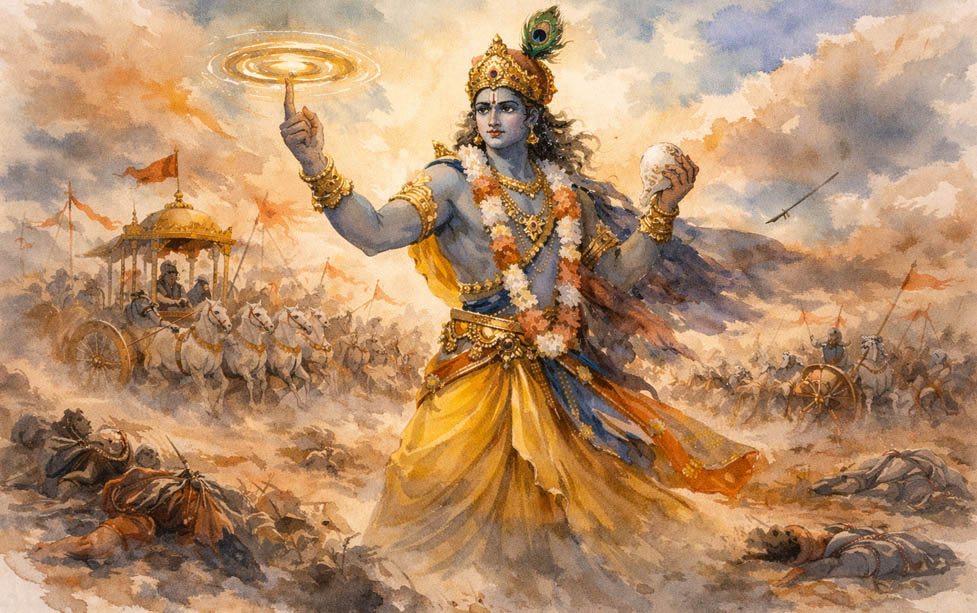
No time for reading the blog? Give it a listen on Spotify.

When the guardian of cosmic order, Krishna, bent the rules, He wasn’t breaking Dharma. He was redefining what righteousness looks like in an unjust world.
The air at Kurukshetra was thick with dust and despair.
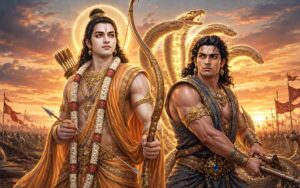
Arjuna, the greatest archer of his age, stood with his bow slipping from his hands. Across the field stood his revered grandfather, his beloved teacher, his cousins. The rules of war, the dharma-yuddha, were clear.
Fight fair. Fight equal. Fight with honor.
Yet, as Krishna raised his chariot whip, He did something unexpected.
He didn’t just counsel Arjuna to fight. Over the next eighteen days, He would bend every rule Arjuna held sacred.
Why?
Because sometimes, following the rules perfectly means watching righteousness die a slow death.
The Problem: Dharma in a Corrupt Battlefield
Let us be clear about one thing: Krishna did not break rules in a vacuum.
By the time the first conch was blown, the Kauravas had already:
Rigged a game of dice to rob five kings of their freedom
Dismissed the rules of the court while disrobing Draupadi
Ganged up on a defenseless boy, Abhimanyu, and slaughtered him when he was unarmed and trapped
Duryodhana did not believe in fair play.He believed in winning.
And so, a terrifying question emerged: If one side has abandoned morality entirely, does the righteous side win by clinging to procedural niceties?
Krishna looked at Yudhishthira—a man who would not tell a lie even to save his life.
Then He looked at the crying mothers of warriors who had played by the rules and died anyway.
His decision was made.
The Case Studies: When the Divine Broke Protocol
I. The False Sunset (Jayadratha)
The vow was absolute: Arjuna would kill Jayadratha before sunset, or enter fire himself.
As the sun dipped, Jayadratha—hidden behind layers of Kaurava protection—laughed. He had survived. Arjuna had failed.
Then, Krishna did something strange. He cast his illusion (maya). The sun dimmed. The light faded. The Kauravas cheered, believing the day was over.
In that moment of premature celebration, Jayadratha was exposed. And Krishna lifted the veil, revealing the sun still hung in the sky.
Was this deception?
Or was it the universe bending light itself to ensure a murderer of children did not escape justice?
II. The Fall of Bhishma
Bhishma was the pitamaha. He was invincible—not because he could not be killed, but because he would not be killed by anyone whose hand he did not choose to fall from.
He had taken a vow: never fight a woman.
So Krishna placed Shikhandi—a warrior who was born female—in front of Arjuna’s chariot. Bhishma lowered his weapons. Arjuna struck from behind.
Was this cowardice?
Or was it using the tyrant’s own rigid code to dismantle his tyranny?
III. The Death of Drona
Dronacharya was unstoppable. As long as he held his bow, the Pandava army bled. Krishna knew Drona’s weakness: his son, Ashwatthama.
The plan was simple, yet devastating. “Ashwatthama is dead,” Bhima roared, loud enough for the entire battlefield to hear.
Drona turned to Yudhishthira—the man who had never lied. Yudhishthira whispered: “Ashwatthama is dead.”
Then, softer: “…the elephant.”
The elephant was dead. The son was alive. But Drona heard only the first sentence. His arms fell. His soul left his body.
Was this a sin against truth?
Or was it forcing Dharma to speak the language Adharma understood?
IV. Karna’s Last Moments
Karna, the son of Surya, had one weakness: his mother’s curse.
When his chariot wheel sank into the blood-soaked earth, he stepped down to lift it. “Wait,” he cried. “This is against the rules. I am disarmed. I am vulnerable.”
Krishna did not wait. “Strike,” He told Arjuna. And Arjuna struck.
Was this murder?
Or was it the universe remembering Karna’s own silence when Draupadi was dragged by her hair and cried for help, and no one—not even Karna—said “Wait”?
The Central Question: What Is Dharma, Really?
We have been taught that Dharma is a straight line. Do not lie. Do not cheat. Do not strike an unarmed man.
But Krishna asks us: Why?
Is the rule meant to protect the form of righteousness, or its essence? If telling the truth leads to the coronation of a tyrant, is truth still virtuous? If sparing a warrior spares a war criminal, is mercy still holy?
Krishna does not worship the rule. He serves the goal: the restoration of cosmic balance.
In the Bhagavad Gita, He declares:
Yada yada hi dharmasya glanir bhavati Bharata…
“Whenever righteousness declines, I manifest.”
He does not say, “Whenever procedures are violated.”
He says, whenever balance is lost, I come.
Form is secondary. Essence is primary.
What This Means for You and Me
This is not a mythology essay. This is applied ethics for the modern world.
We live in systems that are often broken:
Laws that protect the powerful
Contracts that exploit the vulnerable
“Process” used as a shield for injustice
We see leaders who hide behind rules while the spirit of fairness burns.
Krishna’s message is not “cheating is good.”
His message is: Intelligence is a form of devotion.
If you have the ability to outthink evil, you are obligated to do so. If you can bend a broken system to deliver justice, bending is not betrayal—it is worship.
Did Krishna Go Too Far?
Yes.
Even Yudhishthira, after the war, suffered sleepless nights. “My chest burns,” he confessed. “I lied about Drona.”
Krishna did not dismiss his pain. He simply said: “In the pursuit of great good, great burdens are carried by those who act. You chose to carry the burden of a lie so that truth itself could survive. That is not sin. That is sacrifice.”
Dharma is not naive. It is not a children’s story where the hero never gets his hands dirty. It is the art of navigating a fallen world without losing your soul.
The Divine Strategist
Krishna’s genius was not in His weapons. It was in His wisdom.
He knew that when your opponent has already burned the rulebook, you cannot defeat them by politely asking them to stop.
You adapt.
You strategize.
You fight fire with intelligent fire.
And sometimes—when the universe itself hangs in the balance—you bend a rule to save the world.
So, is Dharma always straight?
No.
Dharma is balanced.
And balance requires adjustment.
The question is not whether you bent.
The question is: Why did you bend?
Krishna bent for the crying.
He bent for the humiliated.
He bent for the boy who was killed unfairly.
And if you ever find yourself in a broken system, fighting a battle that isn’t fair—
Ask yourself:What would Krishna do?
This is the uncomfortable, beautiful, terrifying truth of Sanatan Dharma: It does not ask you to be perfect. It asks you to be wise.