
 By
By 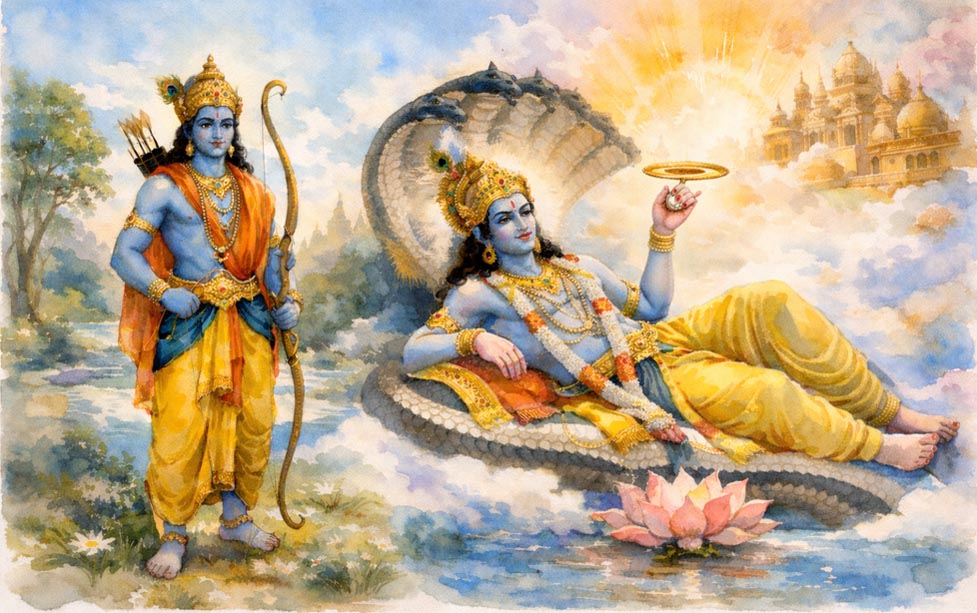

Characters in the story:
Lord Rama: Lord Rama is one of the most revered deities in Hinduism and is the seventh avataar of Lord Vishnu. He is known for his virtues of righteousness, courage, and devotion, and is considered a symbol of ideal human behavior and the victory of good over evil.

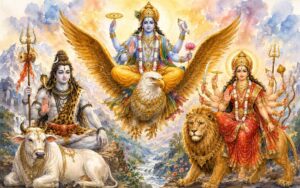
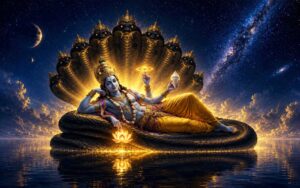
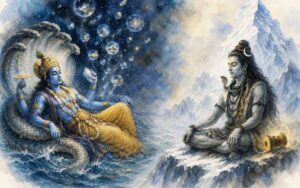
Lord Vishnu: Lord Vishnu is one of the three major deities in Hinduism, known as the preserver of the universe and the protector of dharma (righteousness). He is often depicted with four arms holding a conch shell, a discus, a mace, and a lotus flower.
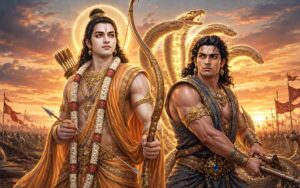
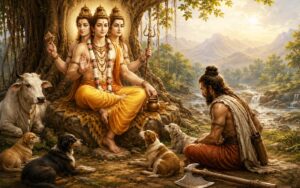
Lakshman: Lakshman is a prominent character in the Hindu epic Ramayana, where he is depicted as the younger brother of Lord Rama and a loyal companion in his journey to rescue his wife Sita from the demon king Ravana.
Bharat: Bharat is a figure in the ancient Hindu epic Ramayana. He is the son of Kaikeyi and the younger half-brother of Lord Rama. He rules Ayodhya as its regent while Lord Rama is banished from his kingdom, and fights to rescue his wife Sita, kidnapped by Ravana.

In the Sanatan Dharma tradition, an avatar is a divine descent of the Supreme Being into the world. When dharma declines and chaos rises, the divine takes form to restore balance. This principle is described in texts such as the Bhagavad Gita and illustrated through many stories in the Bhagavata Purana and the Valmiki Ramayana.
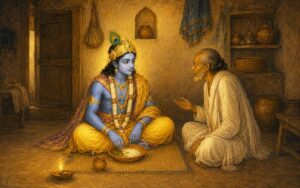
Lord Rama, the prince of Ayodhya, is revered as the seventh avatar of Vishnu. His life was not only a royal story but also a living example of maryada—the highest ideals of duty, honor, and righteousness.
For many years after defeating Ravana and returning to Ayodhya, Rama ruled the kingdom in what came to be known as Rama Rajya, an age remembered as the golden standard of justice, compassion, and moral governance.
But even divine incarnations must eventually complete their mission.
The Final Chapter of Rama’s Life
After many years of ruling Ayodhya, a profound moment arrived that signaled the completion of Rama’s earthly role.
According to later traditions and Puranic narratives, a messenger from the cosmic order arrived with a message: the purpose of the avatar had been fulfilled. The time had come for Rama to return to his divine abode.
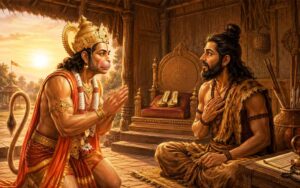
Author’s Note: There is another story connected to this moment in which Lord Yama faced a dilemma, as Hanuman was fiercely guarding Rama’s life. Recognizing Yama’s difficulty, Rama devised a way to outsmart Hanuman so that he could complete his earthly mission and depart for Vaikuntha. Here is the link to the story: Hanuman’s Quest: In Search of Rama’s Ring
Before leaving, Rama ensured that his kingdom was secure and that his people would continue to live in harmony. His rule had established dharma so firmly that the land prospered long after.
Then something extraordinary happened.
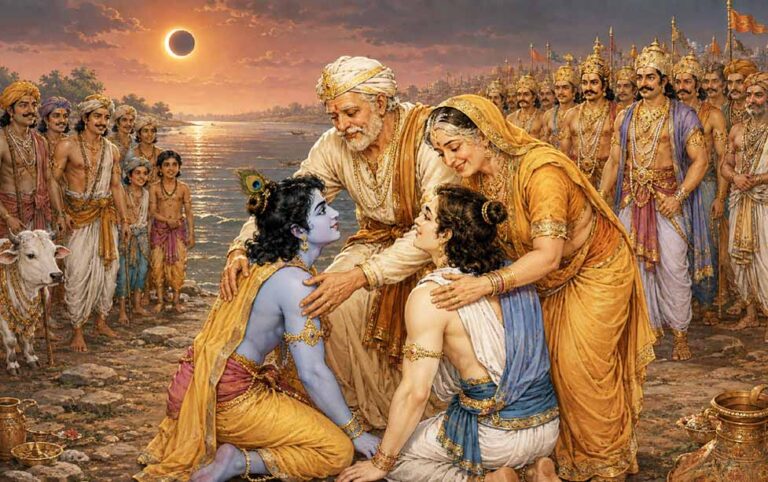
When Rama began walking toward the sacred waters of the Sarayu River, the people of Ayodhya followed him. Not just a few devotees, but vast numbers of citizens, sages, and warriors walked behind their beloved king.
They did not want to live in a world without Rama.
The Transformation of the Brothers
Rama’s brothers walked beside him on this final journey.
In the spiritual tradition described in the Bhagavata Purana, this moment reveals their divine nature.
Lakshmana, who had served Rama with absolute devotion throughout his life, returned to his eternal form as Shesha, the cosmic serpent on whom Vishnu rests.
Bharata, the brother who ruled only as Rama’s representative, became the divine Shankha (conch) of Vishnu.
Shatrughna, the quiet but powerful warrior, manifested as the Sudarshan Chakra, the divine discus.
These transformations symbolized a profound truth: the entire family of Rama was part of the divine cosmic order.
Rama’s Jal Samadhi
When they reached the banks of the Sarayu, Rama stood silently for a moment, gazing upon Ayodhya—the city he had protected and loved.
Then he stepped into the river.
This act is remembered as Jal Samadhi, a sacred departure in which a realized being consciously leaves the mortal body through water.
As Rama entered the Sarayu, the earthly form dissolved, and the divine essence revealed itself once more.
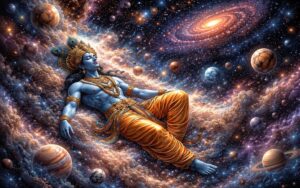
In that moment, Shri Rama returned to his eternal identity as Lord Vishnu, the preserver of the universe, and ascended to Vaikuntha, the celestial realm beyond birth and death.
Many of the citizens who followed him are believed, in devotional traditions, to have also attained liberation.
The Eternal Message of Rama
The departure of Rama is not described as a tragedy. Instead, it carries a deep spiritual message.
Whenever the divine takes form in the world, it follows the same cosmic rhythm as creation itself: appearance, purpose, and return.
Jai Shri Ram