
 By
By 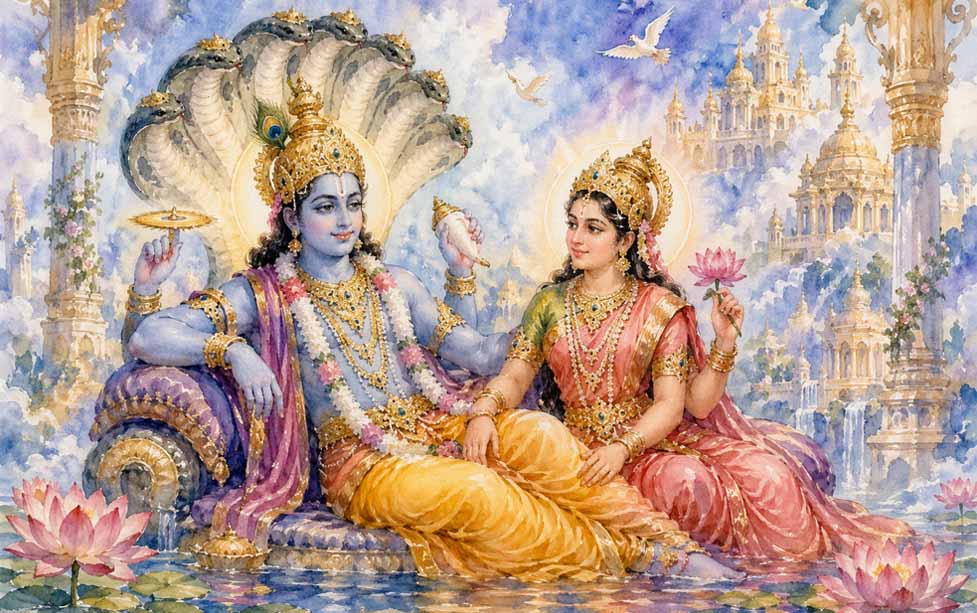
Tune in on Spotify for a deeper exploration of this story in Hindi & English.

When Lakshmi was cursed to leave heaven, she did not fight it. She trusted it. And that made all the difference.

There’s a moment in almost every love story where separation becomes the turning point. Not the end, but the turning point. The story of Goddess Lakshmi and Lord Vishnu is exactly that kind of story.
It begins in paradise and ends there too, but the journey between the two is what makes it worth telling.
A Gift, a Moment of Carelessness, and a Sage’s Fury
The story starts in Vaikuntha, the celestial realm where Vishnu and Lakshmi are said to reside together in eternal harmony. If you imagine it, it is the kind of place where nothing goes wrong. Except, one day, something did.
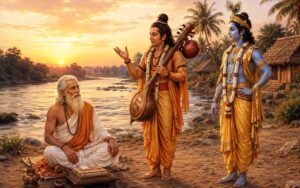
Sage Durvasa arrived with a garland. Not just any garland, but a sacred one, woven with divine intention and fragrant with celestial energy. He offered it to Lakshmi as a gesture of deep reverence.
Lakshmi received it graciously and passed it to Vishnu.
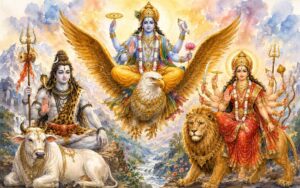
What happened next was small. Almost nothing, really. Vishnu placed the garland on Garuda, his divine eagle mount. The garland slipped. It fell to the floor.
To most people, that is a minor accident. To Durvasa, it was an insult, not to his ego, but to the sacred energy the garland carried. He was furious, and ancient sages with that level of spiritual power did not stay quietly furious.
He looked at Lakshmi and delivered the curse: she would be separated from Vishnu and reborn on Earth. What is striking here is not the curse itself. It is Lakshmi’s response. She did not argue. She did not plead. She simply accepted it.
What Does It Mean When a Goddess Gets Cursed?
Before you assume this is just an ancient punishment story, consider what the curse actually sets in motion.
Lakshmi did not fall from grace. She descended, multiple times, into human lives that each carried a specific purpose. In Hindu tradition, she is said to have been reborn in three significant forms.
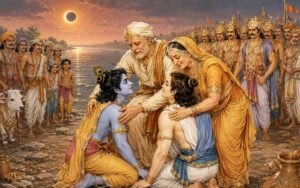
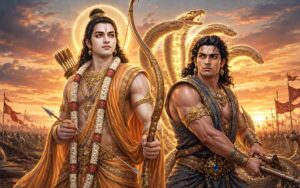
As Sita, she was born to King Janaka and became the wife of Lord Rama. Her life became the central thread of the Ramayana, one of the most widely read epics in the world. It is a story about abduction, resilience, justice, and the cost of honor.
As Rukmini, she was a princess who made the bold choice to choose her own husband, Lord Krishna, refusing an arranged marriage that was not right for her. In a world where women rarely had that agency, her story stood out.
As Padmavati, she was the consort of Lord Venkateshwara, the deity enshrined at Tirupati, one of the most visited pilgrimage sites on Earth. Her patience and devotion became a central part of that temple’s mythology.
In every single life, she was separated from Vishnu. And in every single life, they found their way back to each other.
The Real Question: Why Did She Accept It?
This is where the story gets genuinely interesting, because Lakshmi’s calm acceptance is the spiritual core of the whole narrative.
She was not passive. She was not powerless. She was, by most definitions, one of the most powerful beings in the cosmos. And yet she did not fight the curse.
The reason most scholars and storytellers point to is this: she understood that even consequences that feel unjust serve a larger design. The universe, as Hindu philosophy sees it, operates on karma, a precise law of action and outcome. Even those who stand at the top of the divine hierarchy are not exempt from it.
But there is a more human way to read it too. Sometimes the most graceful thing a person can do is accept a difficult chapter without bitterness, not because they deserve it, but because they trust that what comes next is worth it. Lakshmi’s acceptance was not surrender. It was faith.
What Reunion Actually Looks Like
Here is the part of the story that often gets skipped over: Vishnu did not stay in Vaikuntha waiting while Lakshmi lived out her human lives. He came with her.
Every time she was born on Earth, he took form alongside her. Rama for Sita. Krishna for Rukmini. Venkateshwara for Padmavati. The separation was real, but it was never permanent, and it was never one-sided.
This detail carries a lot of weight. It suggests that the curse was not a punishment inflicted on Lakshmi alone. It was a shared journey, even if the paths looked different.
In Hindu theology, Lakshmi and Vishnu represent two complementary forces: she embodies prosperity, beauty, and abundance; he embodies order, protection, and cosmic balance. Their reunion is not just a love story. It is a symbol of what happens when material well-being and spiritual purpose align. Neither is complete without the other.
Why This Story Still Resonates Thousands of Years Later
Most people who encounter this story are not Hindu theologians. They are ordinary people who have experienced loss, of a relationship, a sense of direction, a version of themselves they thought was permanent.
Lakshmi’s story offers something that is surprisingly rare in ancient texts: a framework for understanding separation that does not cast it as failure.
She did not do something terribly wrong. She did not deserve what happened in any simple moral sense. She was in the middle of someone else’s anger, and she bore the consequence. Sound familiar?
What makes the story remarkable is that her response, calm, faithful, and forward-looking, produced something meaningful. Three lives. Three stories. Three reunions. Each one richer than if the separation had never happened.
That is not a guarantee that every painful chapter ends the same way. But it is a reminder that the chapters in between are not wasted time.
The Takeaway
Lakshmi’s curse is not a story about divine punishment or ancient wrath. It’s a story about what love looks like when it’s tested — and what faith looks like when it has to carry you through an outcome you didn’t choose. She is worshipped across millions of homes every year, particularly during Diwali, as the goddess who brings light, prosperity, and good fortune.
This story reveals a different dimension of Lakshmi. She was not just a goddess of gold and good fortune. She was someone who walked into uncertainty without a map, lived multiple human lives without losing her center, and found her way back every single time. She lost everything. Three times. And three times, she rebuilt the most important thing of all.
That is not a story about divine privilege. That is a story about what faith looks like when it has nothing left to hold onto except itself.


There is nothing unjust in our lives. Everything, good or bad, is a precursor to something, good or bad. And that’s it. Simple.
Namastaey;@#Learn From Laxmi and OrThame.