By
By 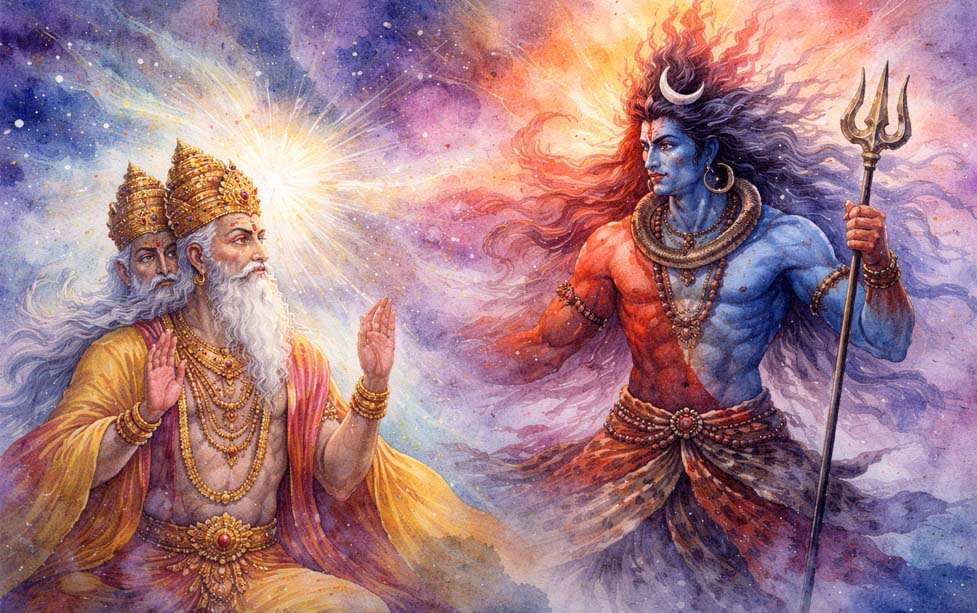
Listen to the podcast on Spotify for a deeper dive into this story.

This is the story of how a moment of frustration in creation led to the formation of Rudra, one of the most powerful and transformative forces in the universe.
Characters in the story:
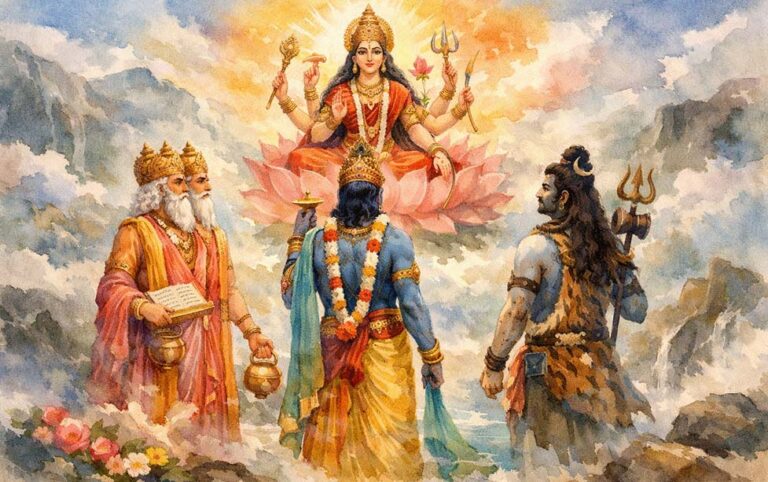
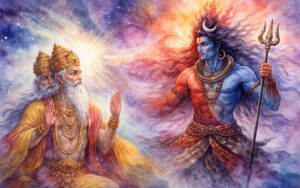
Lord Brahma: Lord Brahma holds a significant position in Hinduism as the divine creator of the universe and all living beings. He is commonly portrayed with four heads, symbolizing his association with the four Vedas.

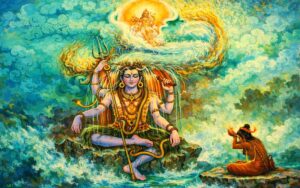
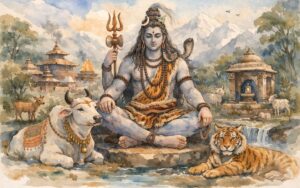
Lord Shiva: Lord Shiva, a major deity in Hinduism, is revered as the destroyer of evil and the force of cosmic change. He is depicted as a meditative ascetic or a divine dancer, characterized by his third eye, a serpent around his neck, and a trident in his hand.

At the beginning of creation, the universe was taking shape, but something was not working. Brahma had begun creating life. Sages, beings, and the early structure of existence had already appeared. But creation lacked momentum.
It felt incomplete.
The First Signs of Resistance
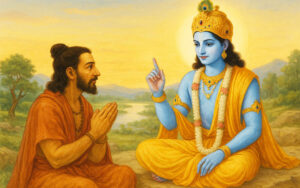
Among Brahma’s earliest creations were four great sages: Sanaka, Sananda, Sanatana, and Sanatkumara.
They appeared as young boys, but they carried deep wisdom. They were detached from worldly life.
Brahma asked them to help expand creation. The expectation was simple. Create life and help the universe grow.
They refused.
Not out of defiance, but out of clarity. Their focus was on liberation, not creation.
This was the first real resistance Brahma encountered.
The Rise of Divine Anger
Brahma understood their decision, but it still affected him. Creation had just begun, and already it was slowing down.
A strong emotion rose within him. He tried to control it, but it became too intense.
Finally, it broke through.
The Appearance of Rudra
From between Brahma’s eyebrows, a powerful being emerged. His form was striking. It carried mixed hues of blue and red. Blue reflected deep emotion, while red reflected raw rage.
Some traditions describe him as embodying both masculine and feminine aspects, hinting at the form of Ardhanarishvara.
The moment he appeared, he began to cry loudly.
He looked at Brahma and said, “Give me a name. Tell me where I belong.”
Brahma replied, “You cried intensely. So you shall be called Rudra.”
There is also a telling where Brahma says “Ma Ruda,” meaning “do not cry,” and from that comes the name Rudra.
But the crying did not stop.
Each time he cried again, new forms of Rudra emerged. Over time, these expanded into multiple manifestations, eventually understood as the eleven Rudras.
The Many Forms and Consorts of Rudra
Rudra was not a single, fixed being.
His masculine aspect divided into eleven forms, including Ajan, Ekaath, Ahirbudhnya, Twashta, Rudra, Hara, Sambhu, Tryambaka, Aparajitha, Easana, and Tribhuvana.
Alongside this, a feminine counterpart called Rudrani also emerged. She too divided into eleven forms, complementing each Rudra.
Rudra is also described as having eleven associated energies or expansions, sometimes referred to as Rudranis, who govern destruction and fear within the universe.
To support creation, Brahma gave Rudra eleven consorts:
Dhee, Vritti, Ushna, Uma, Niyut, Sarpi, Ila, Ambika, Iravati, Sudha, and Deeksha.
These pairings were meant to balance his energy and aid in creation. But as the story unfolds, even this balance proved difficult to sustain.
Other Creations of Brahma
Around the same time, other beings emerged from different aspects of Brahma:
From his mind came the four Kumaras
From his lap came Narada
From his right thumb came Daksha
From his left thumb came a daughter named Veerani
Each origin reflected a different dimension of creation.
Rudra’s Role in Creation
Brahma assigned Rudra multiple abodes:
The heart
The senses
The life force within all beings
The elements such as space, air, fire, water, and earth
The sun and the moon
Austerity and inner discipline
Rudra was present everywhere. Brahma then asked him to expand creation.
When Creation Became Overwhelming
Rudra followed the instruction. He created many beings similar to himself. They were fierce, powerful, and intense.
But their numbers grew rapidly. Their energy became overwhelming. Instead of balanced creation, it began to turn destructive.
Even with the presence of his consorts and Rudranis, the intensity of this force could not be contained.
Brahma saw the danger. If this continued, creation itself could collapse.
The Shift Toward Balance
Brahma intervened and advised Rudra to stop. He guided him toward penance and meditation. Through discipline, balance could be restored.
Rudra accepted this without resistance.
He withdrew from outward creation and turned inward.
From Rudra to Shiva
This is where the transformation happens. Rudra did not lose his energy. He refined it.
The same force that was once uncontrolled became steady and focused.
This is when Rudra becomes Shiva, the auspicious one.
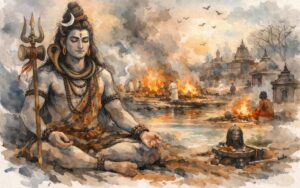
He becomes the great yogi, known for stillness, awareness, and inner mastery.
What This Story Really Means
This story reflects a deeper truth about creation and life.
Creation does not always begin smoothly.
Resistance and tension are part of the process.
Strong emotions can give rise to powerful outcomes.
Rudra represents raw energy.
Shiva represents mastered energy.
Even the most intense force can become a source of balance when guided with awareness and discipline.
The journey from Rudra to Shiva shows that true power lies in mastering energy, not just expressing it.