
 By
By 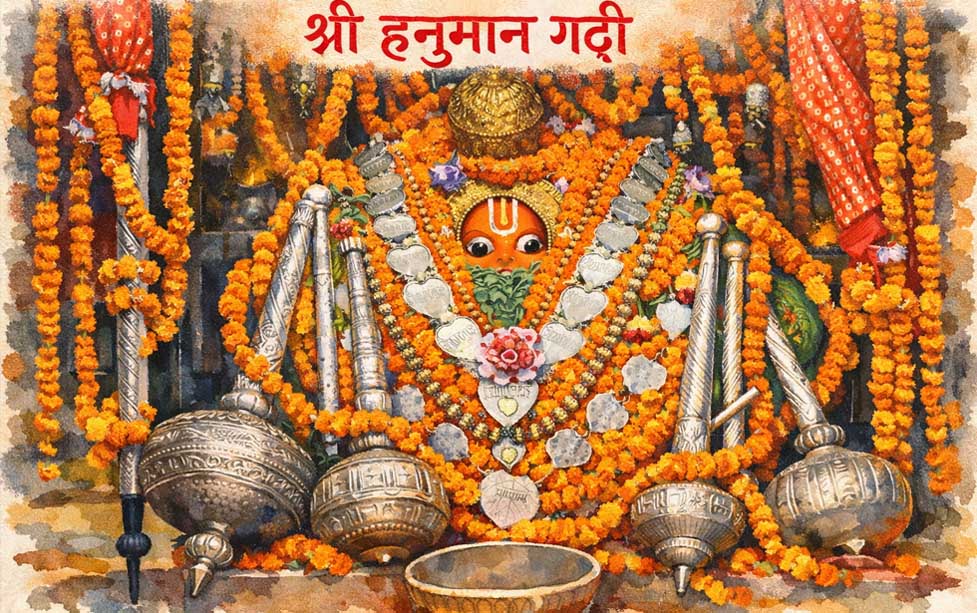
Tune in on Spotify for a deeper exploration of this blog.

In the heart of Ayodhya stands Hanuman Garhi, a fortress-temple where Hanuman is revered not as a humble servant, but as the vigilant king and eternal protector of Ram’s sacred city.
In the sacred city of Ayodhya, where every street carries echoes of Rama, Hanuman Garhi rises like a spiritual citadel. It does not feel like an ordinary temple. It feels guarded. Anchored. Watched over.
And that is intentional.
Because here, Hanuman is not worshipped merely as Ram’s humble servant. Here, he is revered as the King and Protector of Ayodhya.
The Story: Why Hanuman Guards Ayodhya
Tradition says that after Lord Ram returned to Ayodhya and established Ram Rajya, Hanuman chose not to leave. Instead, he took residence on a mound near Ram’s palace and began his eternal vigil over the city.
From that moment on, Hanuman became Ayodhya’s guardian.
Devotees believe that even today, he protects:
Ram Janmabhoomi
The spiritual sanctity of the city
Every pilgrim who steps into Ayodhya
That is why many follow the age-old custom of first offering prayers at Ram Janmabhoomi only after seeking blessings at Hanuman Garhi.
You greet the protector before meeting the king.
A Rare Form: Hanuman as King, Not Das
This temple holds a unique theological position.
Across India, Hanuman is usually worshipped as Ram’s devoted das. But at Hanuman Garhi, he is honored as the sovereign guardian. The protector of the throne. The ruler of the spiritual fort.
That shift is powerful.
It reflects the belief that devotion does not diminish greatness, it elevates it.
The Idol: Bal Hanuman
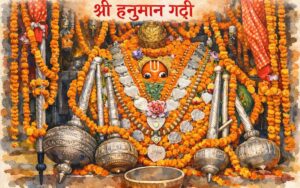
Inside the sanctum sits a small but deeply revered idol of Bal Hanuman — the child form.
Why a child?
Because this form represents:
Pure, ego-less strength
Innocent devotion
Fearless protection rooted in love
The idol is often adorned with flowers and cloth, and devotees must bow low to glimpse him. Strength resides in humility — the temple subtly teaches that.
A Fort of Faith
Climbing roughly 76 steep steps, pilgrims reach a structure that resembles a fortress more than a shrine. Circular bastions rise at the corners. Thick walls surround the complex.
It looks defensive because historically, it had to be.
Hanuman Garhi is not just spiritually symbolic — it physically embodies protection.
Seat of the Nirvani Akhara
Hanuman Garhi serves as the main seat of the Nirvani Akhara, one of the most influential monastic orders in North India.
The Nirvani Akhara belongs to the warrior-saint tradition — ascetics who were not only spiritual practitioners but also protectors of dharma in turbulent times.
This connection explains:
The temple’s fort-like architecture
Its historical resilience
Its central role in Ayodhya’s religious identity
It is not just a temple. It is a spiritual headquarters.
Nawab’s Miracle: A Story of Shared Faith
One of the most fascinating legends tied to Hanuman Garhi involves the Nawabs of Awadh.
Local lore says that the son of Nawab Safdar Jang was suffering from a serious illness. When conventional treatments failed, sacred ash from Hanuman Garhi was given to him. The child recovered.
In gratitude, the Nawab is said to have granted land and funds for expanding the temple in the 18th century.
Whether taken as history or legend, the story reflects something remarkable — a moment where faith crossed political and religious boundaries.
The 1998 Miracle
Modern faith often draws strength from recent memory.
In June 1998, locals recount an incident in which a hidden bomb was allegedly placed near the temple. According to popular belief, a monkey sat on a wire connected to the explosive device, preventing it from detonating.
Many devotees see this as divine intervention — Hanuman himself protecting his abode through one of his vanara forms.
Skeptics may question the details. Believers see protection in action.
Why Hanuman Garhi Matters Today
Hanuman Garhi is considered a Siddha Peeth — a place where prayers are believed to bear fruit swiftly, especially those related to:
Protection
Courage
Strength in adversity
But beyond miracles and legends, the temple represents something deeper.
It reminds us that:
Devotion is strength
Loyalty is power
Protection is love in action
The Emotional Core
Here’s the thing.
In Ayodhya, Ram represents righteousness and kingship. At Hanuman Garhi, you encounter vigilance and fearless service.
The energy is different. Protective. Steady. Uncompromising.
Before approaching the divine king, you meet the guardian who never sleeps.
Hanuman Garhi stands as a living symbol of strength rooted in devotion.
It tells us that true power does not always sit on the throne — sometimes, it stands guard at the gate.
Climb the steps. Bow your head.
And remember, the greatest protector is the one who serves without seeking glory.






The power of humility, the gift of divinity 🙏