
 By
By 
No time for reading the blog? Give it a listen on Spotify.

Often misunderstood, the story of Krishna’s 16,000 wives reveals an act of compassion meant to restore dignity and express the highest form of dharma.
The story of Lord Krishna’s 16,000 wives is often misunderstood when read only at the surface level. Numbers attract attention. Meaning requires reflection. When understood through the Mahabharata and Puranic tradition, this episode is not about physical union, but about dignity, responsibility, and divine protection.
Krishna’s Eight Principal Queens
According to the Mahabharata, Lord Krishna had 16,108 wives, of whom eight were his principal queens: Rukmini, Satyabhama, Jambavati, Kalindi, Mitravrinda, Nagnajiti, Bhadra, and Lakshana.
These eight marriages followed royal and personal bonds, and they form the core of Krishna’s household life. What follows next is a completely different category of relationship, often misunderstood when viewed through a modern or literal lens.
Narakasura and the Imprisoned Princesses
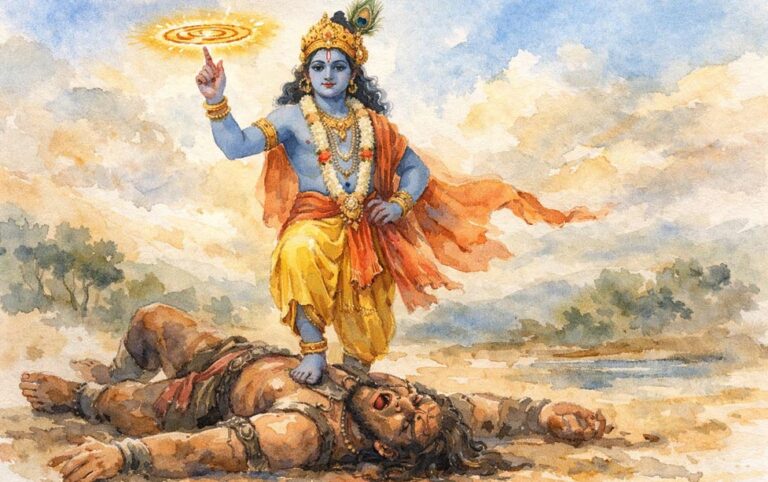
The demon king Narakasura abducted 16,100 princesses from various kingdoms and imprisoned them in his fortress. They were held against their will, stripped of freedom and dignity.
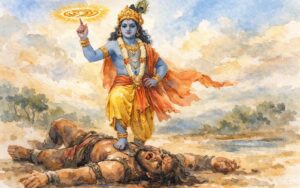
When Krishna defeated Narakasura, the women were freed. But liberation alone did not end their suffering.
In the social order of that time, women who had lived in a demon’s captivity, even involuntarily, were considered disgraced. Their families would not accept them. Society offered no shelter. For many, such rejection often meant exile or death.
They were free, yet nowhere to go.
Satyabhama and the Fall of Narakasura
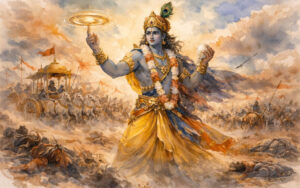
Krishna did not go to battle alone. Queen Satyabhama accompanied him, and her presence was essential.
Narakasura could only be killed by Bhudevi, and Satyabhama was an incarnation of Bhudevi, the Earth Goddess. When Krishna was wounded during the battle, Satyabhama rose, took up arms, and struck down Narakasura, fulfilling the cosmic condition tied to his death.
The rescue of the 16,100 women was therefore not only Krishna’s victory, but also Satyabhama’s act of Shakti. Click here to read this story.
A Crucial Question of Dharma
After their rescue, the women approached Krishna with a painful truth.
Freedom did not restore their place in society.
Returning home meant rejection.
Living alone meant danger and disgrace.
They asked Krishna not for pleasure, but for protection.
Krishna understood something crucial: in that society, a woman’s dignity and safety were inseparable from social status.
Marriage as Shelter, Not Desire
Krishna’s response is the heart of this story.
He accepted the 16,100 women as his wives, not to establish physical relationships, but to give them legal, social, and moral dignity. This was not a marriage of intimacy, but a sanctuary of honor.
Scriptural traditions are clear on this point:
These relationships were not physical unions.
They were bonds of responsibility and protection.
Each woman was granted the status of a queen, lived in safety, and was treated with respect. Krishna assumed the role of guardian, not a husband in the conventional, physical sense.
What society denied them, Krishna restored through dharma.
One Krishna, Many Forms
The question still arises: how could Krishna care for so many?
The answer lies in divine symbolism.
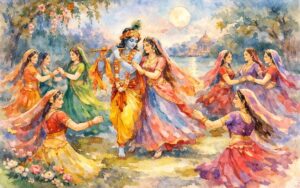
Just as Krishna manifested himself during Raas Leela, dancing with 108 gopis simultaneously, where each felt he was dancing only with her, Krishna manifested himself in 16,108 forms.
This manifestation was not about romance or physical presence. It represented equal attention, care, and protection. Each queen experienced Krishna as fully present in her life, without competition or neglect.
Understanding the Deeper Meaning
This story is not about numbers or marital excess. It is about accountability.
Krishna did not rescue the women and abandon them to social cruelty.
He did not offer charity and walk away.
He took lifelong responsibility for their dignity.
In doing so, he challenged a society that punished victims instead of perpetrators.
What This Story Truly Teaches
Krishna’s 16,000 marriages symbolize:
Compassion over judgment
Responsibility over reputation
Dharma over social convenience
The absence of physical relations is not a denial of humanity. It is the very reason the act becomes divine. Krishna’s role here is not that of a consumer, but of a protector who absorbs social burden to save others from it.
The story of Krishna’s 16,000 wives is not about desire. It is about dignity made permanent.
When society offered rejection, Krishna offered refuge. When honor was stripped away, Krishna restored it.
And in that act, he showed that true divinity is not found in power, but in taking responsibility for those the world abandons.



My Kanah 🙏🕉️