By
By 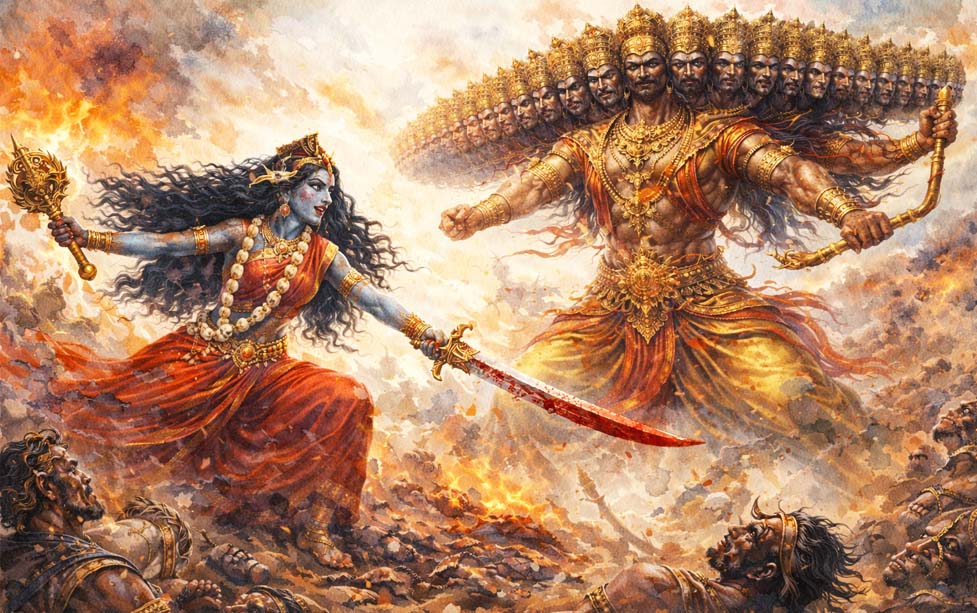
No time for reading the story? Give it a listen on Spotify.

From the Adbhuta Ramayana, this story reveals how Sita, the supreme embodiment of Shakti, destroys the thousand-headed Sahasra Ravana during Rama and Sita’s return from Lanka, unveiling her true cosmic power beyond all illusion.
Characters in the story:
Mata Sita: Mata Sita is the wife of Lord Rama, the seventh incarnation of Lord Vishnu. She is regarded as an epitome of feminine virtues and is worshipped as a goddess by many.

Sahasra Ravana: Sahasra Ravana is a powerful, thousand-headed demon often depicted as the elder, more formidable brother of the famous Ravana, appearing primarily in the Adbhuta Ramayana version of the epic, where he is slain by Sita in her ferocious Mahakali form.

In this lesser-known Ramayana tradition, the focus shifts decisively to Sita’s divine nature. Set after the fall of Lanka and Sita’s rescue, the encounter with Sahasra Ravana is framed not as another war of conquest, but as a final cosmic reckoning—one that only Shakti herself can resolve.
Who Was Sahasra Ravana?
Sahasra Ravana, also known as Sahasramukha, the thousand-headed Ravana, was not the same as the ten-headed Ravana slain in Lanka. He was an ancient and immensely powerful being, closely related to Ravana through lineage but vastly superior in raw cosmic power.
According to the Adbhuta Ramayana tradition, Sahasra Ravana came into being as a result of the intense austerities of the sage Vishrava, the father of Ravana. Through severe tapasya, Vishrava generated a being of extraordinary might, one who embodied deep cosmic forces rather than worldly kingship. Endowed with immense boons, Sahasra Ravana became nearly invincible, immune to gods, demons, and celestial beings.
His thousand heads symbolized not only overwhelming strength, but mastery over illusion, sorcery, and multiple layers of reality. While the ten-headed Ravana ruled through intellect, ambition, and political power, Sahasra Ravana existed on a far more dangerous plane, representing an unresolved cosmic imbalance.
The Encounter After Lanka
After Ravana’s defeat and Sita’s rescue, Rama and Sita set out on their journey back from Lanka. Dharma had been restored, yet the universe had not fully returned to equilibrium. It was during this return journey that Sahasra Ravana emerged and blocked their path.
This placement is deliberate. The Adbhuta Ramayana makes it clear that this was not another battle of conquest, but a confrontation with a lingering cosmic force that could not be resolved during the war of Lanka itself.
Rama and Lakshmana Bound by Illusion
Rama and Lakshmana confronted Sahasra Ravana with courage and divine resolve. In response, Sahasra Ravana unleashed a powerful weapon of illusion, ensnaring both brothers. They were not wounded or defeated, but bound within a distorted reality that could not be broken by weapons, strength, or valor alone.
The text emphasizes an important truth here: Sahasra Ravana was so formidable that even Rama could not neutralize him through conventional divine means. This was not a diminishment of Rama’s divinity, but a recognition that the nature of the threat demanded a different, higher intervention.
Sita Reveals Her True Form
Seeing the cosmic balance disrupted, Sita stepped forward. At that moment, she revealed her true nature and transformed into Mahakali, also identified as Bhadrakali, the fierce embodiment of Shakti.
The battlefield trembled as illusion dissolved instantly. The bonds holding Rama and Lakshmana vanished without effort. Sita’s form radiated absolute authority, not born of anger, but of inevitability. This was not a sudden act of desperation; it was the unveiling of a truth that had always existed beneath her gentle form.
The Slaying of the Thousand-Headed Ravana
Confident in his boons, Sahasra Ravana advanced toward her. Mahakali-Sita did not engage in prolonged combat. With a single, swift sweep of her sword, she severed all one thousand heads of Sahasra Ravana at once.
His massive form collapsed instantly. His army, sustained by illusion, disintegrated and vanished. The conflict ended not through struggle, but through unquestionable supremacy.
The Deeper Meaning of the Story
This episode forms the theological heart of the Adbhuta Ramayana. Rama represents pure consciousness, Shiva. Sita represents Shakti, the divine energy that animates, protects, and restores the universe. When illusion and imbalance exceed even divine order, Shakti must reveal herself.
The story does not diminish Rama. It completes him. Rama and Sita, Shiva and Shakti, are inseparable expressions of the same ultimate reality.
Why This Story Matters
By placing this battle after the return from Lanka, the Adbhuta Ramayana makes a powerful statement: even after visible victory, deeper cosmic disturbances may remain. The final restoration of balance does not come through force alone, but through the revelation of the supreme feminine principle.
The slaying of Sahasra Ravana restores Sita to her cosmic stature, not only as the embodiment of patience and virtue, but as the ultimate guardian of dharma itself. When the universe faces a threat beyond strength, logic, and form, it is the goddess who rises to set it right.