By
By 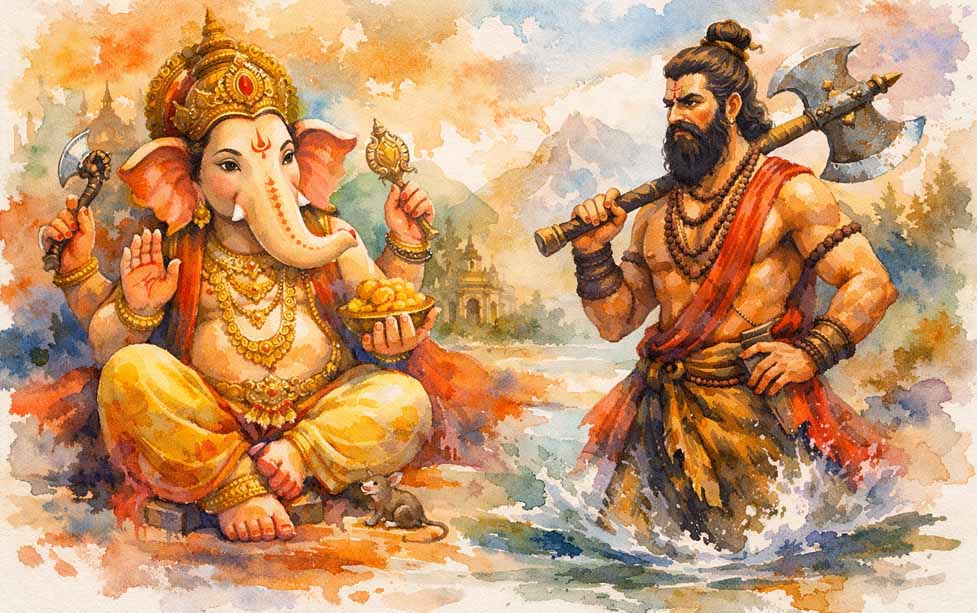
Tune in on Spotify for a deeper exploration of this story in Hindi & English.

This is the story of how Ganesha lost his tusk — and chose to lose it — in a moment of grace that silenced even the fiercest warrior on earth, Parashurama.
Characters in the story:
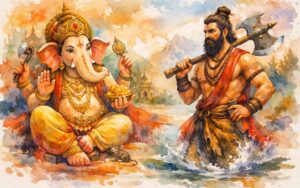
Lord Ganesha: Lord Ganesha, also known as Ganapati, is a Hindu deity who is revered as the remover of obstacles and the god of new beginnings, wisdom, and intellect. He is depicted with the head of an elephant and is widely worshiped across India and beyond.

Parashurama: Parashurama is an iconic figure in Hindu scriptures, known as the sixth incarnation of Lord Vishnu, wielding an axe and revered as the warrior sage who eradicated evil from the Earth.

Most people know Ganesha as the round-bellied, elephant-headed god you pray to before starting anything new. He removes obstacles. He brings good fortune. He is the first deity you invoke.
But there is an older, sharper story — one that explains how Ganesha came to have only one tusk. And it has nothing to do with clumsiness, or battle, or an enemy’s blade.
It happened because of a choice. A deeply deliberate one.
Who was Parashurama, and why did he matter?
To understand this story, you first need to know who Parashurama was.
He was no ordinary man. Parashurama — the name means “Rama with the axe” — was an avatar of Vishnu. He was born a Brahmin but trained as a warrior. He had fought and defeated the Kshatriya ruling class not once, but twenty-one times. He had bathed the earth in their blood.
The weapon he carried — his divine axe, called the parashu — was no ordinary tool either. It had been personally gifted to him by Lord Shiva, who was pleased by Parashurama’s years of fierce penance on the mountains. That axe was sacred. It was a bond between guru and disciple.
Parashurama was fearless, brilliant, and short-tempered. He was also deeply devoted to Shiva. So one day, he decided to travel to Mount Kailash — Shiva’s celestial home — to meet his beloved guru face to face.
He had defeated armies, humbled kings, and shaken the world. But at the gate of Kailash, he met something he had not prepared for.
A small problem at the gate
Mount Kailash is not a place you simply walk into.
As Parashurama approached the entrance, a figure stood in his way. Broad-shouldered, large-eared, elephant-headed, and entirely unimpressed. Ganesha — son of Shiva and Parvati — was guarding the door.
Parashurama announced himself. He was an avatar of Vishnu. He was a student of Shiva himself. He had come a long way, and he wished to meet the Lord.
Ganesha listened politely and said no.
His father was resting. He could not be disturbed. Parashurama would have to wait.
For someone else, that might have been a reasonable answer. But Parashurama was not someone who waited. He had never been told no — at least not in a way that stuck. His blood rose quickly. His jaw tightened.
He argued. Ganesha held firm. He threatened. Ganesha did not move. He tried to push past. And that is when things broke.
The moment the axe left his hand
Rage took over Parashurama completely.
He reached for his divine axe — the weapon Shiva had given him — and hurled it at Ganesha with the full force of a warrior who had never lost a fight.
The axe flew through the air, spinning, humming with divine energy.
And here is where the story does something unexpected.
The key moment
Ganesha saw the axe coming. He had the power to stop it — to deflect it, dodge it, or simply dissolve it. He was, after all, the son of Shiva and Parvati. He was no ordinary being. But he did none of those things.
Ganesha recognized the axe. He knew exactly where it had come from. This was the weapon his own father had lovingly given to Parashurama. This was a piece of Shiva’s grace, manifest in iron.
How could he, as Shiva’s son, raise a hand against his father’s gift?
He could not. He would not.
So he turned his body slightly and received the axe on his right tusk. The impact was enormous. The tusk cracked, splintered, and broke off, falling to the ground at his feet.
Ganesha stood there, bleeding, his face calm. One tusk shorter than before. He did not retaliate. He did not cry out. He simply stood.
A mother’s fury
The sound of that tusk hitting the ground brought Parvati out instantly.
If Ganesha was calm, his mother was the opposite. Parvati, the goddess of power and love, looked at her son — standing there, missing a tusk, blood on his face — and something in her ignited. She turned toward Parashurama with eyes that could melt mountains.
She began to curse him. The words were forming in her throat, carrying the full weight of a mother’s rage and a goddess’s power. What she was about to unleash would have destroyed Parashurama utterly.
And then Ganesha spoke.
The son who calmed the storm
“Mother, stop.”
Parvati turned to look at him, disbelieving.
Ganesha explained, quietly and clearly, what had happened and why. Parashurama had acted in anger — foolish anger, yes, but anger that had already passed. The axe had been a gift from father to disciple. To deflect it would have been an insult to Shiva himself. Ganesha had chosen to absorb the blow rather than dishonor his father’s blessing.
He asked his mother to spare Parashurama.
And Parvati, her fury still burning, listened to her son. She held back the curse.
Parashurama — who had never bowed to anyone — stood there in silence, shaken not by force, but by grace.
What this story is really about
On the surface, this is a story about a broken tusk. But go one layer deeper, and it is about something much more interesting: the nature of real strength.
Parashurama had conquered armies. He had the sharpest weapon and the fiercest will. But when he met Ganesha, he encountered a different kind of power entirely — the power to absorb, to choose, to act from devotion rather than ego.
Ganesha did not lose that fight. He won it in a way that left no casualties. He protected his father’s honor, spared his mother from committing an act of destruction in rage, and allowed Parashurama to walk away humbled but alive.
And the tusk? He kept it broken. He never sought to restore it. That missing tusk became part of who he is — a permanent reminder that he once chose reverence over retaliation.
This is also why Ganesha is depicted holding a broken tusk in some of his classical forms. In Hindu iconography, that broken piece is not a scar. It is a symbol of wisdom — the willingness to sacrifice something of yourself rather than act from pride.
Why this story is lesser known
Most people know the more popular version of Ganesha’s one-tusked origin — involving Vyasa, the scribe work of the Mahabharata, and a broken quill. That story is charming and widely told.
But the Parashurama story, drawn from the Brahma Vaivarta Purana, is rarer in popular retellings. It is also, in many ways, more layered. It involves conflict, devotion, maternal love, warrior pride, and the quiet heroism of choosing not to fight back — all compressed into a single act.
Hindu scriptures are full of stories like this — ones that sit just outside the mainstream, waiting to be found. This is one of them.
Frequently Asked Questions
Why does Ganesha have only one tusk?
There are two main stories. In one, Ganesha breaks his own tusk to use as a pen while scribing the Mahabharata. In the other — from the Brahma Vaivarta Purana — his tusk is struck off by Parashurama’s divine axe, which Ganesha deliberately chose not to deflect out of reverence for his father Shiva.
Who is Parashurama?
Parashurama is the sixth avatar of Vishnu, known as the warrior-sage. Born a Brahmin, he wielded a divine axe gifted by Shiva and is said to have defeated the Kshatriya warrior class twenty-one times. He is one of the Chiranjivis — beings said to be immortal.
What does Ganesha’s broken tusk symbolize?
In Hindu symbolism, Ganesha’s broken tusk represents sacrifice, wisdom, and the ability to give up ego for a higher purpose. It also appears in the Mahabharata story where he uses it as a writing instrument — symbolizing that knowledge is worth any personal cost.
Parashurama came to Kailash with an axe and left without his pride — but Ganesha, standing there with a broken tusk, had never been more whole.
Some victories are won not by striking back, but by knowing when to simply stand still.