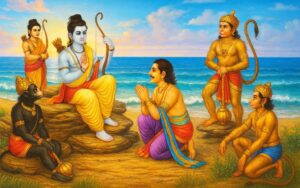
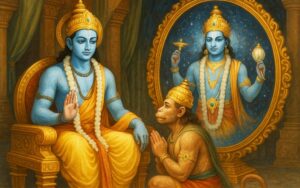
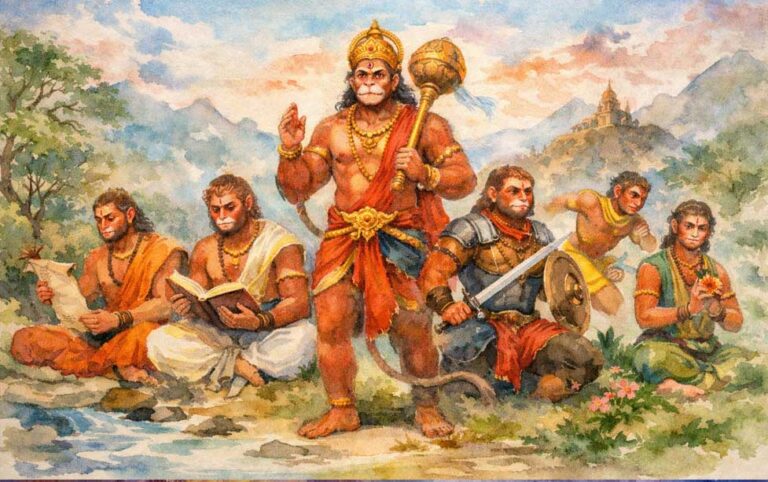
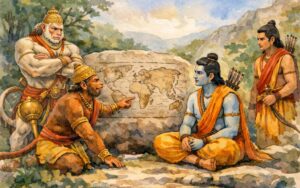
After Rama and Lakshmana learned from Sugriva that Sita was likely in Lanka, Hanuman was chosen to cross the ocean and search for her. His task was clear and limited: find Sita, confirm her safety, give her Rama’s message, and return with certainty.
Moving through Lanka at night, Hanuman searched palaces, inner quarters, and guarded enclosures until he finally found Ashoka Vatika, a secluded royal grove protected by rakshasi guards.
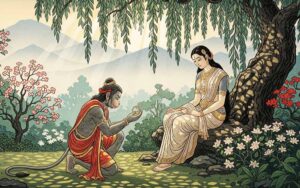
There he saw Sita seated beneath a tree, weakened by grief but unbroken in spirit. Hanuman revealed himself carefully, proved his identity with Rama’s ring, and reassured her that help was coming.
Having found Sita in Ashoka Vatika, Hanuman completed the first part of his mission. He had seen her, spoken Rama’s name, and restored her hope.
But Hanuman did not leave.
Here’s the thing. Discovery alone was not enough. Rama needed to know the strength, pride, and temperament of the enemy. Lanka needed to be measured from within.
So Hanuman made a deliberate choice.
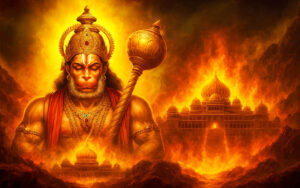
He destroyed Ashoka Vatika.
Not out of rage. Not out of impulse. Tree by tree, pavilion by pavilion, he tore apart the pleasure garden of Lanka. The destruction was loud, unmistakable, intentional. It was a message meant to summon the highest authority of the city.
And it worked.
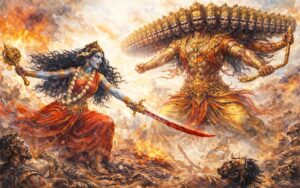
Rakshasa warriors attacked him in waves. Hanuman defeated many, restrained others, but when Indrajit finally bound him with celestial weapons, Hanuman allowed the bonds to hold. He could have broken free. He chose not to.
He wanted to be taken to Ravana.
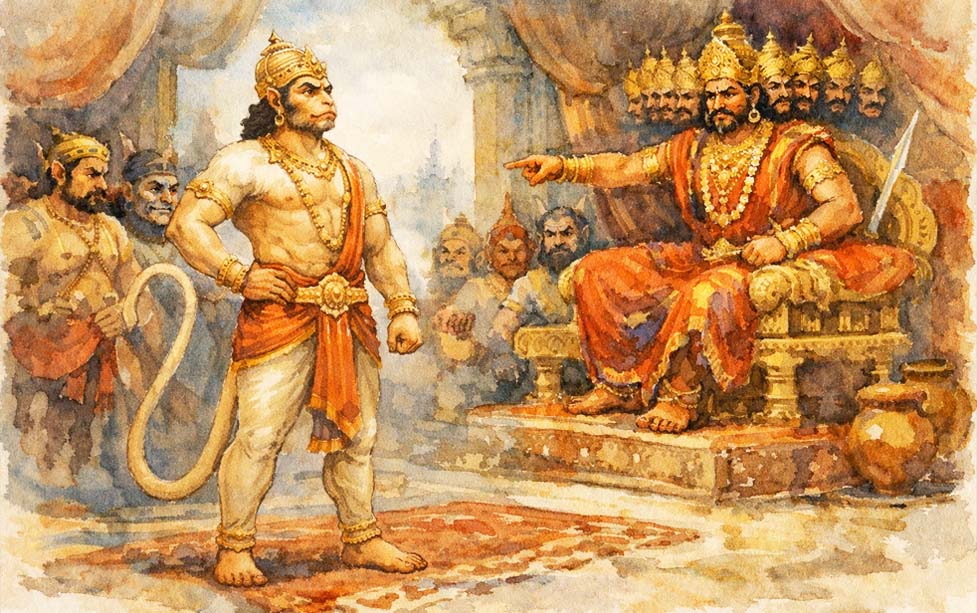
In Ravana’s court
Hanuman was dragged into the royal assembly of Ravana. Chains on his body, calm in his eyes.
Ravana looked at him closely. This was no ordinary vanara. There was intelligence here. Composure. Fearlessness.
Ravana asked who he was.
Hanuman began, not with threats, but with praise.
अहं तु रामदूतस्ते प्रेषितो राघवेण हि ।
सुग्रीवसचिवो नाम वानरोऽहमिहागतः ॥
श्रुत्वा गुणान् बहून् वीर तव रूपबलोदयान् ।
कुलं च वंशं च महत् तपसा च समन्वितम् ॥
He acknowledged Ravana’s lineage, his scholarship, his mastery of the Vedas, his valor, and his greatness as a ruler. Valmiki is clear about this. Hanuman respects Ravana’s capabilities, even while standing against him.
Only after this did Hanuman speak his truth.
He introduced himself as the messenger of Rama, prince of Ayodhya. He explained why he had come. He spoke of Sita. He spoke of dharma.
And then Hanuman did something extraordinary.
He advised Ravana.
He told him plainly: Return Sita. End this before it becomes irreversible. Save Lanka while there is still time.
This was not arrogance. This was restraint. A messenger offering an enemy a way out.
The warning
When Ravana dismissed him, Hanuman’s tone changed.
He spoke of Rama’s strength. Of Lakshmana’s resolve. Of an army that would not stop at walls or oceans. He made it clear that destruction was not hypothetical. It was certain.
Still, Ravana laughed.
Advice from a messenger felt like insult. Truth felt like humiliation.
Ravana ordered punishment.
But even here, Valmiki is precise. Ravana did not order Hanuman’s death. Killing a messenger violated royal and cosmic law. Instead, Ravana ordered Hanuman’s tail to be set on fire, choosing disgrace over execution.
That single decision changed everything.
What this moment really means
Hanuman met Ravana not as a warrior, but as:
a strategist who chose capture
a diplomat who began with praise
a moral voice that offered peace before war
Ravana heard the truth clearly.
And rejected it fully.
That is why the meeting matters. The war did not begin in ignorance. It began in defiance.

 By
By