
 By
By 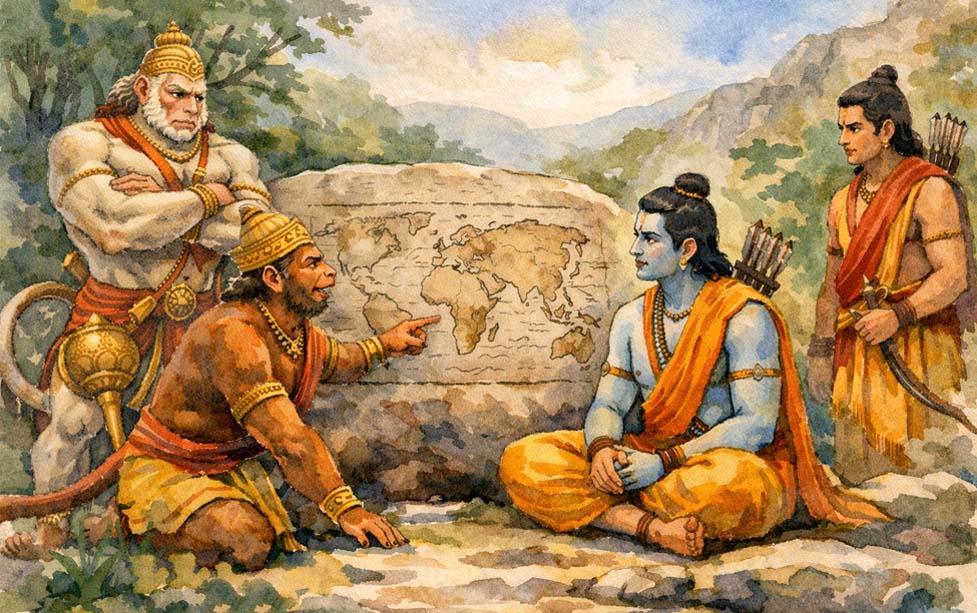
Tune in on Spotify for a deeper exploration of this blog.

The Valmiki Ramayana contains detailed descriptions of mountains, oceans, and distant lands that have led many to explore whether the Ramayana reflects real historical geography.
For centuries, the Valmiki Ramayana has been revered as one of the greatest works of ancient literature. Many people today refer to it as a sacred epic or a mythological story. Yet when one reads the original Sanskrit carefully, certain passages reveal a striking level of geographical awareness.
One particularly fascinating section appears in the Kishkindha Kanda, when Sugriva organizes the global search for Sita after she is abducted by Ravana. Sugriva divides the Vanara army into groups and sends them in different directions across the world.
While giving these instructions, he describes mountains, oceans, distant lands, and unusual natural phenomena. These passages have led many scholars and readers to explore an intriguing possibility: could the Ramayana preserve memories of real geography and historical events?
Let us examine the verses themselves.
Sugriva Organizes the Search for Sita
After forming an alliance with Rama, Sugriva prepares a massive search operation to find Sita. He divides the Vanara army and sends them in all directions.
Sanskrit (Kishkindha Kanda)
ततः सुग्रीवः कपीन्द्रः सर्वान् हरिगणान् तदा ।
दिशो दश विभज्याशु प्रेषयामास वानरान् ॥
Meaning
Sugriva, the king of the Vanaras, divided the monkey army into groups and dispatched them swiftly in different directions to search.
This moment marks the beginning of one of the most expansive search missions described in ancient literature. Sugriva’s instructions go far beyond nearby kingdoms and begin to map a much wider world.
The Eastern Edge of the World: Udaya Mountain
When describing the eastern direction, Sugriva refers to a mountain associated with the rising Sun.
Sanskrit
उदयं नाम पर्वतम् ।
तत्र पूर्वस्य लोकस्य द्वारमाहुर्मनीषिणः ॥
Meaning
There is a mountain called Udaya, which wise men describe as the gateway of the eastern world where the Sun rises.
Ancient commentators often interpreted this as marking the far eastern boundary of the known world.
This shows that the Ramayana’s narrative imagined the earth as stretching across vast distances.
The Western Boundary: Asta Mountain
Sugriva also describes the western limit of the world.
Sanskrit
अस्तं नाम महाशैलं पश्यध्वं वानरर्षभाः ।
यस्मिन्नस्तं गतो सूर्यः सर्वलोकस्य भास्करः ॥
Meaning
Behold the great mountain called Asta, O foremost of Vanaras, where the Sun sets for all the worlds.
Together, Udaya Mountain and Asta Mountain symbolize the eastern and western limits of the world in the Ramayana’s geographical imagination.
The Northern Ocean
Sugriva then describes the regions toward the north, including a distant ocean.
Sanskrit
ततः परं समुद्रं तु श्वेतं क्षीरनिभं शुभम् ।
उत्तरस्यां दिशि स्थितं द्रक्ष्यथ वानरर्षभाः ॥
Meaning
Beyond that you will see a great ocean in the northern direction, shining white like milk.
Some readers interpret this description as referring to a northern polar ocean, possibly resembling what we today call the Arctic Ocean.
A Land Where the Sun Does Not Appear
One of the most intriguing passages appears in Sugriva’s description of northern lands.
Sanskrit
न तत्र सूर्यः भाति न च चन्द्रतारकाः ।
स्वयं प्रभा तु दृश्यन्ते दिव्याः तत्र महात्मनाम् ॥
Meaning
In that region the Sun does not shine, nor the moon or stars. Yet a divine radiance appears there.
Some modern interpreters connect this passage with conditions found in polar regions, where the Sun can remain below the horizon for extended periods during winter.
The reference to mysterious light in the sky has also been linked by some readers to the aurora borealis, the northern lights that illuminate polar skies even when the Sun is absent.
The Southern Direction and the Ocean Beyond
Sugriva’s instructions to the southern search party eventually lead toward the great ocean and the island kingdom of Lanka.
Sanskrit
ततः दक्षिणतो गच्छन् समुद्रं द्रक्ष्यथ वानराः ।
लङ्कां च नगरीं दिव्यां रावणस्य दुरासदाम् ॥
Meaning
Moving further south, you will see the great ocean and beyond it the splendid city of Lanka, the stronghold of Ravana.
This direction ultimately leads the Vanara search party led by Hanuman to discover Sita in Lanka.
Unknown Lands Beyond the Known World
Sugriva also acknowledges that some regions lie beyond known territory.
Sanskrit
ततोऽपरं न गन्तव्यं न तत्र विदितं क्वचित् ॥
Meaning
Beyond that region you should not proceed, for nothing is known further.
This statement suggests that the narrative recognized the limits of geographical knowledge. The Ramayana does not describe lands corresponding to what we today identify as North America or large parts of Western Europe.
Some interpreters have suggested that this absence could correlate with prehistoric geography. During the last Ice Age, vast portions of the northern hemisphere were covered by massive ice sheets, making exploration or habitation extremely difficult.
While such interpretations remain speculative, they show that the Ramayana acknowledges both known lands and unknown frontiers.
What These Verses Suggest
Taken together, the descriptions in Kishkindha Kanda reveal several striking elements:
- references to eastern and western limits of the world
- mention of northern oceans
- descriptions of unusual northern light phenomena
- awareness of vast southern seas
- acknowledgment of unexplored regions
For many readers, these passages suggest that the Ramayana reflects a surprisingly broad geographical imagination.
Some see this as evidence that the epic preserves memories of real geography and ancient exploration traditions.
Ramayana: Epic, History, or Cultural Memory?
The question of whether the Ramayana represents history, epic poetry, or sacred narrative continues to inspire discussion among historians, archaeologists, and scholars.
Over time, several other pieces of evidence have also entered the conversation.
One of the most widely discussed examples is Ram Setu, the chain of limestone shoals between India and Sri Lanka that appears in satellite imagery. The bridge is traditionally associated with the causeway built by Rama’s army to reach Lanka.
Astronomical references within the Ramayana have also attracted attention. Some researchers have attempted to date events in the epic by analyzing planetary positions described in the text.
In addition, ancient cities such as Ayodhya continue to show long cultural and historical continuity, reinforcing the deep roots of the Ramayana tradition in the Indian subcontinent.
While interpretations vary, these elements together suggest that the Ramayana may preserve layers of cultural memory stretching back thousands of years.
The Ramayana has endured for millennia as a timeless story of dharma, devotion, and righteousness. Yet within its verses we also find glimpses of a world far larger than one might expect from an ancient narrative.
The geographical descriptions in Kishkindha Kanda show that the Ramayana engages deeply with the idea of the earth, its boundaries, and its mysteries.
Whether one sees the Ramayana as history, epic literature, or sacred tradition, the text continues to invite exploration and reflection.
Sometimes the oldest stories still carry insights about the world that we are only beginning to rediscover.













Every time you will read Shri Ramayan, you are taken into a new world.
Shri Ramayan is much more than history, epic, or dharmashastra,
It is a divine mirror, that reflects what you are looking for.