
 By
By 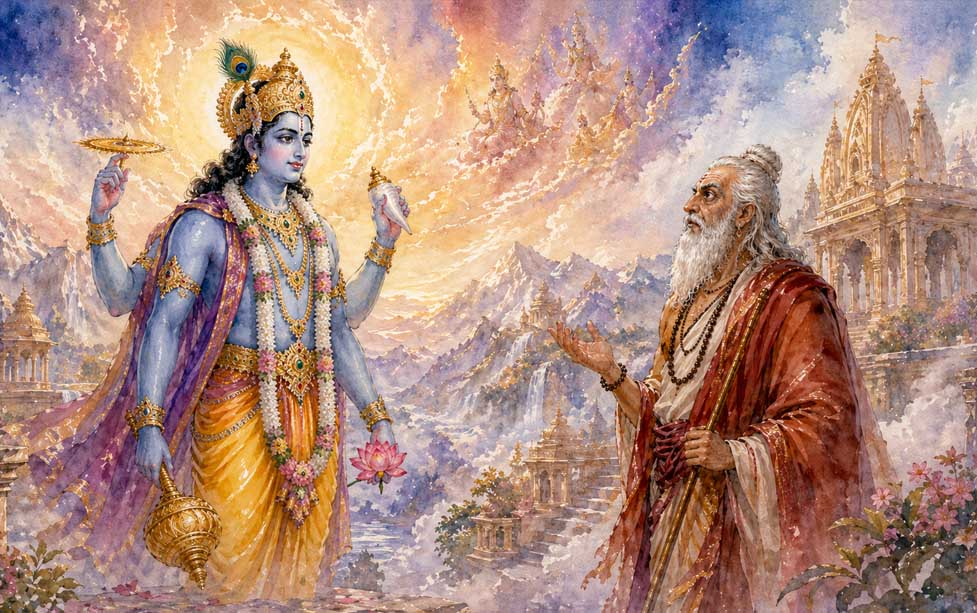
Tune in on Spotify for a deeper exploration of this story in Hindi & English.

Shukracharya’s hatred for Vishnu was born not from ignorance, but from grief, betrayal, and the repeated loss of those he tried to protect.

Shukracharya was not born to be a villain.
He was a sage, a scholar, a master of mantras, and the guru of the Asuras. He knew the movement of planets, the secrets of life and death, and the hidden language of power.
To the Asuras, he was not merely a teacher. He was their protector.
But beneath his wisdom lived a wound. And that wound had a name: Vishnu.
The Day the Wound Began
The Devas and Asuras had been at war again.
The Asuras were losing. Broken, exhausted, and hunted, they fled to the hermitage of Kavyamata, the mother of Shukracharya and wife of Sage Bhrigu. She was no ordinary woman. She carried the strength of tapasya, the force of austerity, and the fierce instinct of a mother protecting those who came seeking shelter.
When the Asuras begged for refuge, Kavyamata did not turn them away.
The Devas followed. Indra was among them. Vishnu too stood on the side of the Devas. To them, the Asuras were enemies who had to be stopped. To Kavyamata, they were frightened beings under her protection.
So she used her spiritual power.
The Devas were stunned. Indra was paralyzed. The force of her tapas held them still. For a moment, the battlefield had moved into the silence of a hermitage, and the mother of Shukracharya stood between the hunted and the hunters.
Indra turned to Vishnu for help.
Vishnu raised the Sudarshana Chakra. In one terrible flash, the discus flew.
Kavyamata was beheaded.
The tradition says Bhrigu was furious when he returned and cursed Vishnu to take birth on earth again and again, experiencing the pain of mortal life.
Kavyamata was later restored by Bhrigu’s power, but for Shukracharya, something had already shattered. His mother had been killed by Vishnu while protecting those under her shelter.
From that day, Shukracharya’s anger was not only political. It was personal.
To the Devas, Vishnu was the preserver of cosmic order.
To Shukracharya, Vishnu was the one who crossed a line.
The Guru of the Defeated
After that, Shukracharya’s bond with the Asuras deepened.
He saw them differently from how the Devas saw them. They were ambitious, flawed, proud, often dangerous, yes. But they were also his students. His people. The ones who came to him when the heavens rejected them.
He taught them strategy. He gave them discipline. He revived them through his knowledge of Sanjivani Vidya, the secret science of restoring life. Again and again, when the Devas gained the upper hand, Shukracharya stood behind the Asuras like a wall.
And in his mind, Vishnu was no longer the neutral guardian of dharma.
Vishnu had become the divine force that always seemed to arrive when the Asuras were about to rise.
That resentment would burn for years.
Then came Mahabali.
The King Shukracharya Loved
Mahabali was not like many Asura kings before him.
He was powerful, but not petty. Ambitious, but generous. He performed yajnas, gave gifts freely, honored Brahmins, and ruled with unusual dignity. Under his rule, the Asuras rose again.
For Shukracharya, Mahabali was more than a disciple. He was proof.
Proof that an Asura could be noble.
Proof that the Devas did not own righteousness.
Proof that power, generosity, and dharma could exist outside heaven’s preferred circle.
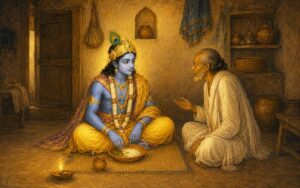
So when Vishnu came again, this time as Vamana, the small Brahmin dwarf, Shukracharya recognized the danger before anyone else did.
Vamana arrived at Mahabali’s sacrifice and asked for a simple gift: three steps of land.
The court smiled. What could such a small boy do with three steps?
But Shukracharya saw through the disguise.
This was Vishnu.
Not a boy.
Not a harmless beggar.
Vishnu.
The same force who had once taken his mother’s head.
The same protector of the Devas who now stood before his disciple with folded hands and hidden power.
Shukracharya warned Mahabali.
Do not give this gift. This is no ordinary Brahmin. This is Vishnu, and he has come to take everything.
But Mahabali’s greatness became his danger. He refused to withdraw his promise. If Vishnu himself had come to ask, Mahabali said, then what greater honor could there be than to give?
Shukracharya must have felt the old wound reopen.
Once again, Vishnu stood before someone he loved.
Once again, Shukracharya could see the loss coming.
And once again, he could not stop it.
The Eye He Lost
In those days, a vow of donation was sealed by pouring water from a kamandalu. Mahabali lifted the vessel to complete the gift.
Shukracharya made one final attempt.
He took a tiny form and entered the spout of the water pot, blocking the flow of water. If the water did not fall, the vow would not be sealed.
For a moment, the guru had stopped destiny.
But Vamana knew.
He picked up a blade of sacred grass and pushed it into the spout.
The sharp grass pierced Shukracharya’s eye.
He cried out and emerged, blinded in one eye. The water flowed. The vow was sealed. Mahabali gave the three steps. Vamana expanded into Trivikrama and covered the worlds.
Shukracharya had lost again.
Not only a political battle.
Not only a disciple’s kingdom.
He had lost an eye trying to protect the one student who embodied everything he believed the Asuras could become.
Why Shukracharya Despised Vishnu
Shukracharya’s hatred for Vishnu did not come from simple evil.
It came from grief.
First, Vishnu killed his mother, Kavyamata, when she sheltered the Asuras. Then, as Vamana, Vishnu outmaneuvered Mahabali and wounded Shukracharya while he tried to stop the vow. In both moments, Shukracharya saw Vishnu not as a distant god preserving balance, but as the power that broke the people he loved.
To Vishnu, these acts protected cosmic order.
To Shukracharya, they proved that the Asuras would never receive fairness from the gods.
That is what made his anger so deep. It was not blind hatred alone. It was the bitterness of a teacher who believed his side was always judged before it was understood.
And that is the tragedy of Shukracharya.
He was wise enough to see Vishnu’s divinity.
But wounded enough to never forgive him.
To the world, Vishnu acted to preserve dharma and restore cosmic balance.
But to Shukracharya, those same acts felt like wounds that took his mother, humbled his disciple, and turned devotion into lifelong bitterness.





A amazing learning happened while reading this.
The curse, catches everyone. Even Vishnu.
So why do we fear. What is written will happen. Vidhi ka vidhaan.