By
By 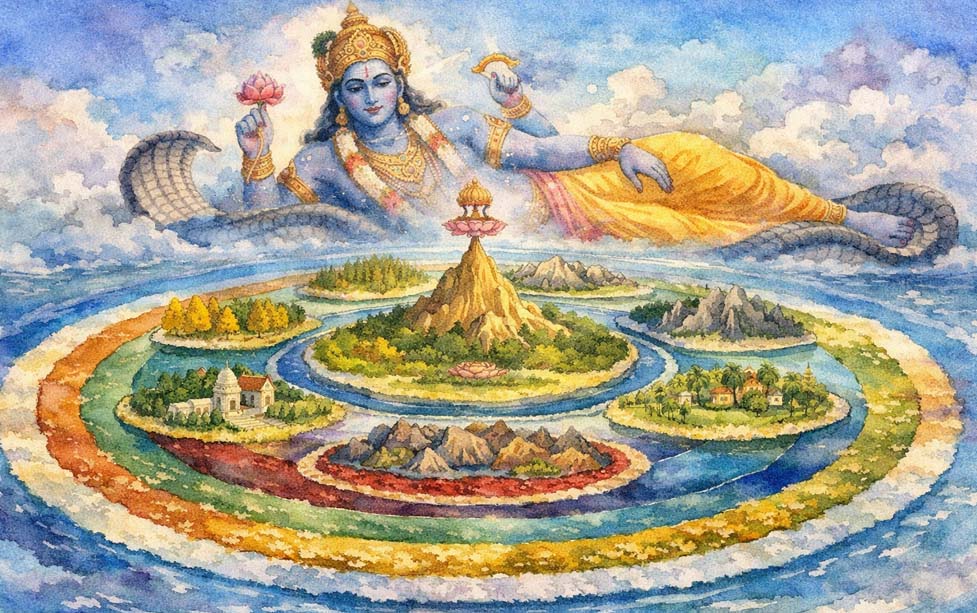
Tune in on Spotify for a deeper exploration of this story in Hindi & English.

In the worldview of the Vishnu Purana, the Earth was never seen as just a single stretch of land. It was imagined as a vast, ordered cosmos, divided into seven great regions known as the Sapta Dvipa.

At the center sits Jambu Dvipa, the most important of them all. This is where Mount Meru rises, radiant and steady, described as the axis around which everything turns.
But this is not geography in the way we understand it today.
Each of these continents is surrounded by an ocean. Not just water, but symbolic substances. One is salt water, another sugarcane juice, another clarified butter, another milk. Each layer adds meaning, not just distance. It turns the map into something deeper than physical space.
The Seven Continents Unfold
The dvipas are arranged in concentric circles, each separated by an ocean, expanding outward like ripples. Each one represents a different state of existence.
Jambu Dvipa: The Center of Human Experience
This is where life as we know it unfolds. It is the only realm where karma is active and choices carry weight. People live, struggle, grow, and search for meaning here. With Mount Meru at its center, it reflects both the outer world and the inner journey. This is where transformation begins.
Plaksha Dvipa: The Realm of Order and Balance
Named after the sacred Plaksha tree, this realm feels calmer and more aligned. Life here is steady, less conflicted, and guided by dharma. There is a natural balance between desire and discipline. It represents a stage where life becomes more intentional.
Shalmali Dvipa: The Land of Strength and Endurance
Linked to the sturdy Shalmali tree, this dvipa stands for resilience. It reflects a phase where challenges are not avoided but faced. Strength is built here, not comfort. This is where character takes shape.
Kusha Dvipa: The Realm of Sacred Discipline
Named after the kusha grass used in rituals, this realm is about purity and focus. Life is shaped by discipline, spiritual practice, and awareness. It marks a shift inward, where actions become more mindful and purposeful.
Krauncha Dvipa: The Land of Transformation
This is the space of deep change. Growth here often comes through disruption. Old patterns break, new ones emerge. It is not always gentle, but it is necessary. This is where real transformation happens.
Shaka Dvipa: The Realm of Expansion and Flourishing
Here, life begins to open up. There is growth in every direction, whether in knowledge, creativity, or awareness. It feels abundant and expressive. What was once potential now starts taking full form.
Pushkara Dvipa: The State of Completion and Detachment
This is the outermost and most subtle realm. It represents a state where nothing more needs to be achieved. There is peace, clarity, and a sense of completeness. It reflects a kind of liberation, where one exists without attachment but with full awareness.
More Than a Map
This is not meant to be a literal map of the Earth. What it offers is a way to understand existence in layers.
Jambu Dvipa reflects the world we live in, where action and growth happen. As you move outward, each layer represents a shift toward greater clarity and detachment. The oceans between them mark transitions, the movement from one state to another.
So yes, it is geography in a way. But it is also philosophy.
The Deeper Insight
Life is not flat or linear. It moves in layers.
We begin at the center, fully engaged in the world. Over time, we gain perspective, grow through experience, and slowly move toward a sense of completeness.
The Sapta Dvipa reminds us that reality has depth. Not just outside us, but within us too. And the journey is not really about going somewhere far away. It is about seeing more clearly where we already are.