
 By
By 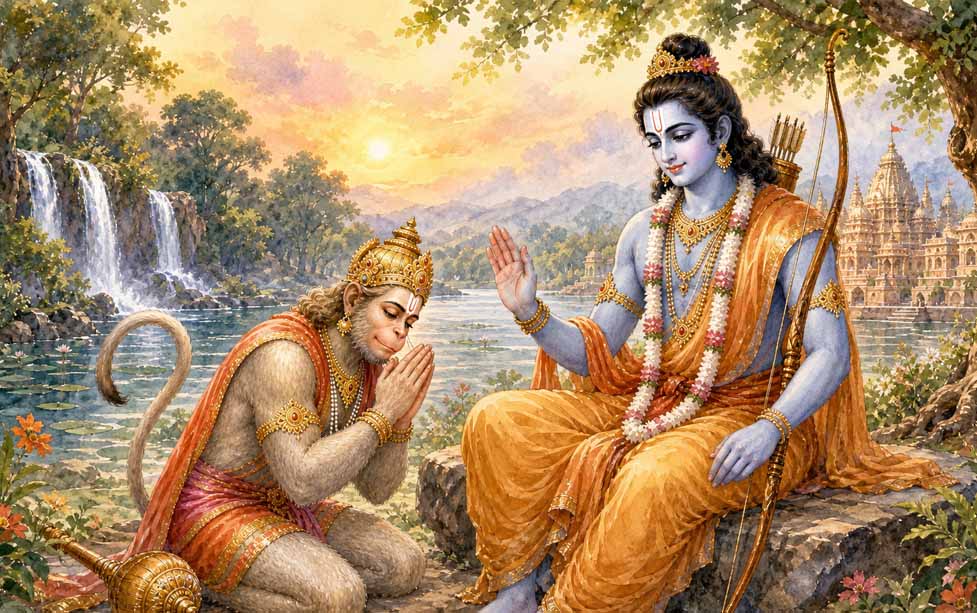
Tune in on Spotify for a deeper exploration of this blog in Hindi and English.

Hanuman’s love for Rama was so pure that serving him felt greater than any reward, even moksha.
There is a moment in the Ramayana that is easy to miss.
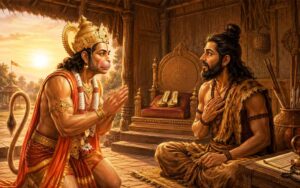
After the war is won, after Lanka has fallen, after Sita is found and Rama returns to Ayodhya in triumph, Rama turns to Hanuman and offers him anything he desires. Any blessing. Any reward. The highest gift the divine can give.
Hanuman folds his hands.
He asks for nothing.
Not heaven. Not power. Not even moksha, that final freedom from birth and death that every soul in Hindu thought is said to seek. He asks only to remain. To stay near Rama for as long as Rama’s name is spoken on this earth.
That answer has quietly astonished devotees for thousands of years.
And the more you sit with it, the more it undoes you.
The Devotee Who Came With Empty Hands
Most people come to God carrying something. A fear they need lifted. A wish they need granted. A wound that hasn’t healed. There is no shame in this; human life is heavy, and the heart naturally reaches toward the divine for relief.
But Hanuman came differently.
He did not arrive at Rama’s feet with a list. He did not love Rama so that Rama would love him back. He did not serve so that he would one day be released from the burden of serving. His devotion had no hidden clause, no quiet condition, no secret hope of reward.
He simply loved. Completely. Without remainder.
This is harder than it sounds. We live in a world that teaches us to measure everything: what we give, what we receive, whether the exchange is fair. Even our prayers often carry this arithmetic. I will surrender if You protect me. I will have faith if You answer me.
Hanuman had no such arithmetic. He had only Rama.
And that is what made his love so rare. So difficult to explain. So impossible to forget.
When the Ocean Lay Between Him and Rama
Think of what Hanuman actually did.
He stood at the edge of an ocean with no bridge, no boat, and no certainty of what lay on the other side. Only the knowledge that Sita was there, suffering, and that Rama’s heart was broken. He took one breath. And he leaped.
Not because anyone told him he could make it.
Not because he was sure.
Because Rama’s grief would not let him stand still.
When he finally found Sita in the Ashoka Vatika, thin, surrounded by demons, holding onto hope like a flame in the wind, he did not announce himself as a hero. He came quietly, as a messenger. He placed Rama’s ring in her hands. He spoke Rama’s name.
That was his gift to her. Not rescue. Not strength.
Rama’s name.
And when he returned, when he stood before Rama and described what he had seen, her dignity in suffering, her unbroken faith, it was Hanuman who wept. Not for himself. For her. For Rama. For the love between two souls he was privileged to serve.
He carried the Sanjeevani mountain because Lakshmana was dying and Rama was on his knees beside his brother, unable to breathe. He burned Lanka not in rage but in grief, the grief of seeing what cruelty had been done in the absence of dharma.
Every action came from love. Not duty. Not obligation. Not the desire for merit.
Only love.
What the Ego Never Touches
Here is the quiet miracle of Hanuman’s inner life.
He was, without question, the most powerful being in the Ramayana. He could shake mountains and leap across oceans and stand in the middle of an army without flinching. And yet, not once does he pause to admire himself. Not once does he think, Look what I have done.
He never said, “I carried the mountain.” He said, “Rama’s work was done.”
He never said, “I found Sita.” He said, “By Rama’s grace, she was found.”
This is not false modesty. It is something far rarer. It is a human being, or a being living as human, who has so completely dissolved the “I” from his actions that the line between himself and his love no longer exists.
When the ego disappears from action, something remarkable happens. The action no longer feels like effort. It feels like breath. Like something natural and necessary and quietly sacred.
This is why Hanuman could serve for a lifetime without exhaustion. Because he was not carrying the weight of his own pride. He had set that down long ago. And in its place, he carried only love, which is, paradoxically, the lightest thing in the world.
The Question That Changes Everything
Moksha, in Hindu thought, is the highest gift. Freedom from the endless turning of birth and death. Freedom from suffering. Freedom from desire. For most souls on the spiritual path, it is the destination everything leads toward.
And yet.
Imagine standing at the threshold of that freedom. The door is open. All suffering ends here. All longing dissolves. All the noise of the world goes quiet.
And then a voice asks: But what about Rama?
What is freedom worth if it means leaving behind the one you love more than freedom itself? What is liberation if liberation means absence, absence from the name, the face, the sacred work that gave your life its only meaning?
For Hanuman, moksha without Rama was not release.
It was a different kind of loss.
He did not choose service because he didn’t understand liberation. He chose it because he understood something liberation alone cannot offer: the joy of nearness. The wholeness of belonging. The indescribable fullness of a love that asks for nothing back.
He did not want to be free from the world.
He wanted to be free within it, free to serve, free to love, free to remember.
And in that freedom, hidden inside devotion, he found what seekers spend lifetimes searching for.
The Strongest One Who Stood With Folded Hands
There is something that breaks the heart softly when you picture it.
Hanuman, who moved mountains, who made the ocean tremble, who made demons run, standing before Rama with folded hands and downcast eyes. Not diminished. Not performing humility. Simply in his truest form.
Because for Hanuman, standing before Rama was not a lesser position.
It was the highest place he knew.
True devotion does not shrink the self. It fulfills it. To serve someone you love completely is not humiliation; it is the end of all longing. It is arrival.
Hanuman was not small before Rama.
He was home.
What He Leaves Behind for Us
We will not cross oceans. We will not carry mountains. Most of us will never stand on a battlefield and have to choose between our fear and our love.
But we are given smaller crossings every day.
The chance to show up for someone without keeping score. The chance to do the right thing when convenience says otherwise. The chance to offer our work, our care, our presence, without making ourselves the center of it.
These are ordinary things. And they are also sacred things.
Hanuman does not ask us to be extraordinary. He asks us to try, in our small and imperfect ways, to love without ego. To serve without expectation. To let something greater than ourselves move through our hands.
Can you act without needing the act to be about you?
That question is the whole teaching.
The Choice
In the end, Hanuman chose Rama over reward, love over liberation, nearness over release.
Not because moksha was small.
But because his love was larger than moksha could hold.
He found what every soul is searching for, not by escaping the world, but by loving one thing within it so completely that nothing else needed to be found.
He chose to remain.
And in remaining, he was already free.
Hanuman’s life reminds us that true freedom is not always found by walking away from the world. Sometimes, it is found by serving with a heart free of ego.
Hanuman’s love for Rama was so pure that serving him felt greater than any reward, even moksha.
Thankyou…enjoyed this very much.