By
By 
Tune in on Spotify for a deeper exploration of this blog in Hindi and English.

Shiva gives boons to demons without hesitation. Understanding why changes how you think about devotion and grace.
Shiva is perhaps the only god in any tradition who will grant a boon to anyone, saint, sage, or demon, and that single fact contains one of the most radical philosophical ideas in all of Hinduism.
The Stories That Make Us Uncomfortable
Most people who grew up with Sanatana Dharma scriptures know these stories and quietly find them troubling.
Bhasmasura, a demon, performs intense penance, pleases Shiva, and receives the boon that whatever he touches will turn to ash. He immediately tries to touch Shiva’s own head. Shiva has to flee.
Ravana, the ten-headed king of Lanka, performs tapasya so extreme that he cuts off his own heads as offerings. Shiva, moved, grants him extraordinary powers. Ravana goes on to terrorize the three worlds.
Andhaka, born from Shiva’s own sweat, grows into a demon lord who attacks Kailash itself.
In each case, the question rises naturally: Why? Why would a god who is supposed to uphold dharma hand weapons to those who will use them against the very fabric of creation?
The answer is not simple. But it is profound.
Shiva Is Not a Manager of Outcomes
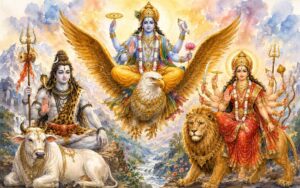
The first thing to understand is that Shiva, in Shaivite philosophy, is not primarily a god of justice or cosmic administration. That role belongs more naturally to Vishnu: the preserver, the strategist, the one who calculates consequences and descends as avatars to correct the balance.
Shiva is something else entirely. He is pure consciousness, unchanging, unattached, prior to cause and effect. The Sanskrit term is Chit, awareness that simply is, without agenda.
When Shiva grants a boon, he is not making a policy decision. He is responding from a state that has no preference between demon and saint, because from the vantage point of pure consciousness, the distinction is ultimately temporary. Sages and demons alike are moving through the same cosmic drama. They will both, eventually, exhaust their karma and return.
This is why Shaivite texts repeatedly use the phrase Bholenath, the innocent lord, the naive lord, the one who is easily pleased. It is not naivety born from ignorance. It is the radical non-discrimination of a consciousness that has transcended all categories.
Devotion as the Only Currency
Here is the key that unlocks everything: for Shiva, devotion is the only qualification.
Not virtue. Not moral history. Not the purpose you intend to use the boon for.
When a being performs tapasya, genuine, sustained, self-dissolving austerity, something real is happening philosophically. The ego is being worn down. The individual will is being subordinated to something larger. Whether that being is a rishi in the Himalayas or a rakshasa in Lanka, the act of sincere tapasya itself is a movement toward the divine.
Shiva responds to that movement. Not to the biography of who is doing it.
This is not carelessness. It is a statement about what the universe fundamentally rewards: the sincere dissolution of the small self in pursuit of the infinite.
Ravana, for all his later horrors, experienced genuine moments of that dissolution when he sang Shiva’s praises with his veena made from his own severed nerves and tendons. Shiva responded to that moment, not to Ravana’s future.
The Ethics of Grace Without Conditions
Western moral philosophy tends to think of ethics in terms of outcomes. A good act produces good consequences. A responsible god would therefore withhold power from those who will misuse it.
But this is not the only ethical framework available to us. Shaivism makes a different argument entirely.
Grace, by definition, cannot be conditional.
The moment grace becomes a reward for good behavior, it stops being grace and becomes a transaction. It becomes a cosmic salary system: do enough good, receive enough blessing. This is a perfectly valid framework for devotional traditions that emphasize karma and moral cultivation.
But Shiva’s tradition makes a sharper philosophical claim: unconditional grace is what grace is. Everything else is just divine commerce.
This is the same insight that appears in mystical traditions across cultures. The Christian mystic who says God’s love falls equally on saint and sinner. The Sufi who speaks of divine love that does not ask for credentials. The Zen master who says Buddha-nature is equally present in everyone regardless of their actions.
Shiva embodies this philosophically because he is the ground of consciousness, and consciousness does not discriminate. It illuminates the thief and the saint with the same impartial light.
But What About the Chaos That Follows?
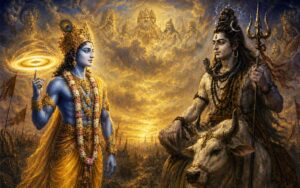
This is the legitimate tension in the narrative. Shiva grants boons. Demons misuse them. The universe suffers. Vishnu has to step in, often through clever tricks, like sending Mohini to seduce Bhasmasura into touching his own head.
Does this not make Shiva irresponsible?
Shaivite philosophy has a clear answer: No. Because Shiva is also Mahakala, the lord of time and destruction.
The chaos that follows the misuse of a boon is not an unintended side effect. It is part of the cosmic rhythm. Demons grow powerful, challenge order, and disturb creation, and in doing so, they catalyze the forces that ultimately restore and elevate it. Ravana’s power forced the story of Rama into existence. Bhasmasura’s threat produced Mohini, one of Vishnu’s most philosophically interesting forms.
From the long view of cosmic time, even the demon’s boon is purposeful. Not because Shiva planned it like a chess master, but because in a universe animated by consciousness, nothing, not even chaos, is outside the pattern.
What This Means for the Devotee
There is something deeply liberating about Shiva’s approach, and it is meant to be liberating for the ordinary devotee, not just a philosophical abstraction.
It means that you do not have to be pure to approach Shiva.
You do not have to have your life in order. You do not have to have already conquered your worst impulses before you dare to sit in meditation. You do not have to earn the right to pray.
The demons in these stories, stripped of their narrative role, represent something within each person: the parts of us that are ambitious, wounded, power-hungry, unresolved. And the message of Shiva’s grace is that even those parts of you, when they genuinely turn toward the divine, are received.
This is the practical ethics of unconditional grace: it makes the path available to everyone, at every stage of their inner life.
Grace and Responsibility Are Not Opposites
There is one final clarification worth making. Shiva’s unconditional grace does not mean that consequences disappear.
Bhasmasura is destroyed by his own boon. Ravana falls through the consequences of his own choices. The boon itself becomes the mechanism of eventual reckoning.
This is not punishment from Shiva. Shiva does not chase anyone down. But the universe, animated by consciousness, has its own corrective intelligence. Grace is given freely. What you do with it writes your story.
The ethic here is subtle but complete: give without calculation, trust the intelligence of the whole, and let consequences unfold naturally. This is something very different from indifference. It is a profound trust in the self-correcting nature of consciousness at every scale.
Shiva grants boons to demons because grace that requires a clean record is not grace at all. It is a transaction, and Shiva is not a banker.
The deeper invitation in these stories is this: if the Lord of Consciousness receives even the most flawed devotion without reservation, then perhaps the universe is far more forgiving of your own incompleteness than you have been led to believe.
And somewhere across the cosmic hallway, Vishnu sighs, picks up his Sudarshana Chakra, and gets to work cleaning up the neighborhood that Shiva just handed a set of keys to.