After the Kurukshetra War ended, the Pandavas had won the battle, but not peace.
They had fought for Dharma, yet their hearts were heavy. The war had taken the lives of their own cousins, the Kauravas. It had also taken the lives of respected elders, teachers, and warriors who were once part of their own world.
Victory did not feel like victory.
The Pandavas were troubled by the sin of Gotra-Vadha, the killing of one’s own relatives, and Brahma-Hatya, the killing of learned and revered elders. The battlefield was behind them, but the burden of what had happened stayed within them.
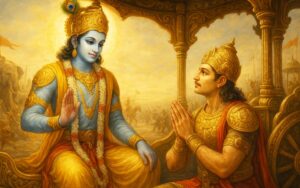
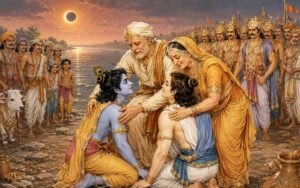
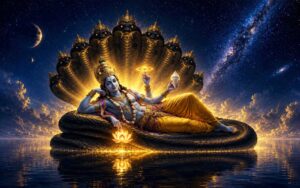
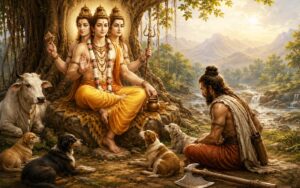
Unable to bear this pain, the five brothers turned to Lord Krishna.
Krishna understood their sorrow. But he did not simply tell them that everything was forgiven. Instead, he gave them a path. A path that required patience, faith, and true repentance.
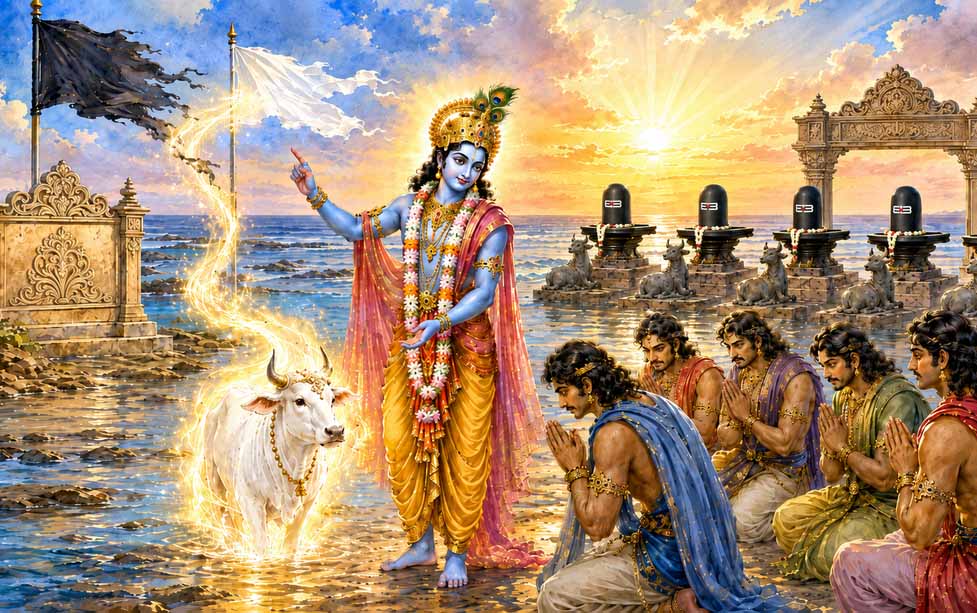
He handed them a black flag and a black cow.
Then Krishna said that they must travel across the land with the cow and the flag. Wherever the cow and the flag turned from black to white, that would be the sacred place where their sins would be washed away.
At that place, Krishna told them, they must worship Lord Shiva with deep devotion.
So the Pandavas began their journey.
They walked through many regions, carrying the black flag and following the black cow. Days passed. Months passed. Years passed. Still, nothing changed. The flag remained black. The cow remained black. Their guilt remained heavy.
But they did not stop.
At last, their journey brought them to the shore of the Arabian Sea, at Koliyak Beach near Bhavnagar in Gujarat.
The moment they reached that sacred coastal land, a miracle happened.
The black cow turned white. The black flag also became pure white.
The Pandavas were stunned. Their hearts filled with relief and humility. They knew they had reached the place Krishna had spoken about. This was the land where their sins would be purified.
Following Krishna’s instruction, the Pandavas sat on the seabed and began their penance. They fasted, meditated, and prayed to Lord Shiva with complete sincerity.
Their remorse was not shallow. Their devotion was not for show. They were warriors, kings, and heroes, but at that moment, they were simply souls asking for forgiveness.
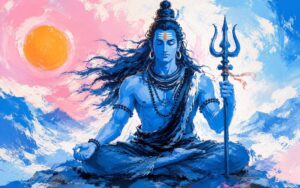
Pleased by their devotion, Lord Shiva appeared before them.
But Shiva did not appear as one single lingam.
He manifested as five self-emerged Shiva lingams, one for each Pandava brother: Yudhishthira, Bhima, Arjuna, Nakula, and Sahadeva. In front of each lingam appeared a Nandi, the sacred bull of Lord Shiva.
This divine moment became the foundation of the Nishkalank Mahadev Temple.
The word Nishkalank means spotless, pure, blemishless, or without stain. The temple was given this name because this was the place where the Pandavas were cleansed of their inner burden and spiritual guilt.
What makes Nishkalank Mahadev Temple even more unique is its location.
The temple stands in the sea, near Koliyak Beach. During high tide, the shrine remains covered by water. When the tide goes down, the path opens, and devotees can walk across the seabed to reach the five sacred Shiva lingams.
It is as if the ocean itself becomes part of the worship.
Every day, the sea covers and reveals the temple, reminding devotees of a deeper truth: sins, sorrow, and guilt may feel overwhelming, but through faith, repentance, and divine grace, purification is possible.
Nishkalank Mahadev is not only a temple. It is a living symbol of redemption.
It reminds us that even the greatest heroes can carry pain. Even those who walk the path of Dharma may need forgiveness. And even the deepest stain of guilt can be washed away when the heart turns sincerely toward the Divine.

 By
By