
 By
By 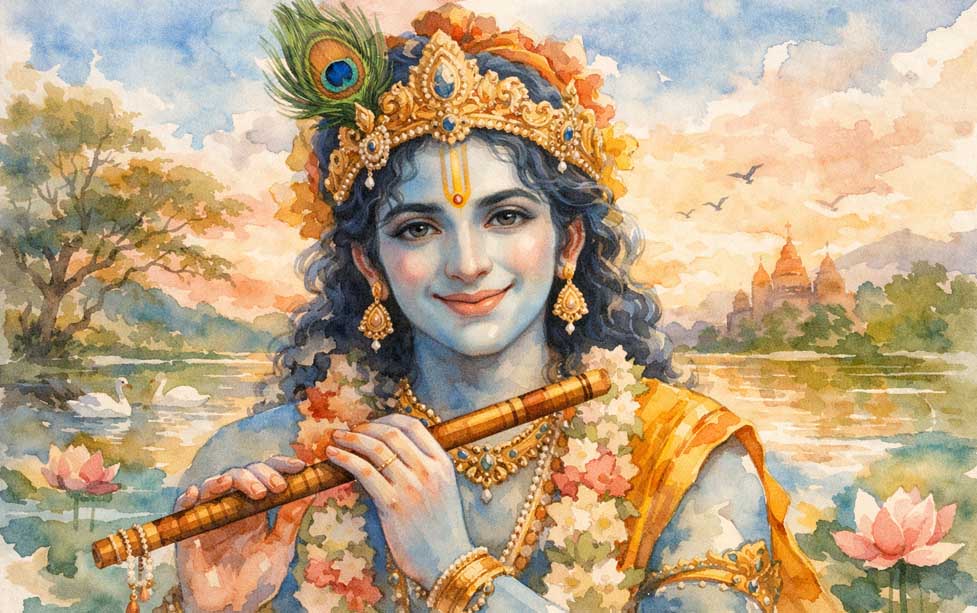
Tune in on Spotify for a deeper exploration of this blog in Hindi and English.

Krishna smiled through war, grief, and betrayal. Here's the mindset behind that, and how to make it your own.
There is a moment in the Mahabharata that most people breeze past.
Duryodhana has just insulted Krishna in open court. He has called him a cowherd, a charioteer’s friend, and someone unworthy of a seat at the table. The entire assembly holds its breath. Ministers look at the floor. Warriors shift uncomfortably in their chairs.
Krishna smiles.
Not a polite, swallow-your-anger smile. A genuine, warm, deeply amused one. As if Duryodhana had said something faintly ridiculous, like a child insisting the sky is green.
That smile has puzzled scholars, devotees, and philosophers for centuries. How does someone smile in the face of humiliation? Or war? Or grief? Or the weight of an entire civilization’s fate resting on their shoulders?
The answer, it turns out, is not a secret. Krishna spelled it out himself on a battlefield, to a man on the verge of a breakdown. We just haven’t been paying close enough attention.
The Battlefield Where Smiling Made No Sense
When Arjuna collapsed in his chariot at Kurukshetra, he didn’t just lose his nerve. He lost his sense of self. He looked across the field and saw his grandfather, his teachers, his cousins — and he couldn’t lift his bow.
“What is the point?” he asked Krishna. “What do we gain from any of this?”
It’s one of the most human moments in all of ancient literature. And Krishna’s response was not to tell Arjuna to toughen up, or to remind him of honor, or to appeal to his warrior pride. Instead, Krishna sat down beside him and began one of the longest, deepest conversations ever recorded about the nature of existence.
He could have rushed. The war was literally about to start. But Krishna was unhurried.
That unhurried quality — that steadiness in the middle of complete chaos — is the first clue to understanding the smile.
What Equanimity Actually Means (And What It Doesn’t)
Equanimity is a state of psychological stability, calm, and composure, particularly under stress or during difficult situations.
People often confuse equanimity with indifference. They assume that to remain calm, you must not care. That to smile at hardship, you must be detached from life in some cold, philosophical way.
Krishna’s life dismantles that idea completely.
He wept when his friend Sudama arrived at his palace, feet cracked and body thin from poverty. He felt the grief of the Pandavas as his own. He loved Radha with an intensity that has inspired poets for three thousand years. He fought, strategized, argued, and negotiated with everything he had.
Krishna cared deeply. About all of it.
But he was never at the mercy of any of it.
That is the distinction that matters. Equanimity, in the Krishna sense, is not the absence of emotion. It is the refusal to be defined by any single emotion. It is feeling everything fully — and then letting it pass through you without building a permanent residence in your chest.
In the Gita, he calls this Sthitaprajna — the wisdom of steady awareness. He describes it simply: “One who is not disturbed in mind, even amidst the threefold miseries or elated when there is happiness — and who is free from attachment, fear, and anger — is called a sage of steady mind.”
Notice that he doesn’t say the sage feels no misery. He says the sage is not disturbed by it.
The Three Things Krishna Never Did
Look closely at how Krishna moved through the world, and you’ll notice three things he consistently refused to do — three patterns that cause most of our suffering.
He never catastrophized.
When Kamsa, his murderous uncle, sent wave after wave of demons to kill him as an infant and child, Krishna dealt with each one as it came. He didn’t spiral into “what’s next?” or “why me?” He faced the demon in front of him, finished it, and went back to playing his flute.
Modern psychology has a name for what Krishna avoided: rumination. The cycle of replaying worst-case scenarios in your mind until anxiety becomes the background music of your life. Krishna seemed constitutionally incapable of it — not because he was naive to danger, but because he understood that most suffering lives in anticipation, not in the present moment itself.
He never made his identity dependent on outcomes.
This one is harder to understand without the Gita’s context. Krishna’s most famous teaching — Karmanye vadhikaraste ma phaleshu kadachana — is often translated roughly as “You have the right to your actions, but not to the fruits of those actions.”
People sometimes read this as resignation. It’s actually the opposite. It’s the most liberating idea in the text. When you separate your sense of self from whether you win or lose, succeed or fail, are praised or criticized — you become, paradoxically, more effective. Because you stop playing defense. You stop protecting your ego from every outcome. You just do the work.
Krishna negotiated tirelessly for peace before the war. He failed. He didn’t spiral into guilt or self-recrimination. He adjusted and moved forward, because his identity wasn’t staked on the result.
He never performed emotions for an audience.
There’s a telling moment when Krishna learned of his friend Abhimanyu’s death — killed in a trap, surrounded and ambushed. By all accounts, Krishna grieved. But he didn’t perform grief to demonstrate his loyalty. He processed it, and then he turned toward what needed to be done next.
This is quieter than it sounds. Most of us, in difficult moments, spend enormous energy managing how our emotions appear to others — suppressing feelings that seem weak, amplifying feelings that seem noble. That performance is exhausting. Krishna seemed to bypass it entirely.
Why the Smile Was Not a Mask
The easiest explanation for Krishna’s perpetual calm is that he was divine — that being God made suffering irrelevant to him. But that reading makes his teachings useless to the rest of us.
A more interesting reading is that Krishna had understood something fundamental about the nature of time.
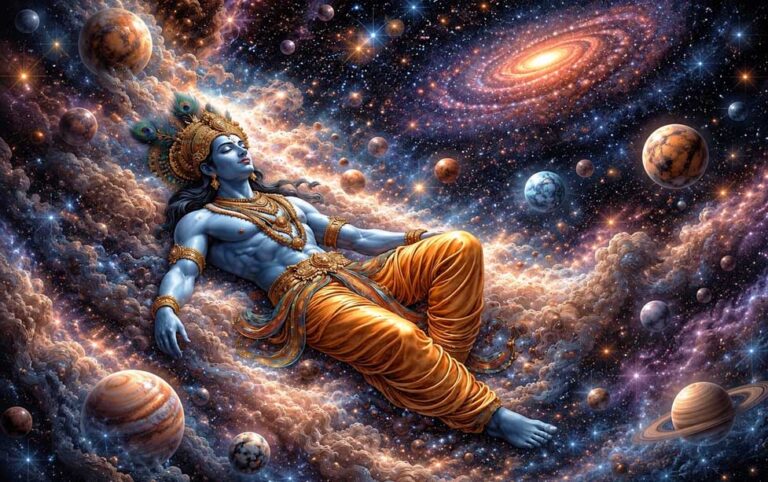
In the Gita’s most dramatic moment, Krishna reveals his cosmic form — the Vishwarupa — and shows Arjuna the entirety of time, past and future, compressed into a single vision. Warriors are shown already dead. Battles are shown already over. The whole sweep of history is present simultaneously.
Most commentators focus on the terror of that vision. But consider what it would do to your relationship with the present moment if you genuinely understood that every crisis was, from a long enough perspective, already resolved. That the thing breaking your heart today was, in the arc of time, a brief passage. Not meaningless — but not permanent either.
This isn’t toxic positivity. It’s not “everything happens for a reason” sewn onto a throw pillow. It’s the deeper recognition that suffering and joy are both visitors. You receive them, attend to them — and you do not confuse them for the whole of who you are.
That understanding is what made the smile genuine. Krishna wasn’t suppressing fear behind a cheerful face. He simply inhabited a vantage point from which panic made less sense than peace.
What This Looks Like in an Ordinary Life
You are not Krishna. Neither am I. We don’t have the luxury of cosmic perspective sewn into our DNA. But the mechanics of what he modeled are accessible.
Separate the event from the story. Something happens — your project fails, a relationship ends, you make a public mistake. That event is real. But the story your mind immediately weaves around it — “this proves I’m not good enough,” “everything I touch falls apart,” “I’ll never recover from this” — that story is not the event. It is something you are adding. Krishna’s steadiness came, in part, from not adding the story.
Practice full engagement with zero grip. This is the hardest one. It means doing everything you can — throwing yourself completely into your work, your relationships, your ambitions — while simultaneously holding outcomes loosely. Not carelessly. Loosely. Like a musician who practices obsessively but doesn’t white-knuckle every performance. The investment is total. The attachment is light.
Find the floor beneath the feelings. In meditation traditions influenced by the Gita, there is a concept of the witness — the part of your awareness that watches your emotions without being swept away by them. Anger passes through you and you notice it. Grief moves through and you let it. What you are practicing is not the suppression of those feelings. You are practicing the discovery of the awareness underneath them — the part that remains even when everything else is in motion.
That awareness is what Krishna pointed to when he smiled. Not an absence of feeling. A presence that was larger than any single feeling.
The Question Worth Sitting With
There’s a line near the end of the Gita that doesn’t get quoted as often as it should.
After everything — after the entire teaching, the cosmic visions, the philosophy — Krishna turns to Arjuna and asks: “Have you heard me with a focused mind? Has your ignorance and illusion been destroyed?”
He doesn’t ask: “Do you feel better?” or “Are you happy now?” or “Have I fixed you?”
He asks if the fog has lifted. If Arjuna can see clearly.
Because that, ultimately, is what the smile was about. Not happiness as a destination. Not the suppression of difficulty. But clarity — a steady, unfogged vision of what is actually happening, uncontaminated by panic or wishful thinking or ego.
When you see clearly, you respond rather than react. You choose rather than compel. You act from your center rather than from your wounds.
And somewhere in that clarity — not always, but often enough — there is something that feels remarkably like a smile.
Final Thought
The world Krishna moved through was not simpler than ours. It held betrayal, warfare, grief, political manipulation, and moral complexity that would exhaust any philosopher. He didn’t smile because life was easy. He smiled because he had found something in himself that difficulty couldn’t touch.
That something is available to all of us. It doesn’t require being divine. It doesn’t require years in a monastery or a complete withdrawal from the world.
It requires practice, and honesty, and the willingness to separate who you are from what is happening to you.
It requires, in the language of the Gita, becoming Sthitaprajna — steady in wisdom.
Start small. The next time something throws you off — a difficult email, an unexpected setback, a conversation that didn’t go the way you hoped — pause before the story begins. Feel what you feel. And then, before the spiral starts, ask yourself:
What would it look like to respond from my floor, not my ceiling?
That pause is the beginning of the smile.
The smile was never about happiness. It was about knowing exactly who you are — even when everything around you is falling apart.




The wisdom this carries, is more than anything else I have read 🙏