
 By
By 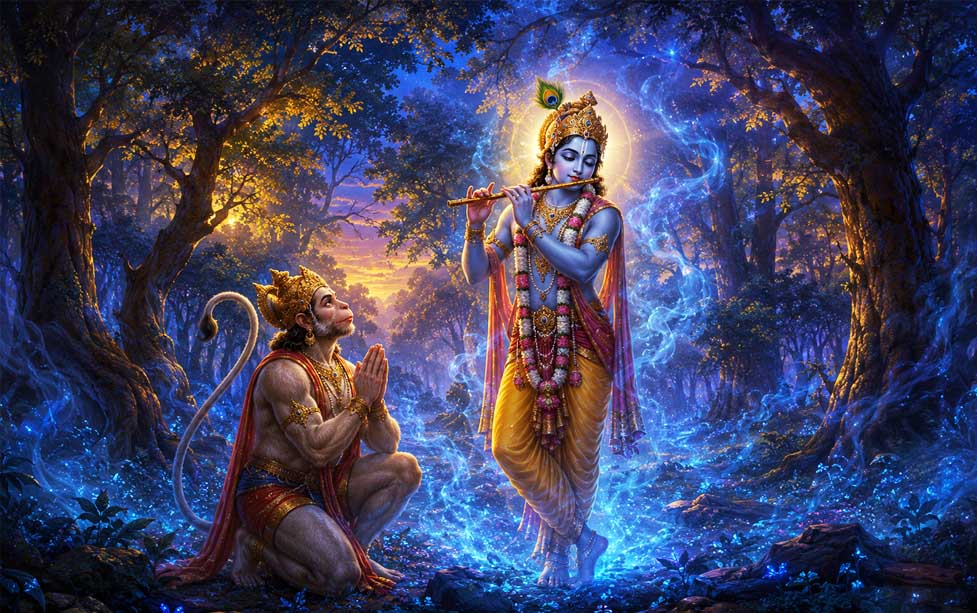
Listen to the podcast on Spotify for a deeper dive into this story.

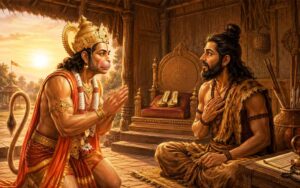
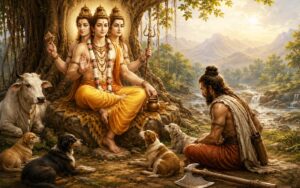
Hanuman had lived through the age of Rama. When it ended, he had nowhere to go. Then, from across the forest, he heard Krishna's flute.
Characters in the story:
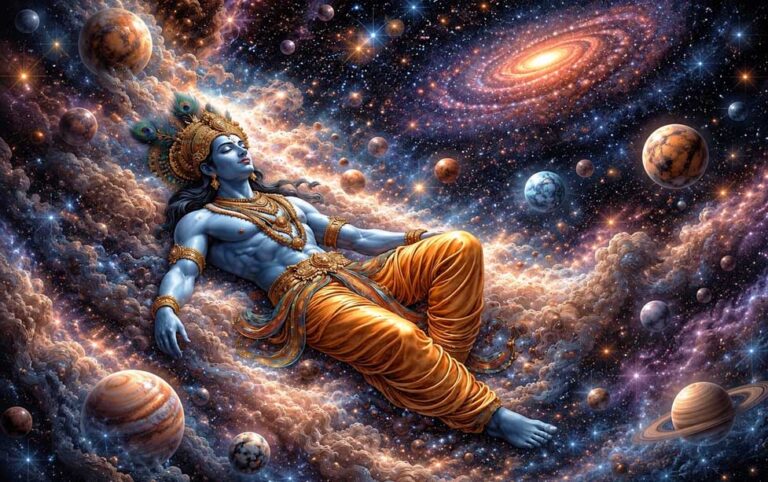
Lord Krishna: Lord Krishna is one of the most popular and revered deities in Hinduism. He is worshiped as the eighth avatar of Lord Vishnu and is known for his divine teachings in the Bhagavad Gita and for his role in the epic Mahabharata.

Lord Hanuman: Lord Hanuman is a revered deity in Hinduism, known for his unwavering devotion to Lord Rama and his incredible strength, symbolizing courage, loyalty, and selflessness.

In Hindu tradition, Hanuman is a chiranjeevi. One who lives across ages. He does not age between yugas, does not pass into whatever comes after death. When Rama’s age ended and the world moved on, Hanuman stayed. Still here. Still breathing. Still wearing the shape of a devotee with no one left to devote himself to.
That is where this story begins. Not in Vrindavan. In the silence between two ages.
Rama had returned to Vaikuntha. Sita was gone. The great war of Lanka existed only in memory, and memory, for an immortal, is a very long road. Hanuman wandered. He did not grieve loudly. He simply moved through the world, carrying something heavy and unspoken, the way a man carries the memory of a person who is no longer alive.
Then one evening, across forest and open sky, he heard the flute.
The Sound That Found Him
He did not go looking for it. He followed it the way you follow a smell that brings back a place you had forgotten. No decision involved. Just movement.
The music came from Vrindavan. It rose out of the trees and over the river and spread in every direction at once, the kind of sound that does not seem to start anywhere in particular. Hanuman walked toward it without knowing he was walking.
When he arrived at the edge of the forest, he stopped.
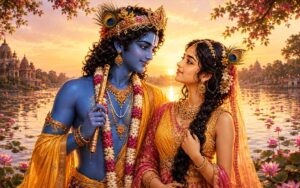
There was a boy moving through the trees. Blue-skinned, a peacock feather in his hair, a flute at his lips. Cows wandering close. Gopas calling after him. The whole scene ordinary and impossible at the same time. Hanuman sat in the branches of a tree and looked down at it. And then, quietly, without a sound, he began to cry.
The music carried the same fragrance. That was what broke him. Not the melody. The fragrance underneath it.
Why He Wept
The gopis passing below noticed him. A large monkey in a tree, weeping. First it struck them as strange. Then, somehow, it did not. They left him alone.
Hanuman could not have explained what was happening, not cleanly. The flute sounded like longing given a shape. And longing, for Hanuman, had only one address. It pointed to Rama. It had always pointed to Rama. And so there he sat, shaken loose by a song that had nothing to do with him, in a village he had never visited, weeping for a Lord who had left the world an age ago.
Or so he believed.
Krishna Comes
Krishna always knows who has arrived. He knows before they arrive, if we are being precise. He set down the flute and walked to the tree and looked up.
He did not ask why Hanuman was there. He asked why he was weeping.
Hanuman said: I followed your music. And when I heard it, it reminded me of my Lord. I do not know how to explain that. The sound is yours and the grief is mine and they should not have anything to do with each other, but they do. And now I cannot stop.
Krishna looked at him for a moment. Then he asked: Do you want to see him?
Hanuman came down from the tree.
The Vision
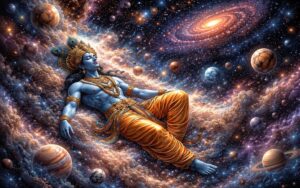
What Krishna showed him next was not the grand cosmic form, not the universe folded into a single body. That is a different story, meant for a different devotee.
What he showed Hanuman was Rama.
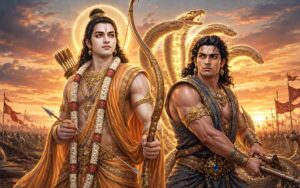
Rama with the bow. Rama with Sita beside him. The exact image Hanuman had carried inside him through wars and oceans and an entire age of the world. Precise. Complete. Unchanged.
Hanuman fell. Not gracefully. He simply collapsed. Hit the earth and did not notice. He was not in Vrindavan at all. He was back in Kishkindha, back in the moment he first saw Rama and felt his life rearrange itself around a single point of light.
Some versions of the story say he cried out so loudly that the whole of Vrindavan went still. The cows stopped. The gopas stopped. Even the river seemed to pause for a moment before continuing on its way.
What It Means
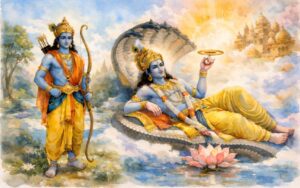
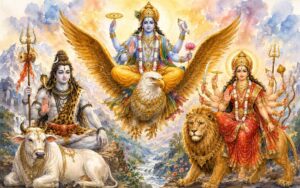
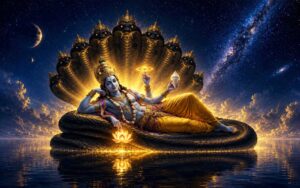
The Vaishnava understanding at the center of this story is that Rama and Krishna are not two separate gods. They are the same consciousness wearing different forms across different ages of the world. The same Vishnu, moving through time, changing his name and his face and the kind of love he asks for, but never the depth of it.
Hanuman’s devotion to Rama was not locked to a particular face. It was pointed at something behind the face. And so when that same something returned as Krishna, dressed in blue and carrying a flute instead of a bow, Hanuman’s heart recognized it before his mind could make sense of it.
That is what the weeping was. Not grief, exactly. Recognition arriving before understanding. The heart catching up to what the soul already knew.
True devotion is not attached to form. It passes through form on its way to something further in.
The story of Hanuman in Vrindavan is not about a happy reunion, though it is that too. It is about what happens when you love something completely enough that you cannot be separated from it even by the end of an age. You just have to wait for it to come back wearing a different name.
Hanuman waited. And the music found him.
This is not a story from a single text. It lives in the oral tradition, in bhakti retellings, in the spaces between the canonical epics where the real devotion tends to happen.
It has survived because it says something true: that love, if it runs deep enough, will always recognize what it is looking for, even when it has changed everything about itself except the feeling it leaves behind.
Jai Kapish tihun lok ujaagar 🙏