
 By
By 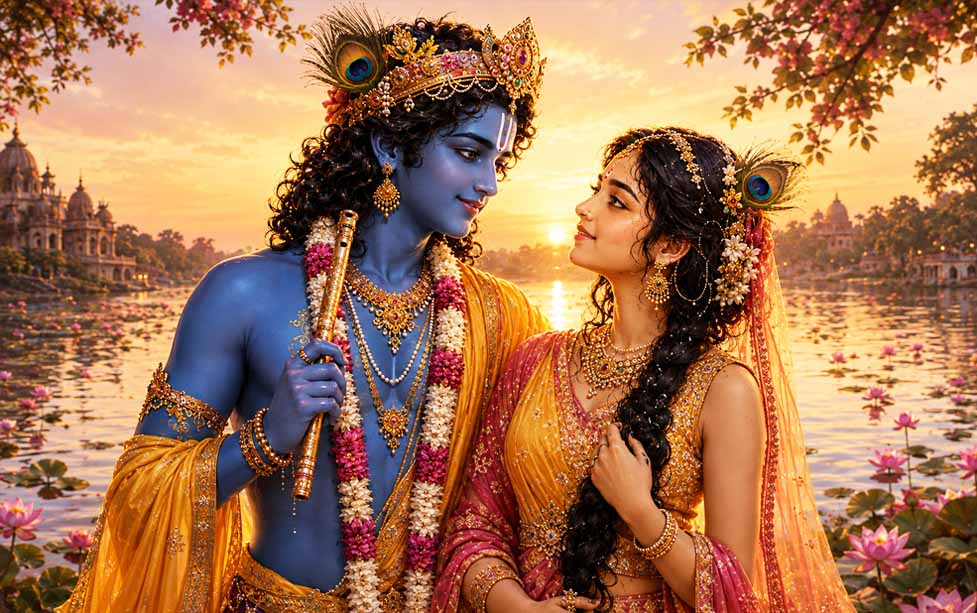
Tune in on Spotify for a deeper exploration of this blog in Hindi and English.

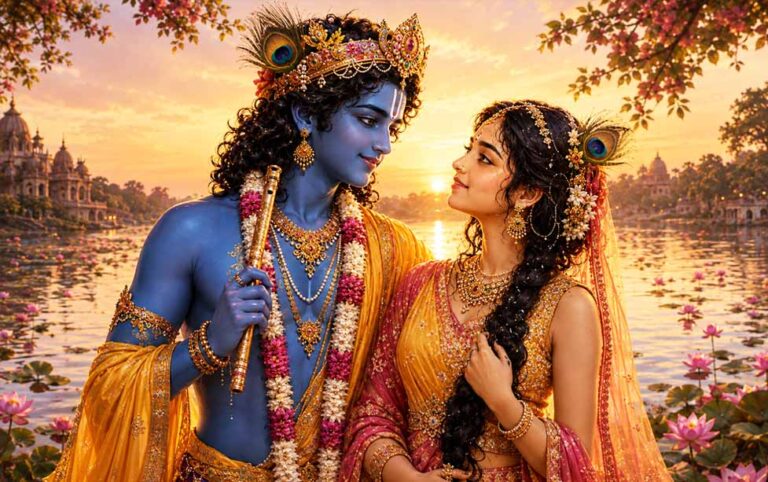
Once in Vrindavan, Radha painted her skin dark, tied a peacock feather in her hair, and walked out pretending to be Krishna himself.
It began on an ordinary evening of shingar. Radha sat before her mirror, preparing to adorn herself for Krishna, as she always did. But that day, something different stirred in her. Instead of dressing for him, she decided to dress as him.
She darkened her skin with color until it took on Krishna’s deep blue-black hue. She fixed a peacock feather at her crown, the way he always wore it. She draped herself in his yellow silks, the pitambara that marked him wherever he walked. When she lifted a flute to her lips and began to play, the notes that came out were sweet enough to pass for his own.
Then she stepped out into Vrindavan.
Why Did the Gopis Get Confused?
The gopis saw her from a distance and stopped. Was it Krishna? The walk, the color, the flute, everything matched. Whispers spread through the group. Some were certain it was him. Others hesitated, unable to say why something felt slightly off.
Radha did nothing to correct them. When they asked who she was, she answered without pause. She said she was Krishna.
She kept up the disguise as she moved through the village, playing the flute, letting the gopis believe what their eyes told them. For a while, the illusion held.
What Happened When Radha Met the Real Krishna?
The game could only last so long. Somewhere along the path, dusk settling gold over Vrindavan, Radha came face to face with Krishna himself.
He stopped walking. For a moment neither of them said anything, two dark-skinned figures standing in the same borrowed light, the same peacock feather, the same yellow silk. He looked at her, this second version of himself standing before him, and asked who she was. His voice carried more amusement than doubt.
Radha did not break character. She lifted her chin and told him he was the impostor, not her. Her flute still hung from her fingers, and she dared him to prove otherwise.
Krishna smiled, the smile of someone who already knew the answer but wanted to watch it unfold anyway. He asked to look into her eyes.
She let him. He stepped closer and looked, the way he always did when he wanted to see past the surface of things, past paint and silk and imitation, down to whatever could not be disguised. His expression shifted, softened, and something behind his eyes settled into certainty.
He told her that when someone looks into his own eyes, they find Radha reflected there. She always had been. But when he looked into hers, disguised as he was in his own form, he found only himself staring back. Not her reflection. Not a stranger’s. Just him.
That, he said quietly, was proof enough. She could not be Krishna. She was Radha.
Radha stood there, caught between the fading color on her skin and the truth her own eyes had betrayed. Her disguise had fooled an entire village, but it could not fool the one person it was ever meant for. She asked him how he had known, her voice smaller now than it had been all afternoon.
Krishna’s answer was simple, spoken the way one speaks a fact rather than a revelation.
Eyes do not lie about who they love. His eyes always carried her image, whether he wore his own form or not. Hers always carried his, hidden beneath dark paint and yellow silk, but never gone.
No disguise, however complete, could change what two people had already given each other.
Frequently Asked Questions
Is this story from a Purana?
No. There is no reference to Radha in the major Puranic texts. Radha appears prominently for the first time in Jayadeva’s Gita Govinda, a twelfth century devotional poem. This particular tale of her disguising herself as Krishna is a folk narrative from the Vraj oral tradition, not a scriptural account.
What does the story symbolize?
The tale plays with the idea of union so complete that identity blurs. Radha and Krishna are often described in Vaishnava thought as two halves of one whole. The story of the eyes reflects that theme without needing textual grounding to make its point.
Why is Radha absent from the Puranas but central to later tradition?
Radha’s rise as Krishna’s principal consort happens largely through medieval devotional literature and regional folk traditions rather than the older Puranic corpus. Texts like the Gita Govinda and later Brahma Vaivarta Purana passages helped cement her place, though even here scholars note significant regional variation in how her story developed.
The paint washed off by evening, rinsed away in the Yamuna without a trace. But what Krishna saw in her eyes that day never did. It stayed there long after the color was gone, the one disguise she could never manage to wear.
Shri Radhe 🙏