By
Tune in on Spotify for a deeper exploration of this story in Hindi and English.

One epic, told in two different styles. In Valmiki, Rama weeps for Sita and the forest does not answer. In Tulsidas, Rama weeps for Sita and he knows exactly where she is.

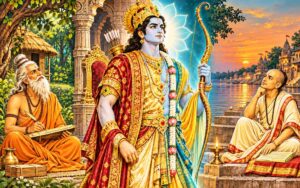
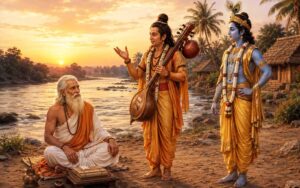
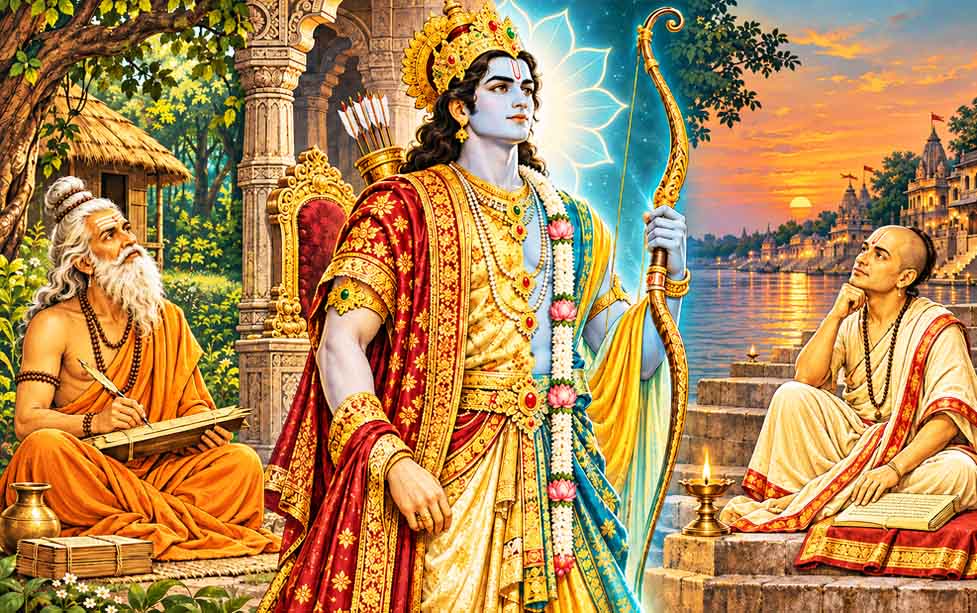
The Valmiki Ramayana is a Sanskrit epic in anushtubh verse, traditionally called the Adi Kavya, the first poem. Scholars treat it as a text built in layers, with the oldest core placed thousands of years back. Tradition says something bolder. Valmiki was Rama’s contemporary, he sheltered Sita in his ashram, and he raised her sons Lava and Kusha. The poet is a character in his own poem.
The Ramcharitmanas is Tulsidas’s Awadhi retelling, begun in Ayodhya in 1574 CE (Vikram Samvat 1631). It brings the story into the language of ordinary people. It is not a translation. Tulsidas names his sources himself in an early Sanskrit verse: the Puranas, the Vedas and Agamas, the Ramayana, and other works. One of those other works is the Adhyatma Ramayana, and it matters later in this post.
Did Valmiki see Rama as a human king?
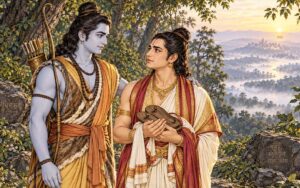
Mostly, yes. The poem opens with a question, not a prayer. Valmiki asks the sage Narada who in this world is truly virtuous, brave, learned and steady in dharma. Narada’s answer is Rama, and his catalogue is a list of human qualities: truthful, firm in his vows, skilled in speech, kind to his people. Rama is praised as a man at the height of what a man can be.
Here the premise needs one honest flag. Valmiki’s text does call Rama divine in places. These passages sit at the edges of the poem: the opening book, the closing book and the last chapters of the sixth. Many scholars think the opening and closing books were added after the original poem was composed. Where the original ends and the additions begin is still debated.
Even so, notice how Rama answers when divinity is put to him. After Sita’s fire ordeal, Brahma and the gods appear and praise him as the Supreme. Rama replies that he thinks of himself as a man, Rama, son of Dasharatha, and asks them to tell him who he truly is. (Yuddha Kanda 6.120 in the vulgate; numbering differs across editions.)
So the cleaner statement is this. In Valmiki’s core narrative, Rama acts, suffers and is judged as a king. Divinity is announced to him from outside. He does not announce it himself.
How does Valmiki’s Rama act as a king?
He acts like a ruler whose decisions have to survive public scrutiny. Two scenes show it best.
In Kishkindha Kanda, Rama kills Vali from hiding. The dying Vali does not praise him. He questions the act, asking how a prince of a noble line could strike from concealment. Rama answers like a sovereign. The land belongs to the Ikshvaku kings under Bharata’s rule, Vali took his brother’s wife, and a king must punish that. It is a legal defence, argued on the field.
In Yuddha Kanda, Sita is brought before Rama after Ravana’s death. He tells her in front of the army that he fought the war to remove an insult to his house and his honour. He says he cannot take her back without suspicion. Sita answers him sharply, Lakshmana builds the pyre, and Agni returns her unharmed. The scene is painful because Rama is not softened. He is a king with a reputation to protect.
Uttara Kanda goes further. Rama hears public rumour about Sita and sends her, pregnant, to the forest. She raises Lava and Kusha in Valmiki’s ashram. The poem ends in loss, with Sita returning to the earth. Many scholars regard Uttara Kanda as a later layer, but it is part of the Valmiki tradition as received.
Why does the Ramcharitmanas begin with Sati doubting Rama?
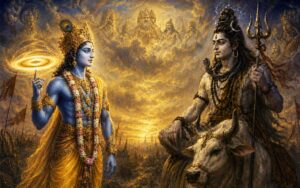
Because Tulsidas states his thesis in the first book. Sati sees Rama wandering the Dandaka forest, searching for Sita and grieving like an ordinary prince. She doubts that he can be the Supreme. She tests him by taking Sita’s form, and Rama recognises her at once. The break that follows with Shiva leads to her death at Daksha’s yagna.
The lesson is placed before the Rama story even begins. Seeing Rama as only a grieving king is the error. In Tulsidas, the weeping is a performance of human life that Rama chooses to play. The tradition calls it nara lila.
What is Maya Sita and why does Tulsidas use it?
In Aranya Kanda, doha 23, Rama tells Sita privately that he is about to play out a human lila. He asks her to dwell in fire until the demons are destroyed. The real Sita enters the fire. A shadow figure takes her place. Lakshmana does not know. Ravana abducts the shadow.
This changes the rest of the story. Rama’s grief at the abduction becomes something Rama knows to be staged. In Lanka Kanda, dohas 107 and 108, the fire ordeal is no longer a test of chastity. It is the moment the real Sita steps out of the fire and the shadow dissolves. Rama’s harshness in Valmiki becomes a cover for a hidden plan.
Tulsidas did not invent this. The motif appears in the Adhyatma Ramayana, a Vaishnava Vedantic retelling, and Tulsidas follows it. That is the clearest sign of what he is doing. He is not correcting Valmiki’s facts. He is rewriting the story so that Sita cannot be touched by Ravana and Rama cannot be accused of cruelty.
How do Ahalya, Kevat and Shabari change in the Ramcharitmanas?
Three small scenes show the shift from host to deity.
Ahalya. In Valmiki, Gautama’s curse leaves her unseen, living on air and ash in his ashram. When Rama arrives, the curse ends, and the two princes bow to her feet. In Tulsidas she has been turned to stone. The dust of Rama’s foot brings her back to life, and she then speaks a prayer of surrender. The one who restores her is no longer a guest who honours her. He is a deity who redeems her.
Kevat. In Valmiki, the Nishada chief Guha greets Rama at the Ganga, offers hospitality and arranges the boat. In Tulsidas, the boatman Kevat refuses to move the boat until he is allowed to wash Rama’s feet. He points to Ahalya: the dust from those feet turned a stone into a woman, and his boat is only wood. The scene is built on the previous one.
Shabari. In Valmiki, Shabari is an old ascetic, a disciple of Matanga, who receives the princes, offers fruit and roots, and gives up her body in fire with Rama’s leave. In Tulsidas, Rama delivers a teaching on the nine forms of devotion, navadha bhakti, and says he recognises only the relationship of devotion, not caste or lineage.
What does the Ramcharitmanas leave out?
It leaves out Sita’s banishment. Tulsidas’s Uttara Kanda moves from Rama’s coronation into Rama Rajya, then into a long theological discussion between Kakabhushundi and Garuda. The painful decision at the end of Valmiki’s story does not appear. The ending of one text is a question about what a throne costs. The ending of the other is a vision of a world in which Rama rules.
Valmiki Ramayana vs Ramcharitmanas at a glance
The two texts differ first in language. Valmiki’s is in Sanskrit. Tulsidas wrote in Awadhi.
They differ most in who Rama is. Valmiki presents an exemplary king and man, with divinity announced from outside. Tulsidas presents Brahman taking human form as a lila. The scenes follow from that.
In Valmiki the real Sita is taken by Ravana. In Tulsidas a shadow Sita is taken while the real Sita waits in fire.
At the fire ordeal, Valmiki’s Rama voices public suspicion and Sita is vindicated. In Tulsidas the real Sita is returned from the fire.
Ahalya is unseen, living on air and ash, in Valmiki. In Tulsidas she is turned to stone and freed by the dust of Rama’s feet.
The endings part ways too.
Valmiki narrates Sita’s banishment in Uttara Kanda and closes in loss, with Sita returning to the earth. Tulsidas does not narrate the banishment and closes with Rama Rajya and a theological dialogue.
FAQ
Is the Ramcharitmanas a translation of the Valmiki Ramayana?
No. It is a retelling in Awadhi that draws on Valmiki, the Adhyatma Ramayana, the Puranas and other sources, as Tulsidas says himself in the opening verse.
Does Valmiki call Rama God?
Parts of the text do, mainly in the first and last books and the closing chapters of the sixth. Scholars debate how much of this belongs to the oldest layer. In the central narrative, Rama acts and speaks as a man.
Was Valmiki really Rama’s contemporary?
Tradition says so, and Valmiki appears as a character in the poem. Critical scholarship treats the text as composed in layers over centuries, so the claim rests on tradition, not on dating.
Why does Tulsidas change the story?
His aim is devotional. Scenes that raise moral discomfort in Valmiki, such as the harshness at the fire ordeal, are reworked so that Rama’s divinity and Sita’s purity are never in doubt.
Why does the Ramcharitmanas skip Sita’s banishment?
Tulsidas ends with Rama Rajya and a philosophical dialogue. The reasons are not stated in the text, so any explanation is interpretation.
Valmiki follows Rama into the court where he sends Sita away, and onto the throne that costs him everything. Tulsidas ends in Rama Rajya with the lamps still lit.
One poet wrote what the king did. The other wrote what the king meant.