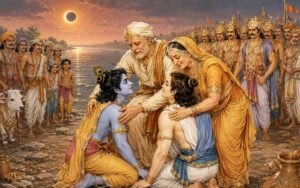
Bharata never wanted the throne of Ayodhya. He took it only as a placeholder, ruling from Nandigrama outside the city, living as an ascetic, wearing bark and matted hair, waiting for his brother to return.
He made himself a promise.
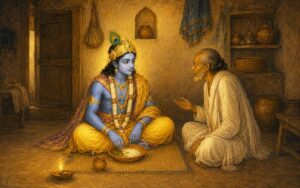
If Rama did not come back on the exact day the fourteen years ended, Bharata would enter fire and die.
This was not a passing threat. Fourteen years is a long time to hold a vow like a blade against your own throat. But Bharata held it, day after day, until the last day arrived.
Rama Learns the Danger
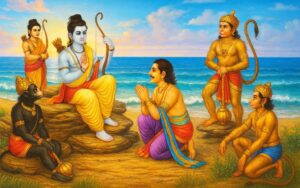
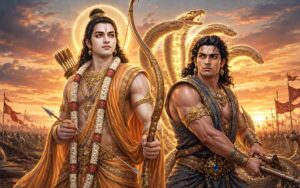
After the war in Lanka, Rama began the journey home in the Pushpaka Vimana, with Sita and Lakshmana beside him, and Sugriva, Vibhishana, and the vanara allies following. As they neared Ayodhya’s outskirts, Rama needed someone to go ahead. Someone had to reach Bharata first, confirm his return, and make certain no one acted on despair before Rama himself arrived.
He chose Hanuman.
The reasoning was simple. Hanuman had already crossed an ocean for this family. He had already carried impossible news across impossible distances, first to Sita in the ashoka grove, now to a brother waiting at the edge of his own patience.
Speed was not the only requirement. Trust was.
Hanuman Reaches Nandigrama
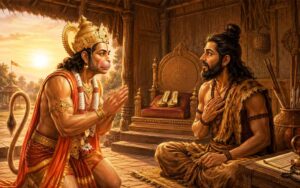
Hanuman took human form and traveled ahead of the full company, arriving at Nandigrama to find Bharata exactly as the vow demanded, thin from years of restraint, dressed in bark, surrounded by the trappings of a king who refused to live like one. The sandals of Rama sat on the throne. Bharata had ruled beneath them, never on them.
Hanuman approached and gave his message directly. Rama was alive. Rama was victorious. Rama was on his way home, and would arrive before the day ended.
Bharata’s response was not composed relief. Several tellings describe him overwhelmed, unable to speak at first, needing the words repeated before he could trust them.
Fourteen years of discipline do not dissolve in an instant. It took a moment for the news to become real.
What the Deadline Reveals
The condensed version of this story usually says something like “Bharata welcomed Rama back after fourteen years” and moves on. That sentence hides the tension underneath it.
Bharata was not merely waiting. He had built a countdown with his own death as the consequence of failure, and he meant to keep it. Hanuman did not arrive to deliver good news to a patient man. He arrived to stop a vow from becoming a funeral.
This is also why the choice of messenger matters. Rama did not send just any vanara ahead. He sent the one whose word Sita had already trusted in her darkest moment in Lanka. Bharata needed to believe the message instantly, with no room for doubt, because doubt at that stage would have cost a life.
FAQ
Did Hanuman really go ahead of Rama to inform Bharata?
Yes, this episode appears in the Yuddha Kanda of the Valmiki Ramayana. Rama sends Hanuman ahead specifically to confirm his safe return before the fourteen-year deadline expires.
Why was Bharata prepared to die if Rama didn’t return?
Bharata had vowed that if Rama did not return by the last day of the exile, he would end his life rather than continue ruling in his brother’s place. He saw the throne as belonging to Rama alone.
Where was Bharata living during the exile?
Bharata ruled from Nandigrama, just outside Ayodhya, living an ascetic life and keeping Rama’s sandals on the throne as a symbol of the true king.
Is this scene mentioned in most Ramayana retellings?
It’s often reduced to a single line about Bharata welcoming Rama home. The specifics of the vow, the deadline, and Hanuman’s role as messenger are frequently left out of shorter versions.

 By
By 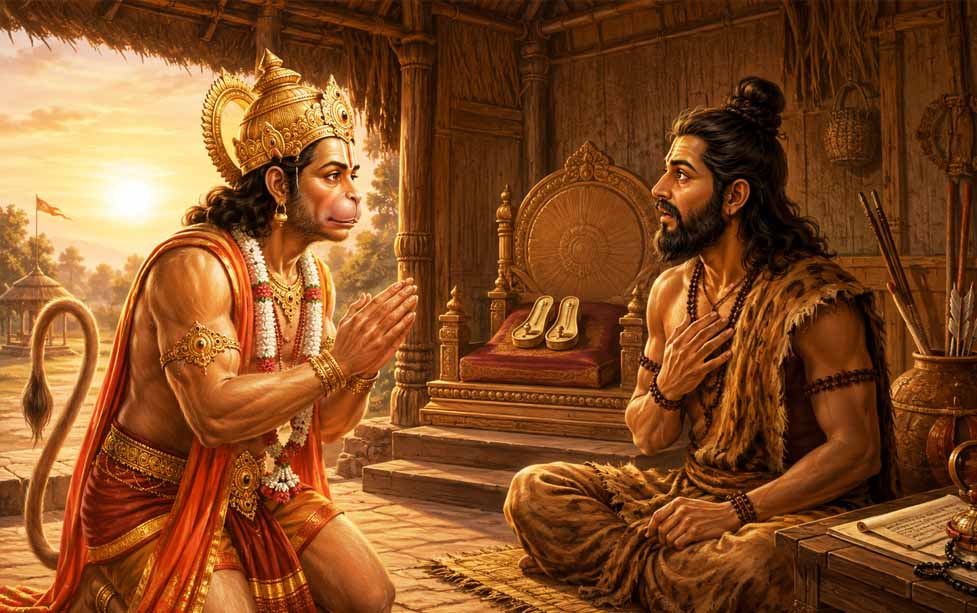














Jai Sia Ram