By
By 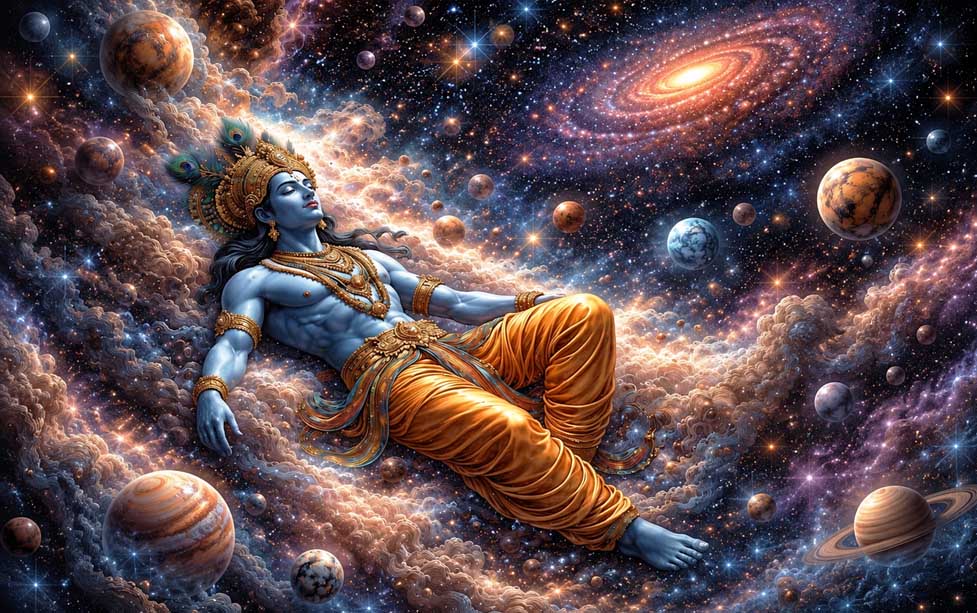
Tune in on Spotify for a deeper exploration of this blog in Hindi and English.

Every time Kali Yuga's end comes up online, someone calls it Pralaya. It isn't. Hindu texts describe three separate endings, on three wildly different scales, and collapsing them into one idea erases what each one actually means.
What is Yuganta, and when does Kali Yuga actually end?
Yuganta simply means the end of a yuga, one age in a four-part cycle. Satya, Treta, Dvapara, and Kali follow each other in descending order of dharma. Kali Yuga is the last and shortest of the four, and its end is described in the Puranas as a moral and social reset, not a physical destruction of the universe.
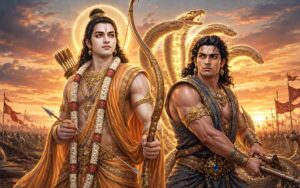
The Vishnu Purana and the Bhagavata Purana both link the end of Kali Yuga to the arrival of Kalki, the final avatar of Vishnu. Kalki appears when adharma has spread as far as it can go. He defeats the forces driving that decline and restores order. Satya Yuga begins again after him. The earth continues. People continue. What ends is a phase of moral decay, not existence itself.
This is worth sitting with, because it’s the single most common source of confusion. Kalki’s arrival gets described in some devotional retellings with apocalyptic language borrowed from other traditions, and that language sticks. But the source texts are describing a cycle resetting, not a cosmos ending.
What is Naimittika Pralaya, and how is it different from a Yuga ending?
Zoom out much further and you reach Naimittika Pralaya, the dissolution that happens at the end of one of Brahma’s days.
A single day of Brahma is a kalpa, and a kalpa contains one thousand Mahayugas. Each Mahayuga is itself a full cycle of the four yugas. So one Yuganta, the kind discussed above, is one four-part cycle. A kalpa is a thousand of those cycles stacked end to end.
At the close of a kalpa, the three worlds, earth, the middle realm, and the heavens, are dissolved. Brahma rests for a night of equal length, and creation resumes when he wakes. The Vishnu Purana and Bhagavata Purana both describe this as a real but temporary withdrawal, not a final end.
Think of it this way: if Yuganta is a chapter closing, Naimittika Pralaya is the whole book being set down until tomorrow.
What is Mahapralaya, and why is it the final dissolution?
Mahapralaya operates on a scale beyond even that. This is the dissolution that occurs at the end of Brahma’s entire lifespan, one hundred of his years, each year built from those 360 kalpa-days and kalpa-nights.
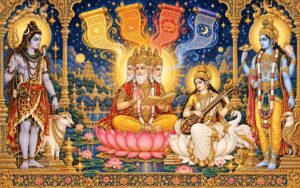
At this point, the texts describe something more total than the nightly rest of Naimittika Pralaya. Not just the three worlds but the subtle elements themselves, the building blocks the Samkhya tradition uses to describe manifest reality, dissolve back into unmanifest prakriti. Even Brahma is not exempt.
The Vishnu Purana and Bhagavata Purana treat this as the closest thing to a true end within one cosmic cycle. There is no next morning waiting on the other side of it in the way there is with Naimittika Pralaya.
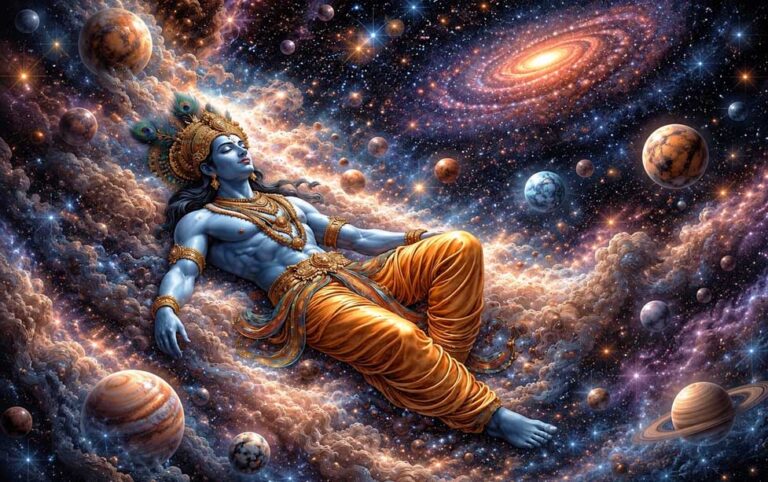
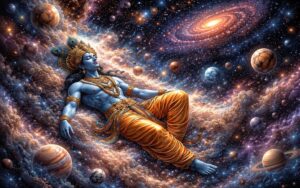
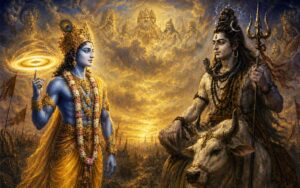
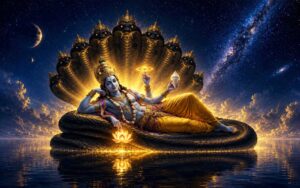
Who or what drives this dissolution depends on which tradition is telling the story. The Vaishnava framing, drawn from the Vishnu Purana and Bhagavata Purana, describes Vishnu withdrawing all of manifest creation back into himself, the same figure who then rests in yoga-nidra until the next cycle of creation begins. The Shaiva framing, found in the Shiva Purana and Linga Purana, centers on Shiva in his form as Kalagni Rudra, the fire of time itself, who consumes the universe at this threshold. Both are complete accounts within their own textual traditions, not competing claims to be reconciled. Which one a given retelling leads with usually says more about its source text than about any disagreement in the underlying cosmology.
It’s also worth naming, briefly, that the Puranas describe a fourth kind of dissolution, Nitya Pralaya, the constant, quiet dissolution happening at every moment as things change and pass. It doesn’t get much narrative attention but it rounds out how these texts think about endings at every scale, from the instant to the cosmic.
Why do people confuse these three events?
Part of it is language. Pralaya gets used loosely in devotional and pop-cultural content as a general word for catastrophe or doomsday, the way “apocalypse” gets used in English well beyond its original meaning. Once that usage takes hold, it’s easy for Kali Yuga’s end, which is really a Yuganta, to get folded into the same word.
Part of it is genuine scale confusion. A thousand Mahayugas separate a Yuganta from a Naimittika Pralaya. That’s not an intuitive jump, and most retellings don’t pause to walk through it.
And part of it is that Kalki himself gets pulled into apocalyptic framing borrowed from outside the tradition, which makes his arrival sound like a world-ending event when the texts describe it as a restoration.
Is there a scale comparing all three?
Laid end to end, the picture looks like this.
A Yuganta closes one four-part cycle of yugas.
A Naimittika Pralaya closes one thousand of those cycles, one full day of Brahma.
A Mahapralaya closes one hundred years of Brahma’s life, 36,000 of those kalpa-days.
Each step up is not a small increase in scale. It’s a different order of magnitude entirely.
FAQ
Does Hinduism believe the world will end?
Not in a single, final sense. The texts describe cycles of dissolution and renewal at multiple scales, with Mahapralaya as the most complete within one cosmic cycle, but even that is followed by creation beginning again.
Is Kalki the same as the god who causes Pralaya?
No. Kalki is an avatar of Vishnu who appears at the end of Kali Yuga to restore dharma. The dissolution associated with Pralaya, in Puranic tradition, is more commonly linked to Shiva in his form as Kalagni Rudra, or described as Vishnu withdrawing creation into himself, depending on which textual tradition is being followed. These are separate events entirely.
How many years until Kali Yuga ends?
Traditional reckonings place Kali Yuga’s total duration at 432,000 years, with different schools of thought disagreeing on how far into it we currently are. This is a live debate across commentarial traditions rather than a settled figure.
Do all schools of Hindu thought agree on this timeline?
No. The specific durations and even the framing of these cycles vary across texts and commentators. What stays consistent is the underlying structure: smaller cycles nested inside larger ones, each with its own kind of ending.
Three endings, three scales, one commonly blurred line.
Kali Yuga closes a chapter. A kalpa’s end closes a day. Mahapralaya closes almost everything.
Next time someone calls Kali Yuga’s end “Pralaya,” you’ll know exactly which one they mean, and which one they don’t.