
 By
By 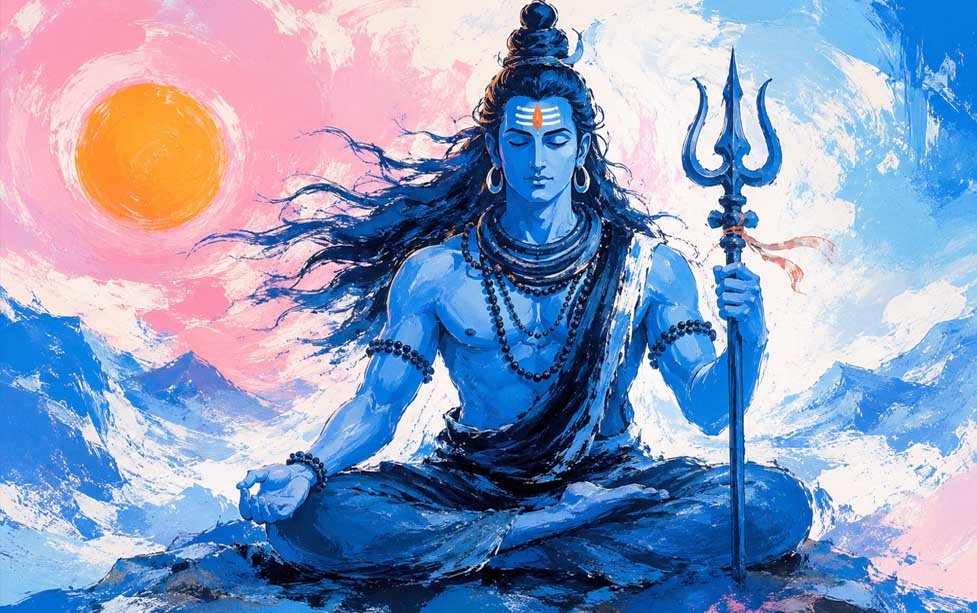
Tune in on Spotify for a deeper exploration of this story in Hindi & English.

The Linga Purana says Shiva has walked the earth twenty eight times, and the last of those visits belonged to a teacher named Lakulisha.

Most people know Vishnu’s avatars. Rama, Krishna, Narasimha, the list is familiar even to those who have never opened a Purana.
With Shiva, the story changes. His avatars barely appear in common retellings, yet the Linga Purana names them one by one and counts every single one.
The text builds its explanation around the idea of the kali yuga, the last and most difficult of the four ages that repeat endlessly within a single kalpa, a single day in the life of the universe.
Each time a kali yuga arrives, the Linga Purana says, Shiva takes a body and teaches a discipline called pashupata yoga, a path meant to pull people back toward clarity when the age itself pulls them toward confusion. The teacher changes. The teaching does not.
By the count the Purana gives, twenty eight kali yugas have already passed in the current kalpa. Which means, by its own logic, Shiva has already done this twenty eight times.
Twenty Eight Names, One Long Thread
The list itself reads less like a cast of divine warriors and more like a lineage of teachers, each one suited to the age he arrived in.
Sveta opens the line, a serene, white-complexioned form of Shiva. Sutara follows, a guide meant to aid liberation, then Damana, whose name points to the taming of inner impulses rather than outer enemies.
Suhotra is remembered as a benefactor, Kanka as a meditative figure adorned with sacred beads, and Lokaaksi as one whose vision extends over all the worlds at once. Jaigeesavya represents spiritual victory, Dadhibahana carries curd or milk as a symbol of gentleness and nourishment, and Rishabha, tied to the bull, stands as an early and primordial teacher-form.
The list then folds in names tied to known sages. Bhrigu appears as a manifestation of the great rishi himself. Ugra, also called Kaali, is the fierce aspect, the one holding cosmic discipline in place through severity rather than calm. Atri, sometimes Puru, echoes the Vedic sage of the same name. Bali stands for devotion paired with power. Gautama arrives as the sage who would go on to found the Nyaya school of logic, and Vedavarsin as a teacher fully absorbed in the Vedas.
Gokarna is remembered through sacred geography and long penance. Grhasvami is the householder form, the one proving that worldly life and spiritual discipline are not opposites. Sikhandi is called a crest-jewel of wisdom, Jaatimali is bound to matted hair and ascetic discipline, and Attahas is the form of roaring laughter, said to mark the destruction of ignorance itself.
Daaruka is tied to the Daruka forest and to protection. Laanguli belongs to a specific strand of yogic discipline. Bheema carries the same fierce, tremendous strength as his Mahabharata namesake. A second Sveta appears here too, a white sage devoted purely to teaching yoga, distinct from the first. Sooli bears the trident. Dandi carries the wandering ascetic’s staff. Sahinsu is patience itself, the forbearing one.
And then the line closes with Somasarma, also called Yogatma, better known by the name that outlasted all the others: Lakulisha.
The Last One: Lakulisha
The twenty eighth incarnation is called Lakulisha, sometimes Nakulisha, and the two names appear to point at the same figure across different texts rather than two separate ones.
The story goes that Lakulisha was born in a village called Karavan, on the banks of the Narmada river in what is now Gujarat. He died as an infant. Then, the tradition says, he rose again, this time inhabiting a dead body, and lived on as a wandering ascetic carrying a club, a symbol that gives him his name, since Lakulisha means the lord who holds a staff.
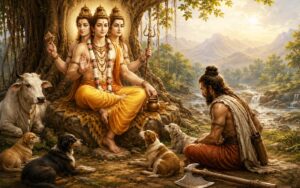
He gathered four disciples, Kaurushya, Garga, Mitra, and Kushika, and through them restored a teaching that had apparently begun to fade: the pashupata path, an early and austere form of Shaiva yoga built around discipline, control, and a hard break from worldly attachment. Other Puranas, the Vayu and the Kurma among them, describe the same event, which suggests this wasn’t a story unique to one text but a tradition several communities agreed on.
There is one detail that pulls this story out of pure thought and into something closer to history. An inscription from a pillar built in Mathura in 380 CE traces a line of teachers back six generations to a man named Kushika. If that Kushika is the same one named as Lakulisha’s disciple, then Lakulisha himself was likely a real teacher who lived somewhere around 125 CE, centuries before the Puranas describing him were compiled in their present form. A wandering ascetic, remembered so well that later generations folded him into Shiva’s own line of return.
What the Story Is Actually Saying
Strip away the yuga counting and the story leaves behind a fairly direct idea: teaching itself is treated as something worth reincarnating for.
Vishnu’s avatars usually arrive to fix a crisis, a tyrant to defeat, a world to save.
Shiva’s avatars, at least in this list, arrive because a discipline is at risk of being forgotten, and someone has to carry it forward again.
Lakulisha closes the list not because the counting stops, but because he is the one incarnation the tradition remembers clearly enough to place in a real village, on a real river, founding a real school of thought that outlived him by centuries.
FAQ
Is Lakulisha the same as Nakulisha?
Most sources treat them as the same figure under two spellings, though a few traditions keep them distinct. The Linga Purana’s own account treats him as one person, the final of the twenty eight.
Are the 28 avatars of Shiva as well known as Vishnu’s avatars?
No. Vishnu’s ten avatars, the dashavatara, are widely known even outside serious study of the Puranas. Shiva’s twenty eight are mentioned mainly in the Linga, Vayu, and Kurma Puranas and rarely discussed outside specialist or Shaiva circles.
Was Lakulisha a real historical person?
There is suggestive evidence for it. An inscription from 380 CE at Mathura traces a teaching lineage back to a disciple matching one of Lakulisha’s four named followers, which would place him as a real teacher around 125 CE.
Why does the number stop at 28?
Because the Linga Purana counts twenty eight kali yugas as having already occurred within the current kalpa. The count is tied to the text’s larger system of cyclical time, not to any claim that Shiva’s incarnations have ended for good.
Twenty eight names, and only one of them left behind a village, a river, and a lineage anyone could trace. That is usually how it works.
Most teachers are forgotten. A few become names no one can fully explain, only repeat.


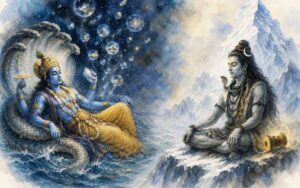
Om Namah Shivaya
Shiv Sada Sahaya 🙏
Shivaji is also known as eternal Guru/ teacher, Aadi Guru, Sadaashiv … Dakshinamurthy … the Supreme Cosmic Teacher …