
 By
By 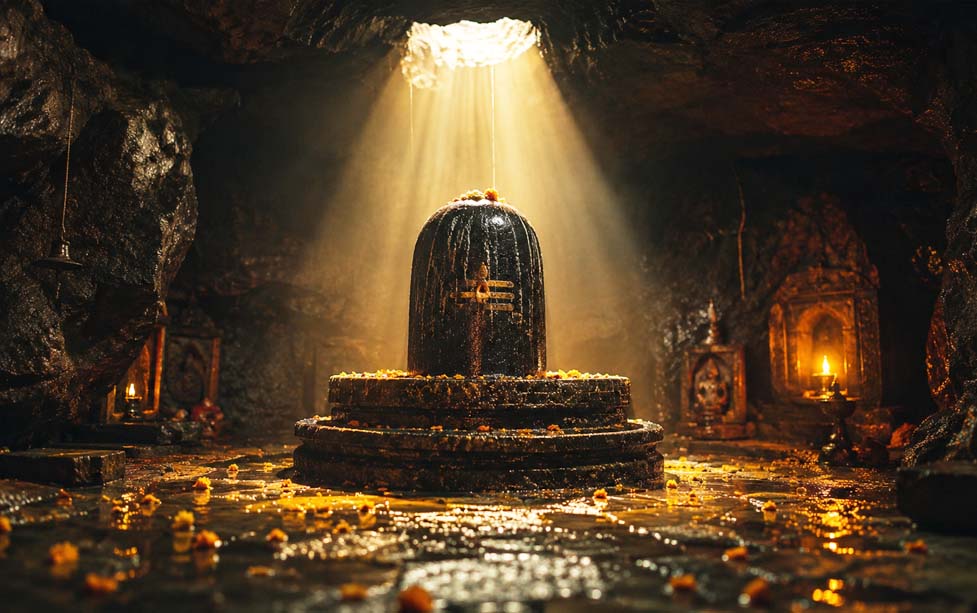
No time for reading the story? Give it a listen on Spotify.

The Linga Purana says the divine is not housed in stone. It was never outside you to begin with.

There is a moment, familiar to almost everyone, that has no good name in English. It happens in deep sleep, just before a dream begins. Or in the middle of a crowd when noise suddenly seems distant. Or at the edge of a long exhale. The mind goes quiet. Not blank, exactly, but still. Whatever was pulling at you releases its grip, just for a second, and something underneath becomes briefly visible: a kind of unshakeable okayness, a presence that was always there but drowned out.
The Linga Purana calls that point the linga.
Not the stone pillar in a temple. Not the symbol carved from black granite and bathed in milk. Those are representations, the Purana is careful to say, pointers for a mind that needs somewhere to look. The real linga is formless. It is the axis inside every living being, the still center around which thought, feeling, breath, and awareness revolve without ever touching it.
Every wheel needs a hub. The hub itself does not spin.
What the Word Actually Means
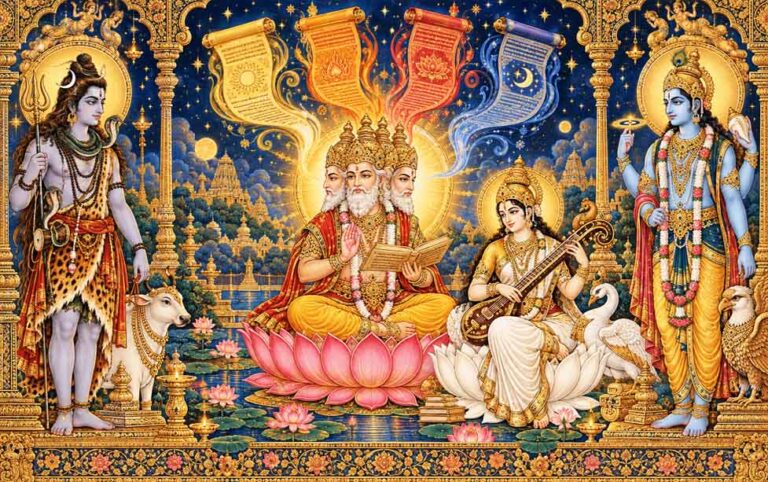
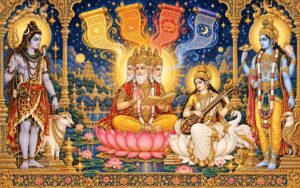
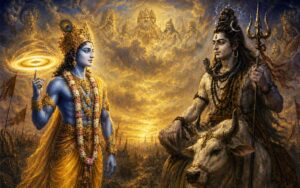
In Sanskrit, linga means mark, sign, or indicator: something that points beyond itself to what cannot be pointed at directly. The Linga Purana opens with Brahma and Vishnu arguing over who created the universe. Their argument is interrupted by a column of fire, infinite in both directions, with no visible source and no visible end. Neither god can find where it begins or where it stops.
That column is the linga.
And the Purana’s deeper argument, made quietly across its thousand verses, is that the same column runs through you.
The word was later associated with the male form, and that association is not accidental. The Purana is explicit: the linga and the yoni together are the axis and the field, consciousness and matter, the still point and the world that spins around it. Neither is complete alone.
The symbol is not about gender. It is about the relationship between what does not move and what moves ceaselessly.
The Axis That Does Not Spin
Indian philosophy, across almost all its schools, returns obsessively to one question: what in you is unchanged by experience? Your body ages. Your opinions shift. You fall in love, fall out of it, grieve, recover, forget. What watches all of that without itself being altered?
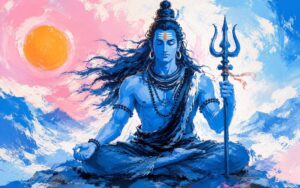
Different traditions answer differently. The Linga Purana’s answer is Shiva, not as a person but as a principle: pure witnessing awareness, without preference, without reaction, without end. The linga is that principle made into a shape, which is to say a shape chosen precisely because it has no face, no hands, no expression. You cannot read its mood. You cannot make it want something. It simply is.
The Purana says this axis is present in every sentient being without exception. Not as metaphor. As ontological fact. At the center of your nervous system, somewhere beneath the noise of thought, there is something that has never been disturbed by anything that has ever happened to you. The linga is that.
Shiva is not worshipped in temples because he lives there. He is worshipped there to remind you where he actually lives.
Why the Formless Needs a Form
The Purana does not dismiss ritual. It contextualizes it. The sages who composed it understood something that modern self-help has mostly forgotten: the mind cannot fix its attention on the formless. It needs a handle. The stone linga in the temple is that handle, a form chosen to represent formlessness, a shape stripped of all the features that make a thing particular. No eyes to implore. No mouth to feed. No arms to shelter under. Just the axis, solid and silent.
You bring your attention to it. You walk in a crescent or half-moon shape around it. You pour water over it, and the water runs off, unchanged by the stone. That is the instruction. Bring everything you are to this center. Let it run off. What remains after everything runs off is what you were looking for.
The great medieval commentators on the Purana were insistent on this point: the external linga and the internal linga are not two different things. The worship is complete only when what begins as an outer ritual becomes an inner recognition.
You realize that what you were circumambulating was always yourself.
The Stillness the World Turns On
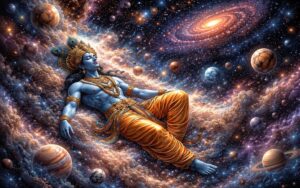
There is an old image in Indian cosmology: the earth rests on a turtle, the turtle on a serpent, the serpent on water, the water on nothing at all. Most people find this unsatisfying. What holds the nothing? But the image is not a physics lecture. It is pointing at the same thing the linga points at: that at the bottom of all structure, all cause and effect, all manifestation, there is something that has no support because it needs none. It is the support.
The Linga Purana’s final claim is simply this. The universe has a center. That center is not a location in space. It is a quality of awareness. And you carry it in you the way a wheel carries its hub: invisibly, necessarily, without drama.
You have never been without it. That is the whole of the teaching. Everything else is commentary.
The Linga Purana is one of the eighteen Mahapuranas of Hindu tradition.
Its philosophical core, sometimes called Shaiva Siddhanta, holds that Shiva as pure consciousness is the ground of all existence, present as witness in every living being.



I just have to quieten the noise, that is the ultimate quest. The linga is already in me.