
 By
By 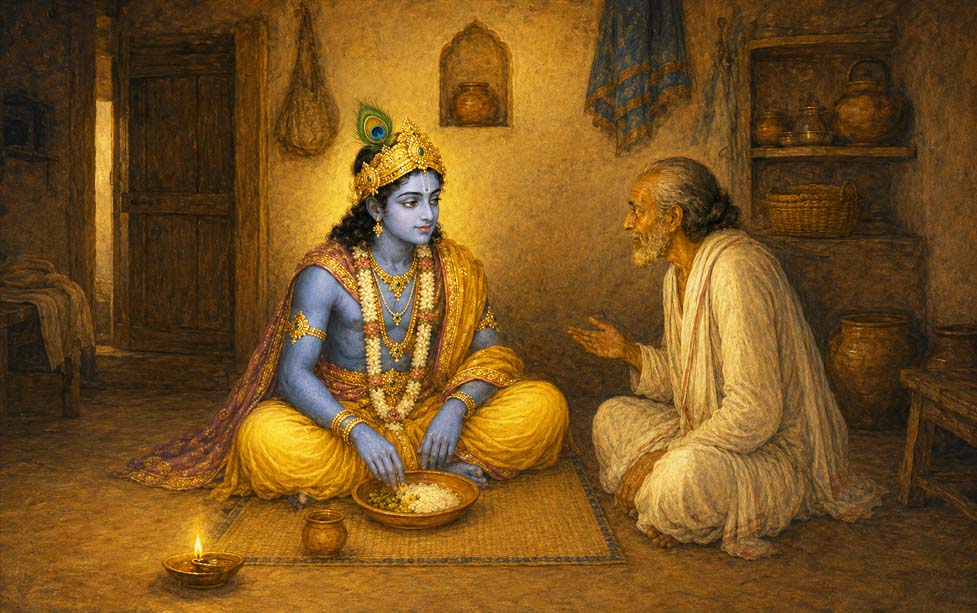
Tune in on Spotify for a deeper exploration of this blog in Hindi and English.

When Krishna arrived at Hastinapura as a peace envoy, Duryodhana offered him a palace and a banquet; Krishna walked past both and knocked on a different door.
The Udyoga Parva is not optimistic. By the time Krishna sets out for Hastinapura, both sides have already counted their armies. Duryodhana has the numbers. The Pandavas have Krishna. Everyone understands that the peace mission is a formality, a last ritual before the killing begins.
Krishna knows this too. He says so, plainly, before he leaves. He tells the Pandavas he will try, but that Duryodhana will not give up so much as a needlepoint of land. He is not going to negotiate. He is going to make visible what has always been true about the Kuru court: who, in that palace, actually stands for something.
The meal at Vidura’s house is how he does it.
What Duryodhana Offered
Duryodhana prepared for Krishna’s arrival the way a man prepares for someone he intends to impress and, through impression, to neutralize. The palace was arranged. A feast was laid. Attendants were stationed. Everything that power can arrange, Duryodhana arranged.
The offer was genuine, in its own way. Duryodhana wanted Krishna on his side, or at least not firmly against him. He understood that Krishna’s presence in the Pandava camp was the war’s most dangerous variable. A feast was the opening move of a longer negotiation.
Krishna declined without ceremony. He would not eat.
His reasoning, as the Mahabharata records it, is precise: food should be accepted from someone who loves you, or when you are starving.
Duryodhana did not love him. And Krishna was not starving. The feast was therefore not food. It was a transaction, and Krishna was not interested in the terms.
This is not rudeness. The Mahabharata is careful about this. Krishna is not performing contempt. He is applying a principle the text treats as foundational: that eating with someone is a form of alignment, and alignment with Duryodhana, at this moment, would be a lie.
The Walk to Vidura’s House
Vidura was not a king. He was the son of the sage Vyasa and a servant woman, which meant the Kuru court treated him as counsel it was free to ignore. He served Dhritarashtra faithfully for decades and watched Dhritarashtra ignore every warning he ever gave. By the time Krishna arrives in Hastinapura, Vidura has already said everything that needed to be said. No one listened.
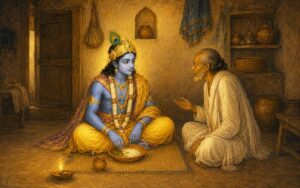
His house was not the palace. There was no feast. What Vidura had, he offered: simple food, the kind of meal that carries no obligations. Krishna ate it.
The Mahabharata makes something quiet and pointed out of this contrast. The man with every resource in the kingdom cannot get Krishna to his table. The man with almost nothing can. The difference is not hospitality. The difference is that Vidura loves the Pandavas honestly, has spent his life arguing for what is right, and has nothing to gain from Krishna’s goodwill. He is not offering a transaction. He is offering himself.
That is the food Krishna accepts.
Kunti in the Corner
There is a detail the Mahabharata does not announce loudly, but it is there. Kunti was living at Vidura’s house. After years in the Kuru palace, she had moved into her brother-in-law’s quieter home, closer to the margins of the court where honest people end up. When Krishna sat down to eat, she was present.
Their conversation that evening carries its own weight. Kunti spoke about her sons, about what they had endured, about what she was willing to ask of them. The meal at Vidura’s table was not only a political statement. It was a family reunion of a particular kind: the family that the Kuru palace had pushed out, gathered together in a smaller room, eating simpler food, and telling the truth to each other.
The Mahabharata gives this scene no dramatic swelling. It happens the way real things happen, plainly. But the contrast with Duryodhana’s empty feast is deliberate.
What the Meal Argues
The Mahabharata is a text obsessed with legitimacy. Who has the right to rule, to speak, to act, to be heard. It works through this question across eighteen books and never gives a simple answer.
But the meal at Vidura’s house is as close to a simple answer as the epic gets. Legitimacy is not the banquet. It is not the palace, the army, the treasury, or the arranged welcome. It is something closer to Vidura’s table: the willingness to tell the truth at personal cost, to love without advantage, to offer what you have rather than what impresses.
Krishna, who could have accepted Duryodhana’s feast and remained technically neutral, chose instead to make his position legible. He walked across Hastinapura and knocked on the door of the man who had the least power and the clearest conscience. That walk was the argument. The meal was its conclusion.
The war had not yet begun. But this was, in its way, the first decision of the battle.
FAQ
Why did Krishna refuse Duryodhana’s feast in the Mahabharata?
Krishna explains his refusal in the Udyoga Parva. He says food should be accepted from someone who loves you or when you are genuinely hungry. Since Duryodhana’s invitation was motivated by political calculation rather than affection, Krishna considered the feast inappropriate to accept. Eating with someone, in the Mahabharata’s framework, implies a degree of alignment. Krishna was not willing to imply alignment with Duryodhana.
Who is Vidura in the Mahabharata and why does Krishna eat with him?
Vidura is the half-brother of Dhritarashtra and Pandu, born to a servant woman. He serves as the chief minister of Hastinapura and is known throughout the epic as its voice of dharma. The Mahabharata identifies him with Yama, the god of righteousness, born in human form. Krishna eats at his house because Vidura’s loyalty to the Pandavas is genuine and his commitment to what is right is unconditional. He has nothing to offer Krishna politically, which is precisely why his hospitality is acceptable.
Was Kunti at Vidura’s house when Krishna visited?
Yes. By the time of Krishna’s peace mission, Kunti was living at Vidura’s house rather than in the main Kuru palace. Krishna met her there, and their conversation touches on the fate of her sons and the approaching war. Her presence adds another layer to the episode: Vidura’s home had become a gathering point for those the Kuru court had sidelined.
What does this episode reveal about Krishna’s character in the Mahabharata?
It reveals that Krishna’s political intelligence operates through symbolic action as much as through speech. He does not argue with Duryodhana at the feast. He simply does not go. The refusal communicates his position more clearly than a speech would. The Mahabharata consistently shows Krishna using gesture and choice to make arguments that words would blunt.
What is the Udyoga Parva in the Mahabharata?
The Udyoga Parva is the fifth book of the Mahabharata. It covers the period of preparation before the Kurukshetra war, including diplomatic negotiations, the marshaling of armies, and Krishna’s peace mission to the Kuru court. The word udyoga means effort or preparation. The book documents the last attempts to prevent the war and the gradual recognition that the war is unavoidable.
Duryodhana’s feast went uneaten. The palace, the arrangement, the effort, none of it moved Krishna. He ate with a man who had no power left to offer, and in doing so said more than any speech in the Udyoga Parva managed to say.
The Mahabharata has always understood that who you eat with is who you are.







Satsang is the most divine gift, to be cherished and worked for.
Dharma Chow.
Food is good Loyalty.