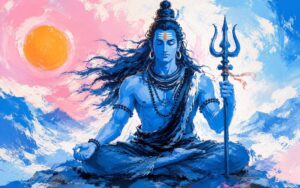
Agastya is one of the most important sages in Hindu scriptures. He appears across the Rigveda, the Mahabharata, and the Puranas. His defining mission was the south of India. He traveled there, settled there, and dedicated his life to making it sacred and livable.
His greatest task was water.
The southern lands were dry. Agastya prayed, and the gods listened. They gave him a small pot filled with sacred water and one promise: wherever this water touched the ground, a great river would rise. The rest was up to him.
The Journey to Coorg
Agastya walked for a long time.
He crossed forests and mountain passes, carrying the pot carefully, searching for the right place to release the water.
When he reached the hills of Coorg, green and layered with mist, he stopped. The land felt right.
The slope, the soil, the stillness of the place. This was where the river should begin.
But the journey had been long. He needed to step away for a moment.
A boy stood nearby, quiet and unremarkable. Agastya asked him to hold the pot. The boy agreed.
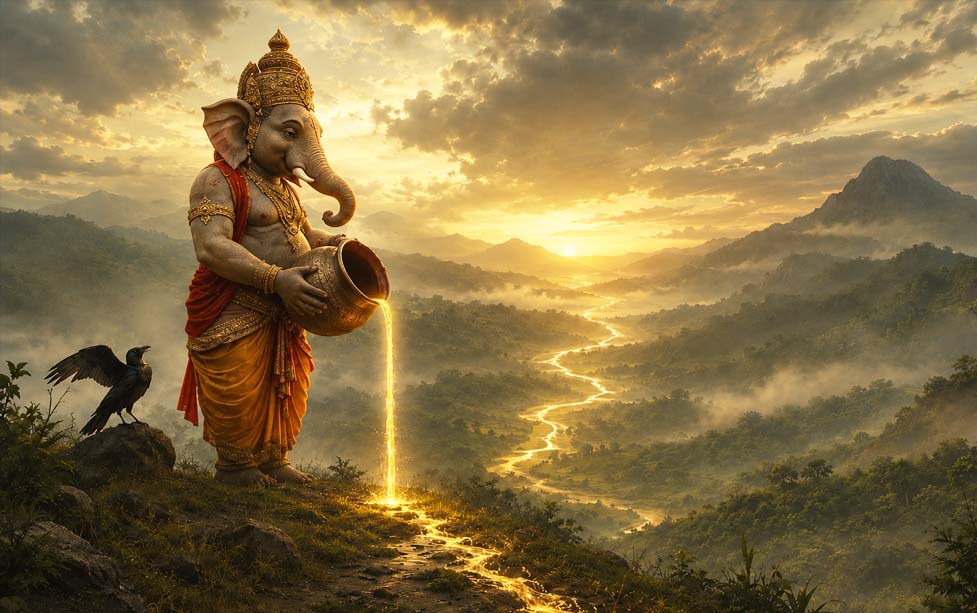
The boy was Ganesha.
What Ganesha Knew
Ganesha is Vignaharta, the remover of obstacles. But he is also something less discussed: a placer of outcomes.
He does not remove obstacles by force. He repositions things so the right result becomes inevitable.
Standing in those hills with the pot in his hands, Ganesha understood something the sage did not. The water was already where it needed to be. The hills of Coorg were not just a good location. They were the exact location. The river was always meant to begin here.
He set the pot down.
The Crow and the River
When Agastya returned, he found the pot resting on the ground. A crow had landed nearby, drawn to the water, beak angled toward the rim.
Agastya moved quickly. He waved the bird off. In the commotion, the pot tipped. The sacred water spilled onto the hillside. It touched the earth and began to move, quietly at first, then with growing force.
It became the Kaveri.
The river ran south from those hills and has not stopped since. It carved through the Deccan plateau, fed kingdoms, and turned dry soil into farmland for millions of people across centuries. It remains one of the most important rivers in South India today.
All of it started with a tipped pot and a crow that got too close.
The Lesson Hidden in the Story
Agastya had imagined the moment differently. He would choose the spot deliberately, pour the water with intention, feel the weight of what he was creating.
Instead, the river began in confusion. A bird, a stumble, a spill.
This is the pattern of Ganesha’s interventions. He does not announce himself. He does not perform miracles in the traditional sense. He places things where they need to be and lets the moment do the rest.
The sage got exactly what he had asked for. He just did not get to control how it happened.

 By
By