
 By
By 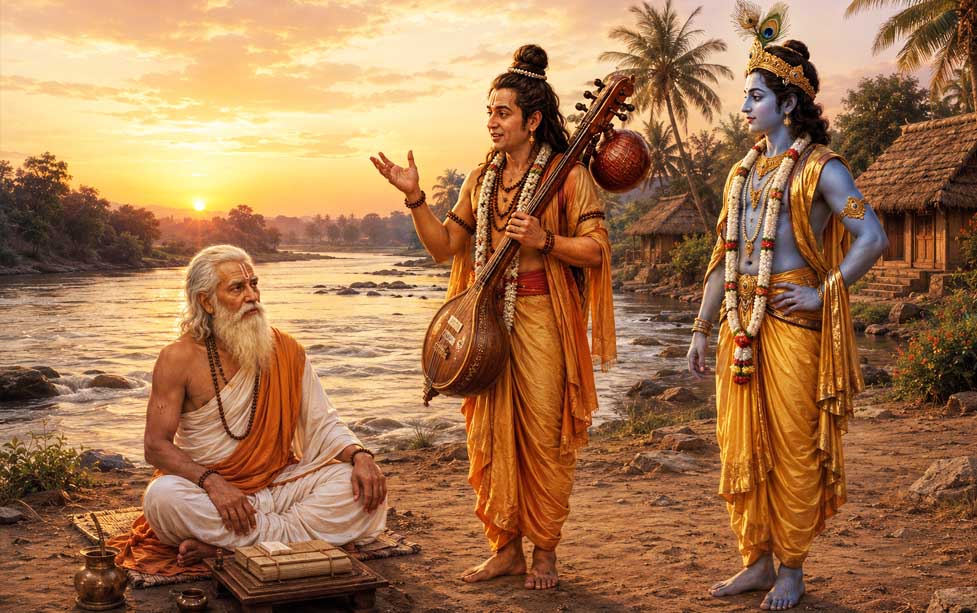
Listen to the podcast on Spotify for a deeper dive into this story.

Even the man who wrote the Mahabharata once sat by a river, feeling like he had failed.
Characters in the story:
Narad Muni: Narad Muni is a divine sage and a devotee of Lord Vishnu. He is known for his wisdom, musical talents, and his role as a messenger and mediator between the gods and humans.

Veda Vyasa: Maharishi Veda Vyasa is a revered sage and author of many ancient Hindu scriptures, including the Mahabharata and the Vedas. He is considered to be one of the most important figures in Hinduism and a key contributor to its philosophical and spiritual traditions.

Before the Bhagavata Purana existed, its own author was unhappy with everything else he had written.
This story comes from the text’s own first canto, chapters four through seven. It is the Purana describing its own birth, which is common in this kind of literature. So it is best read as the tradition’s own story about itself, not as outside history. Worth saying that clearly before we start.
A Sage Who Had Already Done Everything
Vyasa was not a young writer looking for his first big subject. By the time this story begins, he had already sorted the Vedas into their four parts. He had written the Mahabharata. He had written other Puranas before this one. He had done more than most people do in ten lifetimes.
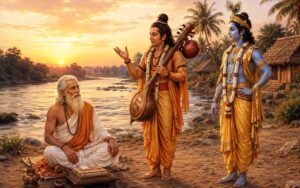
But he sat on the bank of the Sarasvati river, at his ashram, and he felt empty. The text says he was unhappy even though he had achieved so much. Something in his work had not landed the way it should have.
Narada Asks The Right Question
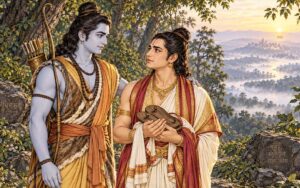
Narada Muni shows up at this moment. And what happens between the two of them is really the whole story.
Narada asks Vyasa a simple question.
Why does a man who has written so much still look unsatisfied?
Vyasa cannot answer it himself. He feels the emptiness but does not know its cause. So Narada tells him. Everything Vyasa had written so far, he says, was about dharma, about wealth, about desire, about freedom, but always as things people chase. Or it was about family lines, right conduct, the rules of ritual and rule. What Vyasa had never done, says Narada, was describe the highest truth directly. He had circled the center his whole life. He had never named it.
It is a simple point, but a sharp one. Vyasa had described the world in full detail. He had never described what the world was pointing toward.
What Was Actually Missing
Narada explains further. Dharma without its source becomes just a list of rules. A reader can learn what is right and wrong from the Mahabharata’s endless account of duty and consequence. But the text never stops long enough to say why any of it matters, beyond one action leading to another. Narada tells Vyasa that a work built entirely around the Supreme itself, told as a living story instead of as instruction, would do something no earlier text had done. It would let the reader feel the truth the other texts had only assumed.
Call it theology. Call it literary criticism. Either way, Narada has named a real gap, not just a vague feeling.
Written In A State of Stillness
Vyasa accepts this. He goes into deep meditation at his ashram, a place called Shamyaprasa, and the tradition says he receives the subject rather than invents it. From that stillness comes the Bhagavata Purana. It follows the same ten subjects every Purana follows. But this time, everything points toward one thing: describing the divine directly, through story, not through law or family record.
Here is what makes this remarkable. The Bhagavata Purana does not present itself as Vyasa’s first attempt at scripture. It presents itself as his correction. A man goes back and rewrites the meaning of his own life’s work because someone he trusted told him it was incomplete.
Handing It Forward
Vyasa writes the text. But he does not simply release it into the world. He teaches it to his son, Shukadeva, who the tradition says was already free of worldly attachment even as a young man. It is Shuka who later recites the entire Bhagavata Purana to King Parikshit, who is dying and has seven days left to live. That deathbed recitation becomes the frame that holds nearly every story in the text.
So the chain runs like this. Narada names the gap. Vyasa fills it. Shuka carries it forward. And a dying king’s last seven days become the reason the whole world gets to hear it. This is why Guru Purnima belongs to Vyasa. The day marks him as the point where this chain begins, and as the reason we use the word guru at all.
FAQ
Is this story historically verifiable?
It comes from the Bhagavata Purana’s own first canto, where the text describes its own origin. This is a common feature of Puranic literature.
Why is Guru Purnima connected to Vyasa specifically?
Guru Purnima is also called Vyasa Purnima. Some traditions mark it as his birth. More broadly, it honors him as the one who organized the Vedas and wrote the Mahabharata and the Puranas, making him the original reference point for the idea of a guru.
What is Shamyaprasa?
It is the name of Vyasa’s ashram on the bank of the Sarasvati river, where the text says he composed the Bhagavata Purana.
Did Vyasa write the Mahabharata before the Bhagavata Purana?
Yes. The story presents the Bhagavata Purana as his response to the emptiness he felt after finishing the Vedas, the earlier Puranas, and the Mahabharata.
What is Shukadeva’s role in this story?
Vyasa teaches the finished Bhagavata Purana to his son Shukadeva. Shuka later recites it to King Parikshit, and that recitation becomes the frame for most of the text’s stories.
A man who had already written the world’s greatest epic sat alone by a river, unable to name what was missing. It took someone else to hold up a mirror. And when Vyasa finally looked, what came out of him was not another book of rules or lineages. It was an attempt to put the infinite into words, knowing full well that words would never be enough.
That he tried anyway, and that we are still reading the result thousands of years later, is the closest thing to eternity most of us will ever hold in our hands.
Aum 🙏