
 By
By 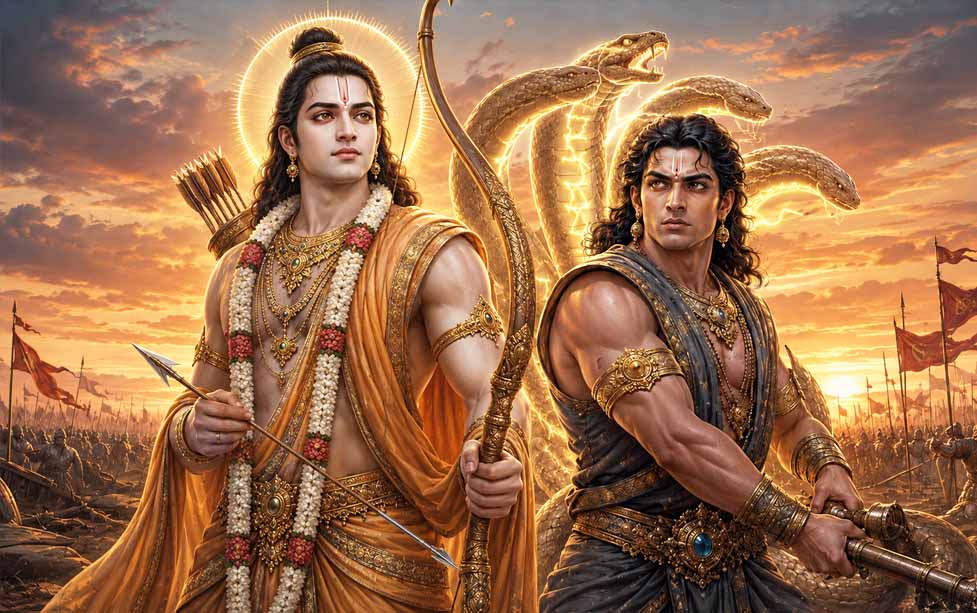
Tune in on Spotify for a deeper exploration of this blog in Hindi and English.

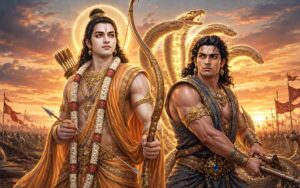
Rama stayed calm through insult and war. Lakshmana never did. That difference wasn't a flaw in either of them, it was the whole point.
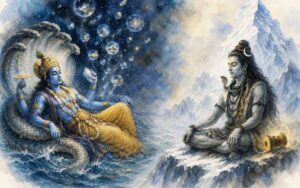
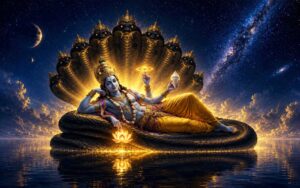
Puranic and folk tradition holds that Lakshmana is an incarnation of Shesha Naga, the great serpent Vishnu reclines on in the cosmic ocean. It’s a detail you won’t find worked out in Valmiki’s original text. It shows up later, layered on by Puranic sources and popular retellings, so it’s fair to treat it as theological gloss rather than something the earliest Ramayana itself insists on.
The image still earns its keep, though. Shesha holds up the entire world without complaint, coil after coil of quiet, load-bearing patience. But he’s still a snake. And a snake that has gone still for a thousand years can still strike in an instant. That’s Lakshmana in one sentence: endless service, until the moment someone he loves is in danger, and then no hesitation at all.
Rama’s identity does the opposite kind of work. As Vishnu, he’s the preserver, the one whose job is to hold cosmic order together, not to answer every slight. A preserver who reacts to everything eventually has nothing left to preserve. Restraint isn’t a personality quirk for him. It’s the job.
The Surpanakha episode: two different first reactions
Surpanakha corners Rama in the forest and proposes marriage. He doesn’t get angry, doesn’t lecture her, doesn’t even really refuse in a heavy-handed way. He just points her toward Lakshmana instead, half-joking that his brother is unmarried and available. It’s almost playful, which is a strange thing to be able to say about a scene involving an attempted seduction and, eventually, a mutilation.
Lakshmana plays along at first, sending her back to Rama. But the moment Surpanakha loses patience and goes after Sita, the joking stops. Lakshmana draws his sword and cuts off her nose and ears, right there, with no debate and no consultation with his older brother first.
Put the two reactions side by side and you get the whole dynamic in miniature. Rama absorbs the provocation. Lakshmana absorbs it too, but only up to the point where Sita is threatened, and then he acts before anyone can talk him out of it.
What was Lakshmana’s reaction to Rama’s exile?
He wanted to fight it. When Dasharatha announces Rama’s fourteen-year banishment at Kaikeyi’s insistence, Lakshmana doesn’t treat it as fate to be accepted. He calls it what it looks like to him: an old king manipulated by a scheming queen into an unjust order. Several tellings have him ready to defy his father outright, even to seize the throne himself if that’s what it takes to stop the exile from happening.
Rama shuts that down, not by arguing that the decision was fair, but by insisting that a father’s word, once given, has to be honored regardless of the cost. He leaves for the forest without protest. Lakshmana eventually channels his fury into something else entirely: he follows Rama into exile rather than fighting the decree that caused it. But it’s worth noticing what his first instinct actually was. Not sorrow. Rage at the unfairness of it.
Did Rama show restraint even toward Ravana?
Yes, and one moment in the war makes this unmistakable. At a point in the battle, Ravana’s chariot is smashed and he’s left standing weaponless in front of Rama. Rather than finish him off, Rama pauses and lets him rearm. It’s battlefield dharma in its purest form, the idea that even a mortal enemy is owed a fair fight, not an execution.
Lakshmana isn’t running on that clock. His fight against Indrajit is built on urgency and precision, on knowing that Indrajit’s power depends on completing certain rituals without interruption, and on ending that threat before it can fully take shape. Where Rama slows down out of principle, Lakshmana speeds up out of necessity.
Neither instinct is wrong inside the story. Rama’s patience is what a king owes to the idea of dharma, even when the person across from him is trying to kill him. Lakshmana’s urgency is what a brother owes to the people he’s protecting, full stop.
So what does the serpent-and-preserver framing actually explain?
It explains why neither brother’s temperament reads as a flaw. Lakshmana’s anger never shows up over small things. It surfaces exactly when Rama, Sita, or dharma itself is under threat, and nowhere else. Rama’s calm is never indifference either. He feels every one of the same provocations Lakshmana does. He just can’t afford to act on all of them, because his role requires the world to stay in balance around him.
Read through the Shesha-Vishnu lens, it holds together. The preserver stays still so nothing falls apart. The serpent underneath him carries the weight in silence, right up until something threatens to break through. Then he strikes.
FAQ
Was Lakshmana really an avatar of Shesha Naga?
That’s the tradition most Puranic and popular sources point to, but it isn’t spelled out in Valmiki’s original Ramayana. Treat it as a later theological layer rather than a founding detail of the epic itself.
Did Rama ever actually lose his temper?
He did, most visibly in his grief and rage after Sita’s abduction. But across the epic as a whole, his default setting is composed and deliberate, especially compared to Lakshmana.
Why did Lakshmana mutilate Surpanakha instead of just sending her away again?
Most versions place the act right after Surpanakha attacks Sita, which frames it as immediate protective retaliation rather than something unprovoked.
Is Lakshmana’s temper ever treated as a genuine flaw in the story?
Some tellings do have Rama actively calming him down, especially during the succession crisis in Ayodhya. But it generally reads as loyalty running hot, not a moral failing.
Which brother is considered dharmically “correct,” Rama or Lakshmana?
The epic doesn’t rank them. Rama’s restraint upholds dharma at the level of kingship and cosmic order. Lakshmana’s urgency upholds it at the level of personal loyalty and protection. Both are treated as necessary.
Rama held the world together. Lakshmana made sure nothing got close enough to test it.
That’s not two different men. That’s one complete one, split in half.
Ramam lakshmanam Poorvajam Sitapatim Sundaram