
 By
By 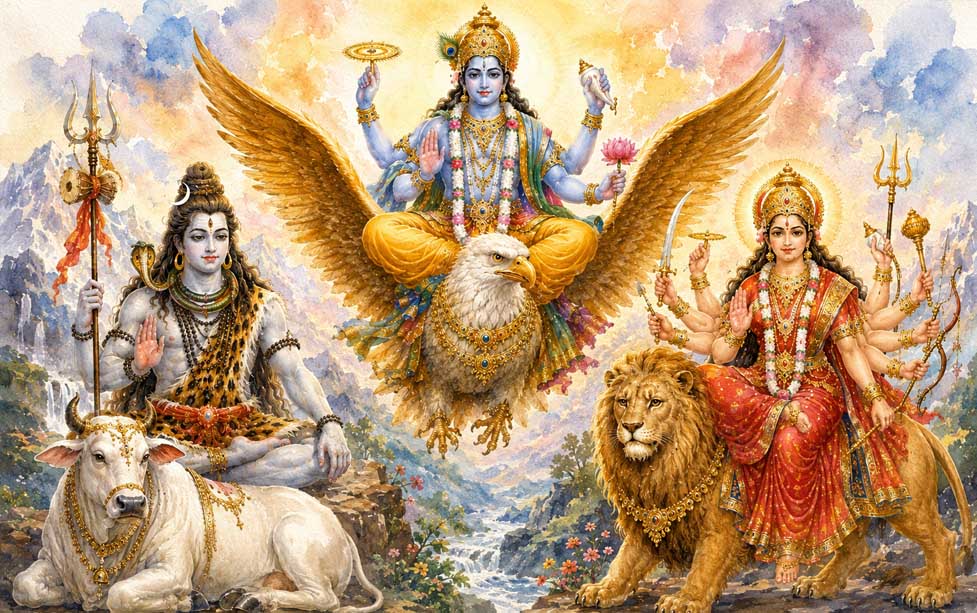
Tune in on Spotify for a deeper exploration of this blog in Hindi and English.

Every deity in Hindu tradition travels with a companion, and that companion is rarely a decoration.
A vahana is the vehicle of a god, almost always an animal, and the pairing is never random. Puranic and Agamic texts treat the mount as a second half of the deity’s identity.
The animal often represents an instinct, a force, or a quality that the god controls, channels, or has tamed.
Read together, god and vahana describe a complete idea: consciousness riding on top of a particular kind of power.
This is why Ganesha’s mouse, easy to dismiss as comic, carries as much philosophical weight as Vishnu’s eagle.
Garuda and Vishnu
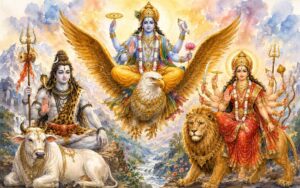
Garuda is a giant eagle, sometimes shown with a human torso and a hooked beak, and he carries Vishnu across the three worlds at extraordinary speed. In the Mahabharata and several Puranas, Garuda is born already an enemy of serpents, and his rivalry with the nagas becomes one of the more elaborate side stories in Hindu literature.
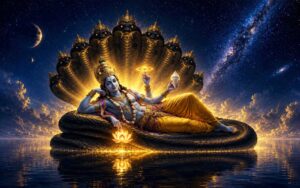
As Vishnu’s mount, Garuda represents swiftness, the ability to move between heaven and earth without obstruction, and the destruction of deceit, since serpents in this context often stand for cunning and hidden danger. Vishnu seated on Garuda is a picture of order that can act instantly wherever it is needed.
Nandi and Shiva
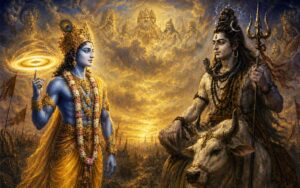
Nandi is a bull, usually shown seated and facing the sanctum in Shiva temples, and he is considered Shiva’s principal attendant as much as his vehicle. The bull signifies strength, virility, and a kind of grounded endurance, but in the context of Shiva, that raw physical power is disciplined into stillness.
Nandi does not rage. He waits, watches, and guards. Several temple traditions hold that a devotee’s request is first heard by Nandi before it reaches Shiva, which places the bull in the role of threshold keeper as much as mount.
Mooshika and Ganesha
Ganesha’s vehicle is a mouse, sometimes described as a rat, and the size contrast between the elephant headed god and his tiny mount is often the first thing people notice. The Ganesha Purana and later Puranic material frame the mouse as a symbol of desire and restlessness, the kind of small persistent urge that can gnaw through anything given enough time.
Ganesha riding the mouse shows wisdom controlling appetite rather than being controlled by it. The obstacle remover succeeds precisely because he has already mastered the smallest, most stubborn obstacle inside himself.
Simha and Durga
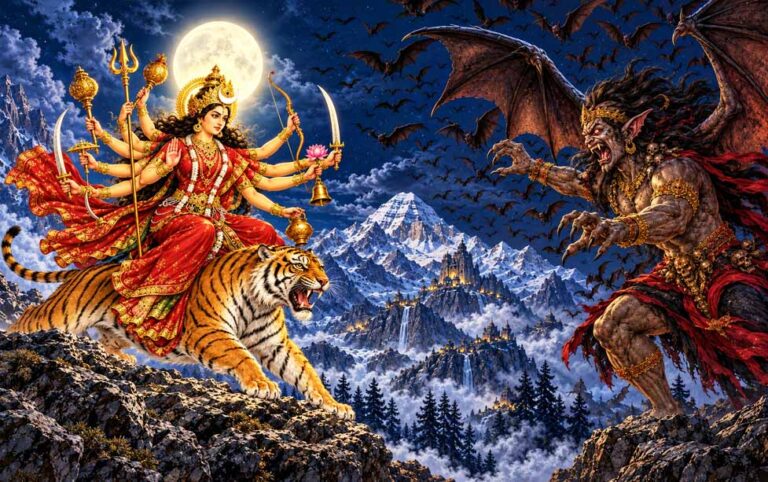
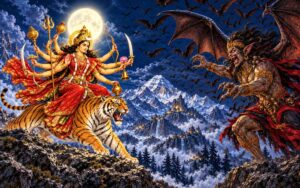
Durga rides a lion, though some traditions and regional depictions show a tiger instead, and the animal is not a mount she was given so much as an ally she earns through the sheer force of her own power.
The lion embodies raw aggression, dominance, and unchecked will, the very qualities Durga must command to defeat Mahishasura and other forces of chaos in the Devi Mahatmya. Her seat on the lion is a claim: the fiercest energy in the animal world submits to the goddess, and through her it becomes a weapon against disorder rather than a source of it.
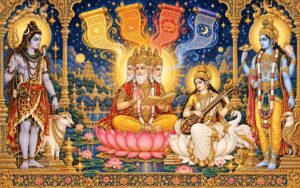
Hamsa and Saraswati, Hamsa and Brahma
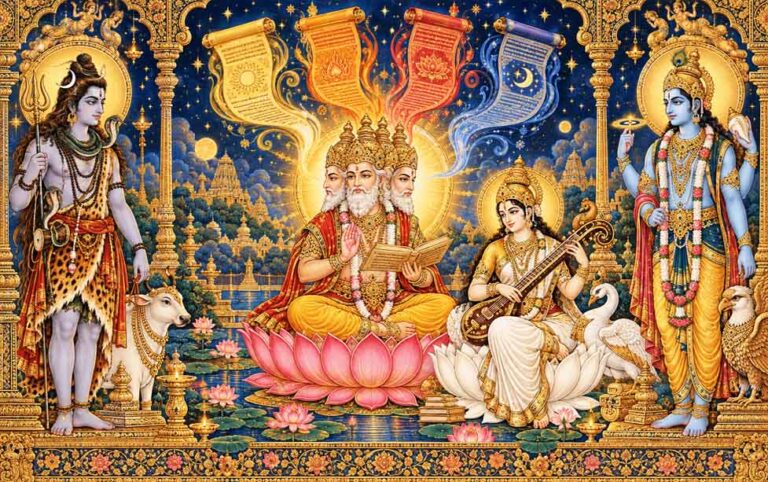
The swan, or hamsa, belongs to both Saraswati and Brahma, and its defining trait in Indian literature is an ability to separate milk from water when the two are mixed. That image of discrimination, the capacity to extract what is true and worthwhile from what is not, is exactly what the swan lends to these two deities.
Saraswati on the hamsa represents discernment in knowledge and art, the skill to find clarity inside noise.
Brahma on the hamsa carries the same idea into the act of creation itself, since bringing a coherent universe out of undifferentiated potential is its own kind of discrimination.
Mayura and Kartikeya
Kartikeya, worshipped widely as Murugan in South Indian tradition, rides a peacock named Paravani. The peacock is often read as a symbol of the ego or of vanity, since it displays such an elaborate show of beauty, and Kartikeya’s mastery over it suggests a war god’s authority over pride, including his own.
Some tellings also connect the peacock to the destruction of the asura Surapadma, who is said to have taken the form of a peacock and a rooster after his defeat, joining Kartikeya’s iconography as both mount and banner. Where that specific transformation account appears varies by regional text and oral tradition, so it is worth treating as a devotional layer rather than a single fixed Puranic source.
Uluka and Lakshmi
Lakshmi’s vahana is the owl, an animal associated with night vision and with wealth that can appear suddenly out of darkness. The owl also carries a warning built into the story itself: it is a creature that can be blinded by too much light and is often labeled foolish in folk tradition.
Lakshmi riding the owl is frequently interpreted as a reminder that wealth without wisdom becomes exactly that, blind and foolish, and that prosperity needs the discernment Saraswati’s swan represents to avoid ruin.
Airavata and Indra
Airavata is a white elephant, born from the churning of the ocean of milk according to the Puranas, and he serves as Indra’s mount in his role as king of the heavens.
The elephant signifies royal power, stability, and the ability to command the skies, since Airavata is closely tied to clouds and rain in the older Vedic imagination. Indra on Airavata is the picture of sovereignty at its most literal: a ruler whose authority over the weather and the heavens rides on an animal built out of the same primordial ocean that gave rise to the world’s abundance.
A Pattern Worth Noticing
Across these pairings, the vahana is almost never a lesser being simply carrying a greater one. It is the specific force the deity has learned to direct. Read this way, the animal mounts of Hindu gods form a kind of shorthand ethics: strength must be disciplined, appetite must be mastered, wealth needs wisdom, and even the fiercest instincts can be turned toward order instead of chaos.
FAQ
What is a vahana in Hindu thought?
A vahana is the vehicle or mount of a deity, almost always depicted as an animal or a bird, and it typically symbolizes a specific quality or force that the god has mastered.
Why does Ganesha ride a mouse despite being so large?
The size contrast is intentional. The mouse represents small, persistent desires, and Ganesha’s control over it shows that true wisdom begins with mastering the smallest urges rather than only the obvious large ones.
Is Durga’s vahana a lion or a tiger?
Both appear across Hindu tradition. Classical Sanskrit texts most often describe a lion, while several regional and folk traditions, particularly in parts of eastern India, depict a tiger. Either way, the animal represents the same fierce, dominant energy that Durga commands.
Do Brahma and Saraswati share the same vahana?
Yes, both are associated with the hamsa, or swan, which in Indian literature is credited with the ability to separate milk from water, symbolizing discernment and the power to distinguish truth from illusion.
What does Shiva’s bull Nandi actually represent?
Nandi represents strength and virility that has been disciplined into stillness and guardianship. In many temple traditions, Nandi also functions as an intermediary who receives a devotee’s prayer before it reaches Shiva.
A vahana is never just a ride.
The eagle still hunts. The bull still could gore. The lion still could maul.
They simply choose not to.
And the vahan given to all of us is our physical body, the one if tamed can truly liberate us.