
 By
By 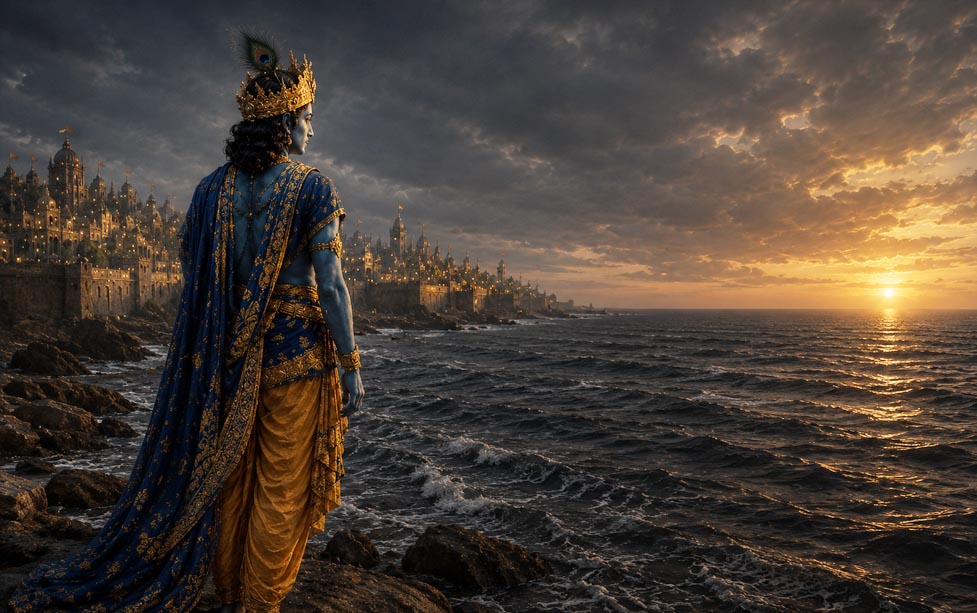
Tune in on Spotify for a deeper exploration of this blog in Hindi and English.

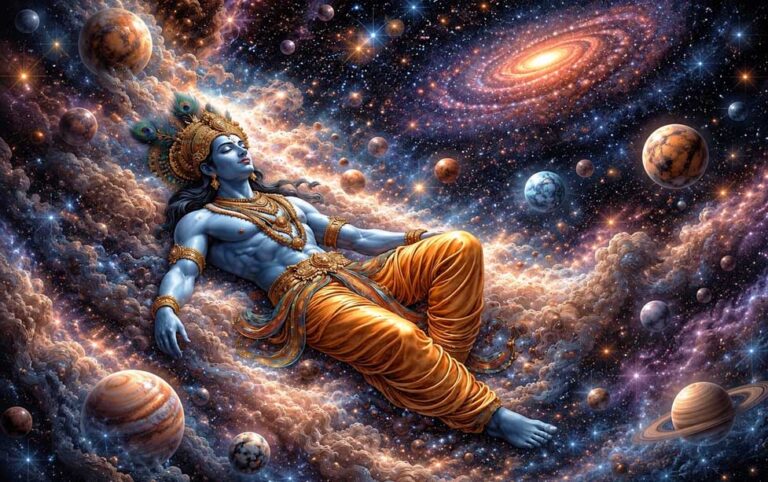
After the Mahabharata war, Krishna ruled Dwarka for thirty-six years. The texts barely mention it. This piece is about those missing years, and what the silence reveals.
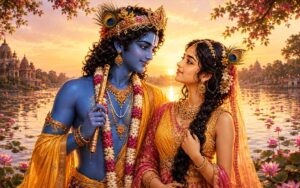
Every tradition has its preferred version of Krishna. The North loves the boy with the flute, stealing butter and hearts in equal measure. Philosophers love the charioteer who paused a war to deliver the Gita. Poets love the lover, the one who danced with a hundred women under a single moon and somehow belonged to each of them fully.
What almost no one loves, or writes about, or chooses to remember, is the king.
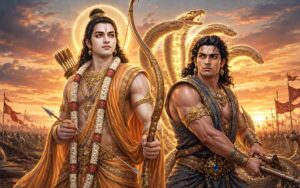
After the Kurukshetra war, Krishna returned to Dwarka. He was, by every measure, the most powerful figure in the subcontinent. The Pandavas had won because of him. The Kauravas had fallen because of him. He had no enemies left who could threaten him. He had a city, a fleet, a clan, a throne.
He ruled for roughly thirty-six years.
The texts are nearly silent about what happened during those decades.
The Architecture of Forgetting
This silence is not an accident. The Mahabharata is a vast text, encyclopedic in its attention to genealogies, battle formations, philosophical digressions. It finds time for everything. When it skips something, the skipping is a choice.
The Bhagavata Purana, which builds the most elaborate portrait of Krishna’s life, is similarly selective. The childhood chapters are lush, sensory, almost novelistic. The Vrindavan years glow. Then there is the great war. Then, in the final portions, the Mausala Parva, there is a cursory account of how everything ended.
The middle, the reign, the governance, the decades between victory and death: almost nothing.
One reason is obvious. A god administering a kingdom is not an interesting theological proposition. Taxes, diplomacy, succession planning: these do not generate devotion. The scriptures and the tradition they inspired need Krishna at his extremes, in innocence or in crisis. A competent administrator fills neither role.
The scriptures and the tradition they inspired need Krishna at his extremes, in innocence or in crisis.
But there is a second reason, more uncomfortable. The thirty-six years of Krishna’s reign ended in catastrophe. The Yadava clan, his own people, destroyed themselves in a drunken brawl at a festival on the beach. They picked up reeds from the sand and beat each other to death. Krishna watched. He did not intervene.
The texts prefer not to dwell on this.
The Curse He Accepted
The destruction of the Yadavas was not random. It was foretold. Gandhari, whose hundred sons had died in the war, cursed Krishna directly after the battle. She told him he would watch his clan annihilate itself, just as she had watched her family fall. He accepted the curse without argument.
This is the detail that the devotional tradition finds hardest to absorb. Krishna, who could orchestrate the death of Bhishma and the fall of Drona, who could stop the sun in the sky, stood and received a mother’s grief like a verdict he had already agreed to.
He then went home and ruled for thirty-six years, knowing what was coming.
There is something almost unbearable about that image. A king governing, holding court, attending to a kingdom, while carrying the foreknowledge of its total ruin. The Mahabharata gives us no interior account of those years. We are not told what Krishna thought, or felt, or whether the knowledge changed how he moved through the world.
The silence covers exactly the years we most want to understand.
What Dwarka Was
Dwarka was not a minor settlement. The texts describe it as an engineered city, built on land reclaimed from the sea, designed by the divine architect Vishwakarma at Krishna’s request. It had towers and harbors. It was a maritime kingdom, oriented toward the ocean rather than the interior of the subcontinent.
Archaeological excavations off the coast of modern Gujarat have found submerged structures dated between three and five thousand years old. It establishes that the western coast of India, at around the time the Mahabharata stories are thought to be set, saw sophisticated coastal construction that was subsequently lost to the sea.
Dwarka sank after Krishna’s death. The ocean came in and covered it. The Mausala Parva records this plainly. A city was built, it flourished, it was abandoned when its people died, and then the sea took it back.
The later scriptures and geography agree on one thing: the city is gone.
The God Who Ruled By Not Ruling
There is a theological argument, sometimes made explicitly in commentaries, sometimes only implied, that Krishna’s apparent absence from the business of governance was itself a form of governance. He did not impose. He allowed. The Yadavas made their choices, and the consequences followed.
This reading maps onto the Gita’s central argument about action and non-attachment. The lord of the universe performs no action in the cosmic sense. He is the witness. The world moves through its own nature. He neither initiates nor prevents.
It is a coherent theology. It is also, if you are a Yadava watching a family member die on that beach, an extremely cold comfort.
The gap between the philosophical position and the human cost of it is where the silence of those thirty-six years lives.
The Death That Chose Itself
After the Yadavas were gone and Balarama had died, Krishna sat alone under a tree. A hunter named Jara mistook his resting foot for a deer and shot it with an arrow. Krishna died from the wound.
He had the power to prevent it. Every commentator agrees on this. The question they circle without quite settling is whether prevention was ever the point.
Jara, in some versions of the story, had been Vali in a previous life, the monkey king killed by Rama from behind a tree with an arrow. The death was a repayment. Krishna had been Rama. The universe was balancing its own books.
A god who accepts the logic of karma rather than exempting himself from it is a strange kind of god. It suggests that even the source of the rules is subject to them. That divinity does not purchase escape. It purchases, at most, full understanding of what cannot be escaped.
Dwarka is under the sea. The Yadavas are dust. And somewhere in those thirty-six silent years is a version of Krishna the tradition never quite found the courage to write: the god who knew the ending, ruled anyway, and called that acceptance rather than defeat.
If the Gods have accepted, why are we such fools to question?