
 By
By 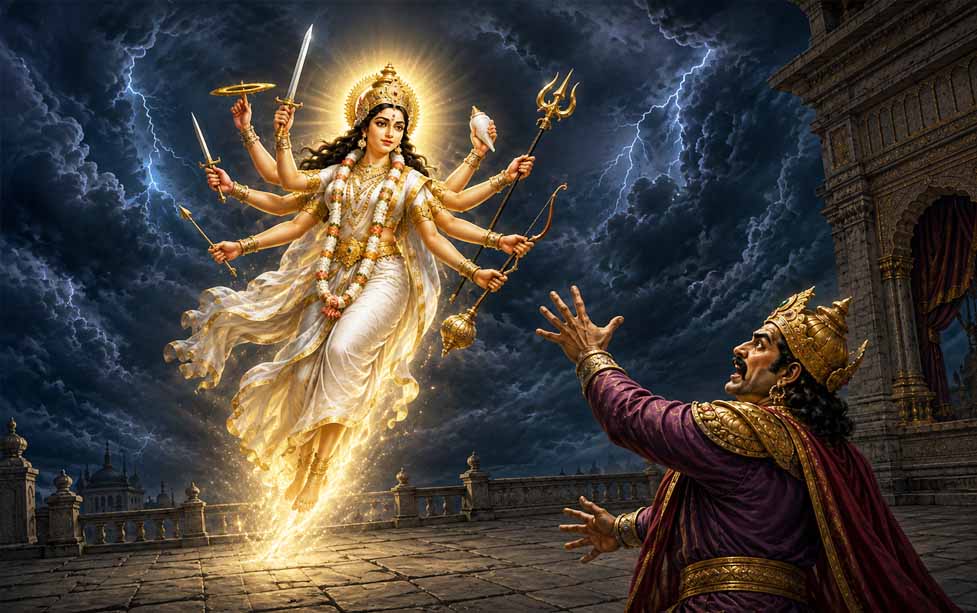
Tune in on Spotify for a deeper exploration of this story in Hindi & English.

Kansa killed six of his sister's children to escape a prophecy. The seventh slipped past him too. But the eighth birth brought a goddess who slipped through his fingers that same night, and she would outlast him in ways he never saw coming.

Kansa, the tyrant king of Mathura, had heard a voice from the sky. It told him that the eighth child born to his sister Devaki would end his life. Fear turned him into a jailer. He locked Devaki and her husband Vasudeva away and killed each child as it was born, one after another, until six were gone.
The seventh survived only because he was mystically transferred to another womb. He would grow up as Balarama.
The eighth was Krishna. And on the night of his birth, Vasudeva carried him out of the prison through a storm, crossed a swollen river, and left him in the care of Nanda and Yashoda in Gokul. In his place, Vasudeva brought back a newborn girl, born that same night to Yashoda.
Kansa was never meant to find this child. But he did.
A Newborn Snatched From Yashoda’s Arms
Word reached Kansa that Devaki’s eighth child had been born. He stormed into the prison and seized the infant girl from her cradle, certain this was the one the prophecy had warned him about.
Devaki begged him to spare her. He didn’t listen. He gripped the child by the legs and swung her toward a stone slab, intending to end her life the way he had ended six before her.
The child slipped from his hands.
The Goddess Who Rose Into the Sky
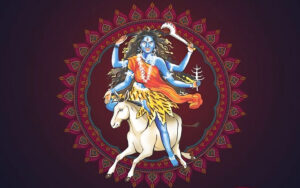
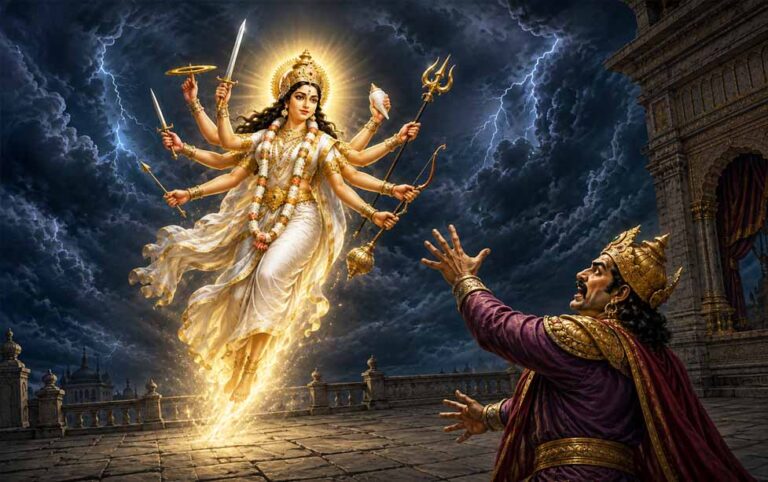
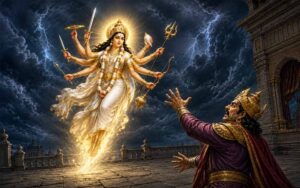
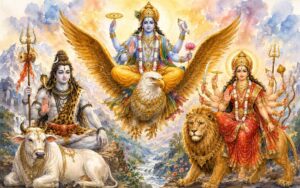
She did not fall. She rose, and as she rose, the infant’s form dissolved into something else entirely. Where a baby had been a moment earlier stood a radiant, many-armed goddess, garlanded, armed, and glowing with a light that filled the prison hall.
She told Kansa plainly that his killer was already alive and safe elsewhere, beyond his reach. Then she vanished into the sky, and the Bhagavata Purana adds a detail worth pausing on: it says she came to be worshipped afterward under many different names, in many different places.
That single line is the seed of everything that follows.
Not Yet “Vindhyavasini”: What the Bhagavata Actually Calls Her
Here’s where the story most people don’t get told clearly: the Bhagavata Purana and the Vishnu Purana, the two texts that narrate this scene, do not name this goddess Vindhyavasini. In these texts, she is called Yogamaya, or Nidra, Vishnu’s own power of cosmic illusion, personified as a goddess and sent to protect Krishna by taking his sister’s place. She’s presented as an instrument of Vishnu’s plan, not as an independent deity with her own separate legend in that moment.
The Devi Bhagavatam, a text with a Shakta rather than Vaishnava lens, tells the same core event but gives Yogamaya far more independent stature, treating her less as an extension of Vishnu’s will and more as Devi acting in her own right. Both readings exist in the tradition. Neither cancels the other out; they simply come from texts with different theological centers of gravity.
How a Vindhya Goddess Entered Krishna’s Story
Vindhyavasini, “she who dwells in the Vindhyas,” is the name of a goddess worshipped for centuries at a temple near the Vindhya mountain range, in present-day Mirzapur. Her story predates any clean link to Krishna’s birth story. Over time, largely through that one open-ended line in the Bhagavata about the goddess being worshipped under many names, later tradition folded the Vindhya goddess into the same identity as Yogamaya from Krishna’s birth night.
This kind of merging is common across Puranic literature. Regional goddesses were often absorbed into the pan-Indian narrative by identifying them with a figure from a more widely known story. It doesn’t make the connection false, exactly, but it does mean the link is a later theological interpretation layered onto the text, not something the Bhagavata or Vishnu Purana states outright.
One Goddess, Three Names
The layering doesn’t stop with Vindhyavasini. In temple traditions tied to Jagannath Puri, Krishna and Balarama are worshipped alongside a third sibling figure named Ekanamsha, and some traditions identify her with this same escaped goddess from the birth-switch story.
So depending on which text or tradition you’re reading, the goddess who slipped from Kansa’s hands is called Yogamaya, Nidra, Vindhyavasini, or Ekanamsha. Some traditions treat these as four names for one figure. Others keep them distinct. The source texts themselves were never fully unified on the question, and that’s worth sitting with rather than smoothing over.
FAQ
Who is Vindhyavasini in Hindu tradition?
Vindhyavasini is a goddess associated with the Vindhya mountain range, later identified in tradition with the goddess who appears in Krishna’s birth story in the Bhagavata Purana.
Is Vindhyavasini connected to Krishna’s birth story?
The connection comes from later tradition, not the Bhagavata Purana itself. The text names the goddess in that scene as Yogamaya or Nidra; the identification with Vindhyavasini developed afterward.
Why does Kansa’s plan fail in the Bhagavata Purana?
Kansa kills Devaki’s first six children and seizes the seemingly eighth-born infant, but the child he seizes is not Krishna. She is a goddess sent to protect him, and she escapes before he can harm her.
Is Yogamaya the same as Vindhyavasini?
In some traditions, yes. In the source texts, they are not explicitly equated; the identification is a later theological development, and some traditions keep the two distinct.
Kansa spent a lifetime chasing a shadow he could never catch. His hands closed on nothing. Above the stone where a small body was meant to break, a goddess rose into the dark instead, gone before his fingers remembered they were empty.
Jai Maa 🙏💐