
 By
By 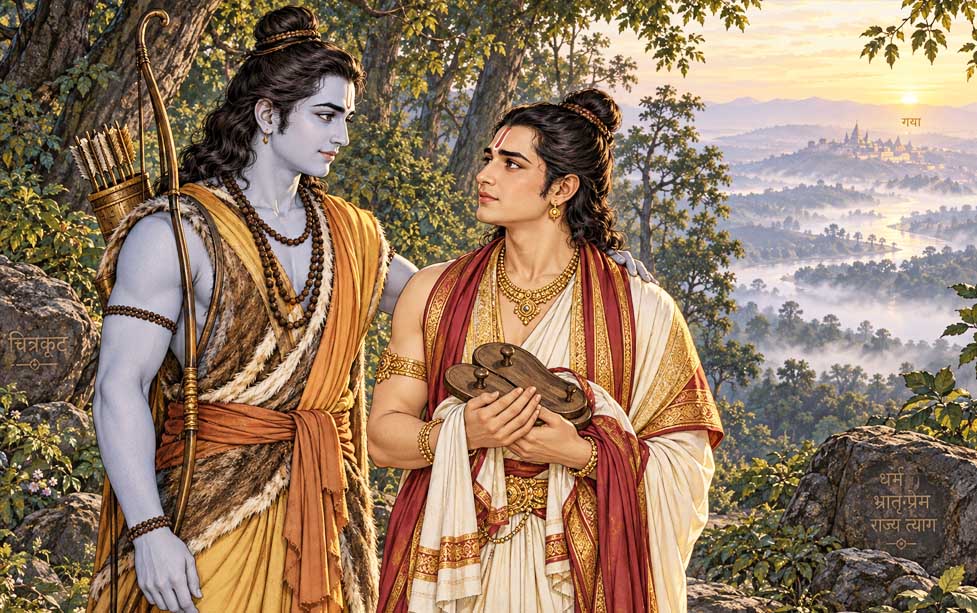
Tune in on Spotify for a deeper exploration of this blog in Hindi and English.

In a forest at Chitrakuta, Rama once quoted a verse about a king named Gaya, tying pind daan to a son's duty. A Purana later told of an asura by the same name, whose body became the very ground where pind daan is offered today.
What does the Ramayana say about Gaya?
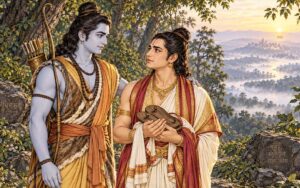
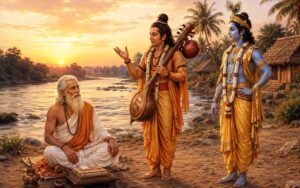
Bharata has walked into the forest to beg his brother to come home. He lays out every argument he can. Their father is gone. The throne is waiting. The kingdom needs its rightful king.
Rama will not move. He is bound by his father’s word, and no grief can undo a promise once given. He tells Bharata to return to Ayodhya and rule in his place.
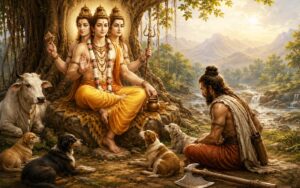
Then, to make his point land, Rama reaches for an old verse. A king named Gaya once performed a sacrifice at a place that came to share his name, and in honour of his ancestors he sang these lines. A son is called putra, the verse says, because he rescues his father from a hell called Put. So a wise man wishes for many good sons, since it takes only one of them, at the right time, to travel to Gaya and set his forefathers free.
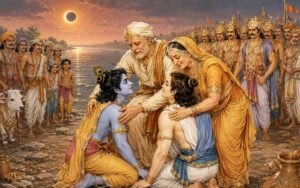
Rama is not planning a trip. He is reminding Bharata of something older and heavier than any single choice they face: a son’s duty to his father does not end at the father’s death. Already in this epic, centuries before any temple stood there, Gaya is the place where that debt gets paid.
What does the Mahabharata say about Gaya?
Years later, the Pandavas are in exile, and grief has followed them into the forest. The sage Dhaumya tries to comfort them by describing the sacred geography of the land, region by region, as if laying out a map of where sorrow can be set down.
When he reaches the east, he speaks of a hill called Gayasira. Growing there is a banyan tree the Brahmanas call eternal, because whatever food is offered to the ancestors beneath it never runs out. It keeps giving, season after season, the way a well-kept memory does. Beside it runs the river Phalgu, its waters counted among the most sacred in the land.
The Pandavas do not just hear about this place. Later in their long pilgrimage, they walk to it. They arrive in a region consecrated by a royal sage named Gaya, and find there the same hill Gayasira, along with a river called Mahanadi flowing through it.
Notice what the epic does not say. There is no asura here, no cosmic sacrifice on a demon’s back. In both the Ramayana and the Mahabharata, Gaya is simply the name of a righteous king whose devotion made the ground sacred. That is the older layer of the story.
Who was Gayasura in the Vayu Purana?
The Puranas tell a stranger and grander story, and it belongs to a different Gaya altogether.
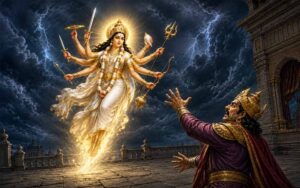
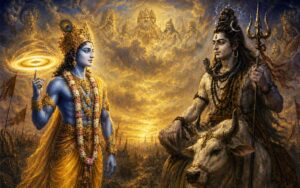
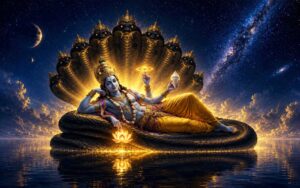
In this account, Gaya is not a king. He is an asura, gigantic beyond imagining, and he undertakes a penance so intense that it begins to unravel the balance of the three worlds. Heaven grows crowded. The realm of the dead sits empty, because souls no longer need to go there. The gods panic and rush to Brahma, and Brahma, unsure how to fix what a demon’s devotion has broken, takes them all to Vishnu.
Related story: The Legend of Gaya: How Vishnu’s Blessing Turned a Demon into Sacred Earth
Vishnu’s solution is strange enough to remember. He tells Brahma not to fight Gayasura, but to ask him for something impossible: his own body, offered up as the ground for a sacrifice. Gayasura, true to his nature, agrees without hesitation. He lies down, and his enormous form becomes the site itself. Brahma begins the yajna upon him.
But something will not settle. Even after the rites are underway, Gayasura’s body keeps stirring, restless, as if the sheer scale of what is happening will not let it stay still. A sacrificial post is driven into the ground to anchor him, and still he moves. It takes Vishnu himself, pressing down with his mace, to finally hold him in place. From that moment, Vishnu is remembered there as Gadadhara, the mace-bearer.
Gayasura asks for only one thing in return: that the land carry his name forever. And so it does. Tradition even maps his body onto the landscape, his head resting at Gaya, his navel far off at Viraja mountain, his feet at Mahendra mountain, as though the whole region were built from a single act of surrender.
Why do people offer pinda at Gaya?
Pinda are simple offerings, balls of cooked rice given to one’s ancestors as a gesture of remembrance and gratitude. What makes Gaya different is that two very different stories both insist this exact ground is where such offerings matter most.
The epics give it a righteous king and a banyan tree whose gifts to the dead never run dry. The Purana gives it something even larger: a demon’s entire body, laid down and made permanent by a god’s own foot. Between them, Gaya becomes a place where duty to one’s ancestors is not just a private ritual, but something woven into the land itself.
That memory still stands in stone. At the Vishnupada Temple, pilgrims gather around a footprint pressed into rock, said to mark the very spot where Vishnu once stood to still Gayasura’s trembling form. People do not just remember the story here. They can walk up and touch where it supposedly happened.
Did Sita offer pinda at Gaya?
This is the story most visitors to Gaya hear first, and it is also the one built on the shakiest ground. It does not appear in Valmiki’s Ramayana at all.
The popular telling goes that Rama and Sita stopped at Gaya to perform the rites for Dasharatha, and that in the process Sita cursed the river Phalgu, which is why it appears to run dry and flows instead beneath the sand. It is a beautiful story, and it is deeply loved at Gaya. But it belongs to later tradition and local memory, not to the epic itself.
FAQ
Is Gaya mentioned in the Ramayana?
Yes. In the Ayodhya Kanda, Rama quotes King Gaya’s verse about sons, the hell called Put, and going to Gaya.
Is Gayasura in the Mahabharata?
Not in the passages about Gaya. Those name a royal sage, the hill Gayasira and the Phalgu. Gayasura’s story comes from the Vayu Purana.
Where is Gaya?
Gaya is in Bihar, on the banks of the Phalgu.
When is pinda daan offered in 2026?
During Pitru Paksha. Some panchangs begin it on 26 September and others on 27 September, and it ends on Sarva Pitru Amavasya, Saturday 10 October 2026.
Two stories, one river. A king gave Gaya its name in the epics, and an asura gave it his body in the Purana.
Every autumn, a son still walks to the Phalgu with rice in his hands and a name on his lips.

A beautiful verse, celebrating the love and respect for father, in life and beyond 🙏