By
By 

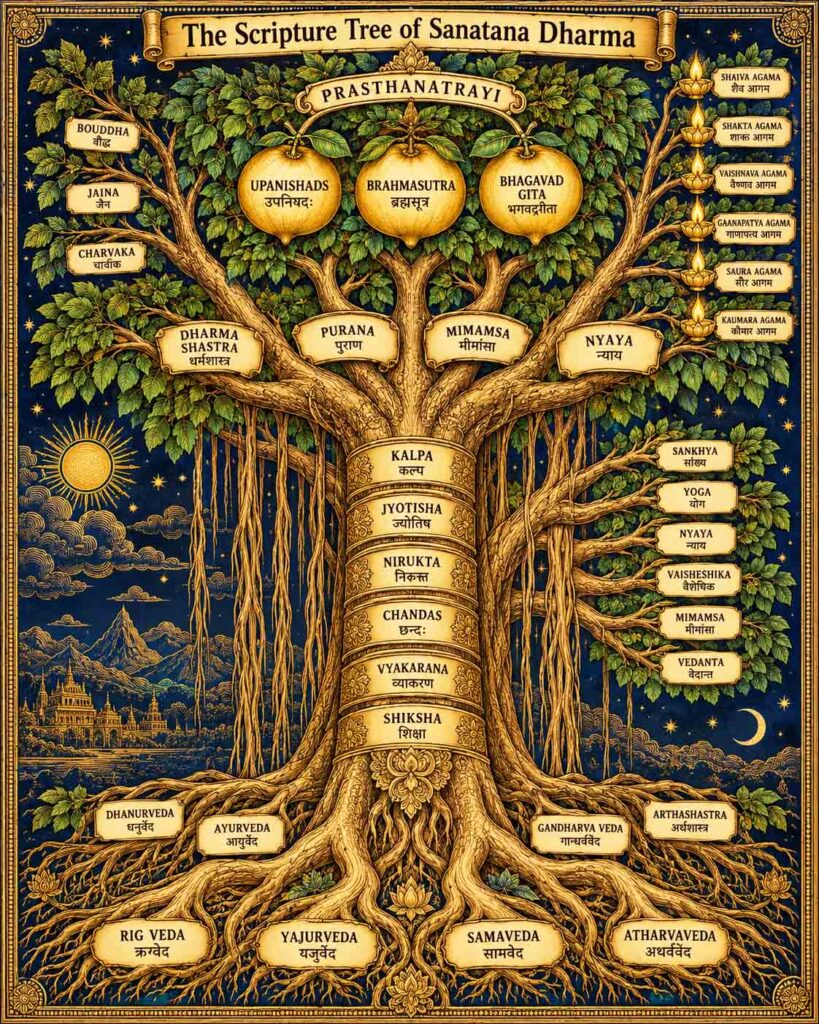
In the Abrahamic religions, each faith is tied to a single book, and the same shortcut is quickly applied to Hinduism: the Bhagavad Gita is “the book” of the Hindus. It is a very limited view. In the Sanatan world, the Gita is one branch of a far larger tree of knowledge, and this is the map of that tree.
Why is the Bhagavad Gita not the only scripture of Hinduism?
The Gita has 18 chapters and about 700 verses. It sits inside the Mahabharata, in the Bhishma Parva, and that epic runs to roughly 100,000 verses. The Gita is a conversation on a battlefield between Krishna and Arjuna, placed at the moment Arjuna’s resolve breaks.
It is also one of three foundational texts of Vedanta, which is only one of six classical schools of philosophy. Above the Gita stand the Upanishads and the Vedas. Around it stand the law codes, the epics, the Puranas and the temple traditions.
Hinduism has no single book that speaks for the whole tradition. It has layers, and each layer does a different job. The clearest way to see them is as a tree.
What are the four Vedas?
The Vedas are the roots. They are the Rig Veda, Yajurveda, Samaveda and Atharvaveda, and tradition calls them Shruti, “what was heard,” because they are held to be revealed rather than authored.
Each Veda is built in four layers.
The Samhita holds the hymns and mantras.
The Brahmanas explain the rituals.
The Aranyakas, the forest texts, turn ritual inward.
The Upanishads close each Veda with philosophical inquiry.
This is why Vedanta is called “the end of the Veda.”
The Rig Veda is the oldest, with over a thousand hymns arranged in ten books.
The Yajurveda holds the sacrificial formulas in prose and verse, and it comes in two divisions, Shukla (white) and Krishna (black).
The Samaveda sets verses, most of them drawn from the Rig Veda, to melody, and it is regarded as the root of Indian music.
The Atharvaveda holds hymns for healing, protection, home life and kingship.
Each Veda is linked to an Upaveda, a practical science. These are Ayurveda (medicine), Dhanurveda (warfare and archery), Gandharva Veda (music and performing arts) and Arthashastra (statecraft). The pairings vary by source. The Prasthanabheda of Madhusudana Sarasvati links Ayurveda with the Rig Veda and Dhanurveda with the Yajurveda. Other lists reverse the two.
What are the six Vedangas?
The Vedangas are the limbs of the Veda. A text preserved by voice needs discipline, and these six sciences supply it. Together they ensure the Veda is pronounced, parsed, chanted, understood and performed correctly.
Shiksha covers phonetics, the exact sound of each syllable.
Vyakarana covers grammar, and its towering work is Panini’s Ashtadhyayi, a system of about 4,000 compact rules.
Chandas covers meter, and Pingala’s treatise is its classic.
Nirukta covers etymology, the study of what Vedic words mean, and Yaska is its great voice.
Jyotisha covers astronomy and the timing of rituals, and the Vedanga Jyotisha is its oldest text.
Kalpa covers ritual procedure through the Shrauta, Grihya, Dharma and Shulba Sutras. The Shulba Sutras even record geometry used to build altars.
What are the four Upangas?
If the Vedangas protect the Veda, the Upangas carry it into daily life. The traditional list is Dharma Shastra, Purana, Mimamsa and Nyaya, as given in the Yajnavalkya Smriti.
Dharma Shastra holds the Smritis, the “remembered” texts, including those of Manu, Yajnavalkya and Parashara. They deal with duty, law, family and society. Tradition holds that different Smritis guide different ages, and it names Parashara’s for the present one.
The Puranas comprise 18 Mahapuranas and 18 Upapuranas, though the Upapurana lists vary by source. Classically a Purana speaks of five themes: creation, re-creation, genealogies, the cycles of the Manus and dynastic histories. In practice they hold much more, including stories of the deities, pilgrimage, ritual and cosmology. Beside the Puranas stand the two Itihasas. The Valmiki Ramayana has seven kandas and about 24,000 verses. The Mahabharata is the longest epic in the world. Together they are the epic record of a living civilization, and they keep dharma alive through story rather than rule.
Mimamsa supplies the rules for interpreting the Vedic text, and Nyaya supplies the rules of logic and valid reasoning. Both also grew into full darshanas, which is why they appear again below.
What are the six Astika Darshanas?
Darshana means “vision” or “way of seeing.” These six schools accept the authority of the Vedas, and each asks a different question about reality. Each is anchored by a foundational text and a traditional founder.
Nyaya traces to Gautama and asks how we know anything at all. It names four sources of valid knowledge: perception, inference, comparison and testimony.
Vaisheshika traces to Kanada and sorts the world into categories, with an early atomic theory.
Sankhya traces to Kapila and divides reality into Purusha (pure consciousness) and Prakriti (matter and nature).
Yoga is codified in Patanjali’s Yoga Sutras and lays out the eight limbs of disciplined practice, of which posture is only one.
Purva-Mimamsa traces to Jaimini and studies Vedic ritual and duty.
Uttara-Mimamsa, or Vedanta, traces to Badarayana and his Brahmasutra, and it asks what the ultimate reality is.
Vedanta stands on three texts called the Prasthanatrayi:
the Upanishads (the scriptural base),
the Brahmasutra (the logical base) and
the Bhagavad Gita (the remembered, Smriti base).
This is where the Gita truly belongs. The great Vedanta teachers wrote commentaries on all three, and those commentaries gave rise to the major schools of Advaita, Vishishtadvaita and Dvaita.
What are the non-Vedic Darshanas?
Three schools stand outside Vedic authority: Bauddha, Jaina and Charvaka. They are called Nastika, meaning they do not accept the Vedas as authoritative. The word does not mean “atheist” here.
Bauddha rests on the teachings of the Buddha, preserved in the Tripitaka.
Jaina follows a line of 24 Tirthankaras, the last being Mahavira, and has its own canon and a deep ethic of non-violence. Both are living traditions with vast literatures.
Charvaka, also called Lokayata, is a materialist school traditionally attributed to Brihaspati. It accepted only perception as valid knowledge. Its own texts are lost, and it survives mainly through the arguments of its critics.
Why does the Sanatan tradition make room for schools that reject the Vedas?
Look at what this tree contains. Its own map of knowledge includes schools that deny the authority of its foundational texts. Bauddha, Jaina and Charvaka were not erased. They were named, argued with and preserved, often in the very works written to refute them. Charvaka survives today largely because its opponents took it seriously enough to record it.
This shows that Sanatan philosophy has space for thought that opposes or differs from the Vedic view. Debate was treated as part of the tradition’s method, not as a threat to it. Few religious traditions have built their dissenters into their own map of knowledge this way.
What are the Agamas and the six worship traditions?
The Agamas are the texts behind living temple worship. They govern the building of temples, the consecration of images, daily ritual, mantra, festival and personal sadhana. If the Vedas are the roots, the Agamas are why a temple bell rings the way it does today.
The major streams are Shaiva, Vaishnava and Shakta. The Shaiva Agamas are traditionally counted as 28. The Vaishnava stream includes the Pancharatra and Vaikhanasa Agamas, and the Shakta stream is closely tied to the Tantras.
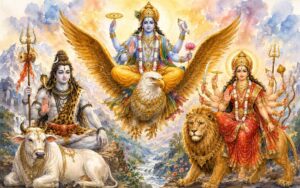
Tradition also names six paths of worship, known as the Shanmata and traditionally linked to Adi Shankara: Shaiva, Vaishnava, Shakta, Ganapatya, Kaumara and Saura. They center on Shiva, Vishnu, Devi, Ganesha, Kartikeya and Surya.
None is ranked above another. Each is a complete road to the same summit.
FAQ
Is there one holy book in Hinduism?
No. The tradition rests on many texts across several categories, with the four Vedas as its foundation.
Is the Bhagavad Gita the only scripture of Hinduism?
No. It is part of the Mahabharata and one of the three Prasthanatrayi texts of Vedanta, alongside the Upanishads and the Brahmasutra.
How many Vedas are there?
Four: Rig, Yajur, Sama and Atharva.
What are the four parts of each Veda?
The Samhita, Brahmana, Aranyaka and Upanishad.
What is the difference between Shruti and Smriti?
Shruti, “what is heard,” refers to the Vedas. Smriti, “what is remembered,” covers texts such as the Dharma Shastras and the Itihasas.
What are the six Vedangas?
Shiksha, Vyakarana, Chandas, Nirukta, Jyotisha and Kalpa. They are the auxiliary disciplines for understanding and performing the Vedas.
What are the six Astika Darshanas?
Nyaya, Vaisheshika, Sankhya, Yoga, Purva-Mimamsa and Uttara-Mimamsa (Vedanta).
What is the Prasthanatrayi?
The three foundational texts of Vedanta: the Upanishads, the Brahmasutra and the Bhagavad Gita.
Are Buddhism and Jainism part of the Vedic tradition?
No. They are classed as non-Vedic darshanas, though they grew up in the same intellectual world.
Does Sanatan philosophy accept ideas that reject the Vedas?
It engages with them. Bauddha, Jaina and Charvaka are classed as Nastika darshanas, and the tradition debated, recorded and preserved them rather than suppressing them.