
 By
By 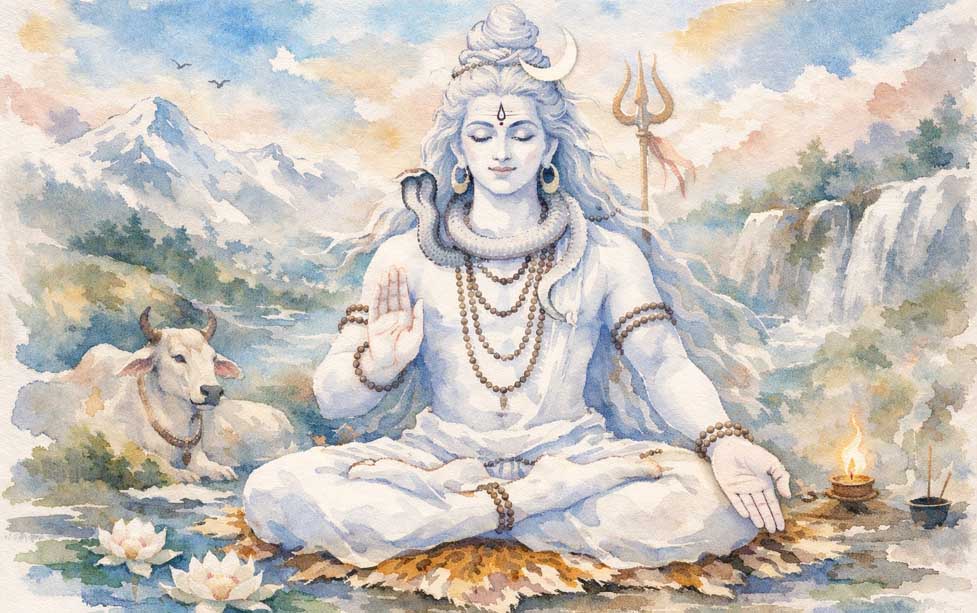
Tune in on Spotify for a deeper exploration of this blog in Hindi and English.

What the Karpura Gauram mantra reveals about the true nature of Shiva.
There is a small mantra chanted at the close of every Shiva aarti, in temples and homes across the subcontinent. Most people repeat it by heart, following the rhythm of the bells. But if you pause with any single phrase, you find that the whole theology of Shaivism is compressed inside it, the way a seed contains the blueprint of a forest.
कर्पूरगौरं करुणावतारं संसारसारम् भुजगेन्द्रहारम् ।
सदावसन्तं हृदयारविन्दे भवं भवानीसहितं नमामि ॥
“I bow to Shiva — pure as camphor, the very incarnation of compassion, the essence of existence, wearing the king of serpents as his garland — who dwells eternally in the lotus of my heart, together with Bhavani.”
The first word, Karpūra-gauram, is a revelation in itself. Camphor-white. Not fair-skinned, not pale, but camphor. The choice is deliberate and precise: camphor burns completely. It leaves no ash, no residue, no trace of itself. It disappears entirely into light and fragrance. That, the mantra says, is the true colour of Shiva. Not the ash-smeared, blue-throated, three-eyed terror we see in iconography, but a pure luminosity that leaves nothing of the ego behind.
So who, then, is the terrifying figure on the mountaintop?
The God With Two Faces, But Only One Truth
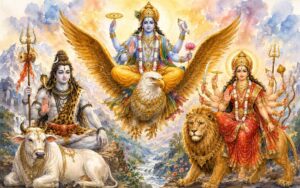
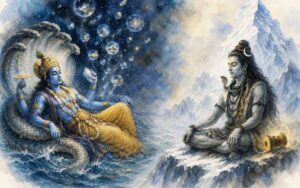
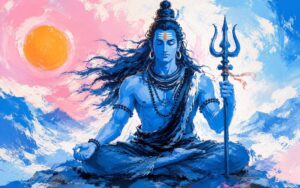
Shiva’s outward appearance is almost a deliberate provocation. He is matted-haired where other gods are groomed. He is ash-smeared where others are anointed with sandalwood and gold. He lives in a cremation ground, the smashan, while Vishnu rests on a celestial ocean and Brahma sits on a lotus. He wears no crown. He rides a bull, not a chariot. And coiled around his neck, instead of a garland of flowers, is a living serpent.
The inner reality: Karpūra-gauram: White as camphor
Pure, egoless consciousness. Compassion incarnate. The still centre of all existence. Untouched by the world he sustains.
The outer projection: Rudra: The howling one
Ash-smeared, serpent-garlanded, wild-eyed. The face the cosmos shows to those who approach existence without surrendering the ego.
This duality is not contradiction; it is teaching. The cremation ground ash he wears on his body is a constant reminder: everything you cling to will burn. Your body, your pride, your possessions, your identity, all of it ends in ash. The god wears that ash so that you never forget. His appearance is not what he is. It is what he wants you to see.
Within, the mantra insists, he is camphor-white. He is karuṇāvatāraṁ, compassion itself, descended into form.
The Sacrifices That Define Him
No figure in Hindu cosmology gives more of himself for the sake of others than Shiva. He is a continuous act of absorption: of poisons, of forces, of the unbearable, so that the world may continue. Each sacrifice is not a story of martyrdom but a demonstration of what pure, egoless consciousness actually does when confronted with the world’s suffering.
Drinking the Hālāhala: The Poison of the Universe
When the gods and demons churned the cosmic ocean for the nectar of immortality, the first thing that emerged was not nectar. It was Hālāhala, a poison so destructive it threatened to annihilate all creation. Both gods and demons fled from it. No one would touch it. Shiva alone stepped forward, held the poison in his throat, and refused to swallow it further, protecting the world at the cost of his own throat turning permanently blue. He became Nīlakaṇṭha, the Blue-Throated One. This is not just a puranic story. It is a statement: the one who has no ego, who has nothing to gain or lose, is the only one capable of bearing the unbearable for others. […more details here…]
Bearing the Ganges: Absorbing What Would Destroy the World
When the sage Bhagiratha brought the celestial river Ganga down from the heavens, her force was so immense it would have split the earth apart. Shiva received her in his matted hair, letting her cascade slowly and safely from lock to lock before releasing her gently onto the plains. He did not command the Ganga; he contained her. His body became the instrument of her taming. The god who is the ascetic of ascetics, with nothing and wanting nothing, becomes a vessel of grace, literally absorbing a force that would otherwise cause catastrophe. […more details here…]
Wearing the Cursed Moon: Embracing the Fallen
The moon, Chandra, was cursed by the god Daksha to wane and fade as punishment for his arrogance and favoritism among his twenty-seven wives. No one would shelter him. Shiva placed the diminished, disgraced moon on his own head, offering him refuge and dignity. Every time you see the crescent moon in Shiva’s matted hair, you are seeing an act of shelter extended to the outcast. Shiva does not surround himself with the powerful, the beautiful, and the successful. He wears the cursed moon. He lets wandering ghosts sit at his court. He listens to the marginalized. This is karuṇā: not sentiment, but active, unconditional compassion. […more details here…]
The Ascetic Life: Renouncing What Gods Cling To
Among the trinity, Brahma creates and Vishnu sustains. Both inhabit magnificent celestial realms adorned with jewels and attendants. Shiva sits on Mount Kailash with almost nothing. No palace. No ornaments except what the cosmos has cast off: serpents, a skull, ash, a hide. He is the Mahāyogi, the great ascetic, not because he is indifferent to creation but because he is utterly free from it. The mantra says he is saṁsāra-sāram, the very essence of worldly existence, yet he lives beyond its pull. He is the ground of all things, but not enslaved by any of it. That is the paradox of liberation he embodies.
The Serpent Garland: Time Around His Neck
The Bhujagendra-hāram, the king of serpents worn as garland, is perhaps the most philosophically dense image in all of Hindu iconography. The serpent Vasuki, king of the Nāgas, coils around Shiva’s neck, awake and alive. In most traditions, serpents symbolize time, death, and the cycles of creation and dissolution. To wear one as a garland is to be entirely at ease with impermanence, to have made peace with the fact that everything arises and passes away.
Most beings flee from the serpent. The devotee flinches at the thought of impermanence. Shiva wears it as an ornament. He does not control time by fighting it; he controls it by being its ground, the awareness in which time moves but which is not itself moved.
Shiva and Bhavani: The God Who Is Incomplete Alone
The mantra closes with a crucial phrase: Bhavānī-sahitam, together with Bhavani, his consort Parvati. Shiva is never worshipped as complete without Shakti, the divine feminine principle. Pure consciousness without energy is inert. Energy without consciousness is blind. Together, they are Ardhanārīśvara, the god who is half woman, an image of such radical completeness that it dissolves the very boundary between masculine and feminine at the level of ultimate reality.
Parvati herself is remarkable in this context. She was the one who pulled Shiva, the eternal ascetic lost in meditation, back into the world of relationship, responsibility, and love. She is not merely his consort. She is the force that makes his compassion active rather than merely potential. In the mantra’s final image, the camphor-white, serpent-garlanded, heart-dwelling god is always seen beside her.
Dwelling in the Heart’s Lotus
Perhaps the most quietly radical line in the mantra is hṛdaya-aravinde sadā vasantam, who dwells eternally in the lotus of the heart. After all the cosmic imagery, the poison throat, the Ganges in the hair, the serpent garland, the mantra does not end with Shiva sitting on a remote mountain or reigning in an unreachable heaven. He is said to live inside the devotee’s own chest, in the heart-lotus.
This is the non-dual heart of Shaivism: the terrifying, ash-smeared, camphor-pure, all-compassionate god is not elsewhere. He is the witness-consciousness that sees through your eyes, the stillness beneath your thoughts, the awareness that remains when everything else falls away. The cremation-ground god is already inside you, already watching the ash of your passing thoughts drift by, already unchanged.
The mantra is not, in the end, a petition sent outward to a distant deity. It is a recognition, a turning of awareness inward, toward the pure light that was always already there.
Shiva is a paradox. Shiva’s path is the path of pathlessness. It is not possible to define or understand Shiva. One needs to expereince Shiva.
One can either be a Shav (corpse) or Shiva!
“He who is pure within is seen as terrible without, because the unprepared cannot approach pure light without being undone by it.”
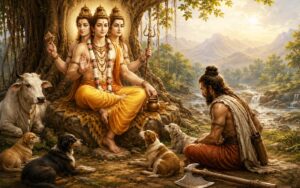
The ultimate truth, Shivoham 🙏
An outstanding piece 🙏