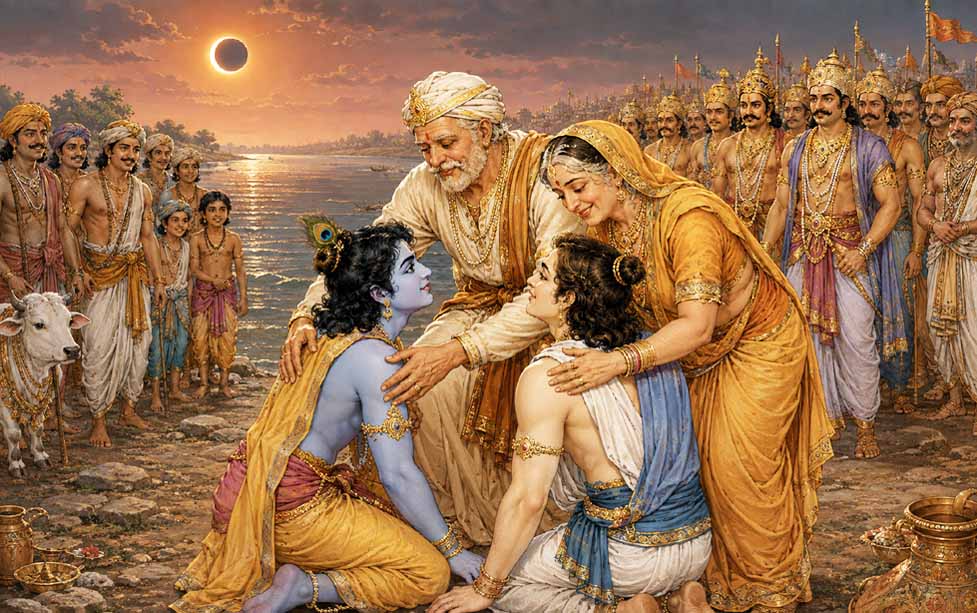
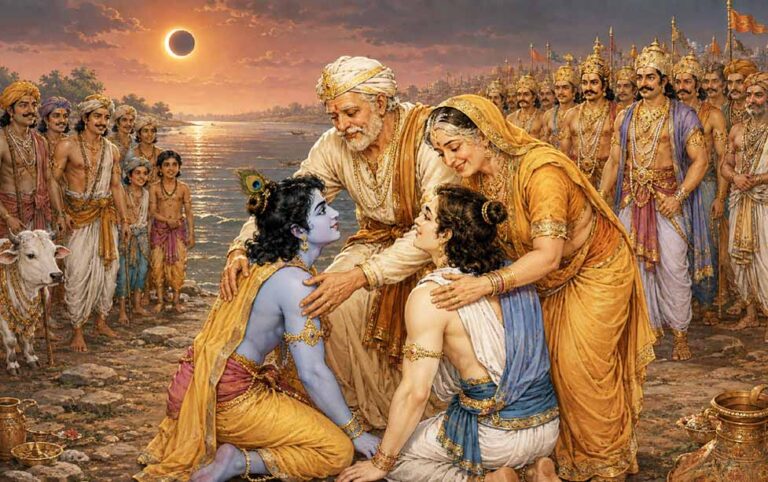
A total solar eclipse was inauspicious by tradition, the kind of day people spent indoors, waiting for the sky to right itself. But this eclipse carried a different reputation. Rituals performed during it, prayers offered at the right sacred site, were believed to carry weight far beyond an ordinary day. Kurukshetra, on the banks of the Sarasvati, was one such site, and word of the eclipse spread the way news does before a festival, reaching royal courts and cattle pastures alike.
Neither group setting out for Kurukshetra knew the other was doing the same.
Two Journeys, One Destination
In Dvaraka, the departure was orderly. Krishna, Balarama, their sister Subhadra, and the extended Yadu dynasty prepared for the pilgrimage the way royalty prepares for anything: chariots readied, retinues assembled, the machinery of a kingdom moving as one body.
In Vrindavana, the departure was something else entirely. Nanda Maharaja gave the word, and the response wasn’t logistics, it was longing finally given somewhere to go. Mother Yashoda, the gopis, the cowherds who had watched Krishna grow from a mischievous toddler into the boy who lifted a mountain, all of them had spent years carrying an ache they rarely spoke of. The eclipse didn’t just give them a ritual to perform. It gave them a reason they could say out loud for wanting to see him again.
When the Caravans Met at the Riverbank
There is a particular kind of chaos that happens when two crowds who have been waiting years for each other suddenly close the distance. That’s what the banks of the Sarasvati became.
Kunti found her brother Vasudeva in the crowd and broke down before either of them could say a proper greeting. The years of separation, the hardship, the not-knowing, it all came out at once. Vasudeva held her and explained what she likely already understood in her bones: none of it had been a choice. Kamsa’s tyranny had scattered them, kept brother from sister, kept a family from being a family. It wasn’t an excuse. It was just the truth, finally said plainly.
Nearby, Rohini and Devaki found Yashoda. There was no formality in it. These were three women bound by the same child, raised in different houses, loved by different mothers, and they came together like people who had been rehearsing this moment for years without knowing it. Devaki and Rohini thanked Yashoda, not with polite words but with the kind of gratitude that only makes sense to another mother: for the nights she’d stayed awake, for the meals she’d made, for loving a child that wasn’t hers to love and doing it without holding back.
Two Kings Kneel Before Their Parents
Then came the moment the whole pilgrimage had been building toward, even if no one had said so.
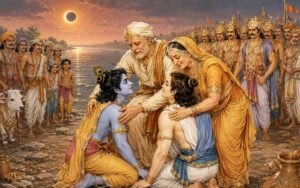
Krishna and Balarama saw Nanda and Yashoda across the crowd. These were two men who had walked into Kamsa’s court and walked out having ended him. Two men who commanded a kingdom, who had faced demons and never flinched. And at the sight of the couple who had fed them, worried over them, waited up for them as children, both of them lost whatever composure a prince is supposed to have.
They fell at Nanda and Yashoda’s feet. Not a formal gesture, not the bow of a king acknowledging an elder. This was something closer to collapse, the body doing what the throat couldn’t. Neither Krishna nor Balarama could speak. Whatever they might have rehearsed on the journey there, whatever they meant to say, none of it came out.
Nanda and Yashoda didn’t wait for words. They reached down, pulled their sons up, and held them the way you hold something you were afraid you’d lost. Yashoda, who had once tied Krishna to a mortar and still worried he’d wandered too far into the forest, now had him in her arms again, grown, powerful, still hers. Whatever distance a throne puts between a mother and a son, it closed in that instant.
What the Gopis Wanted, and What They Didn’t Ask For
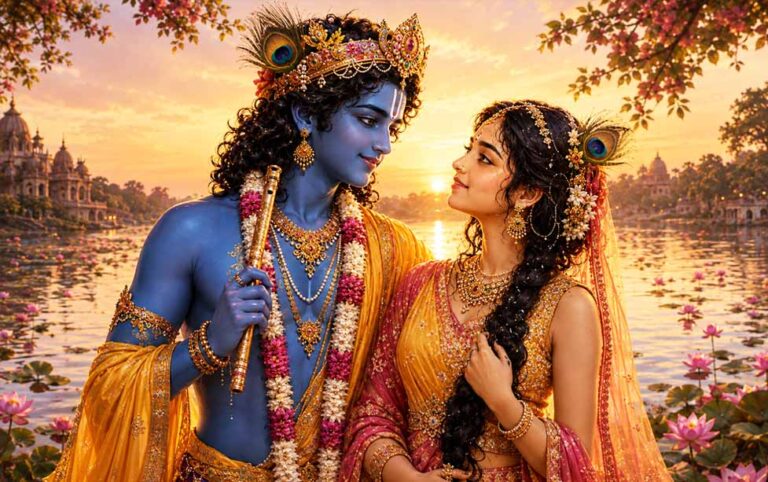
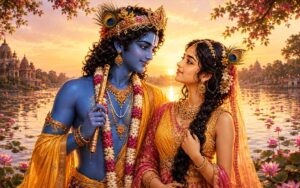
Away from the noise of the main reunion, Krishna found a quieter moment with the gopis. Their grief had always cut deeper than anyone else’s. They hadn’t just lost a friend or a foster son. They’d loved him in a way that left no room for anyone else, and his absence had never really healed, it had just gone quiet.
Seeing him now brought both relief and a fresh wave of the same old sorrow, because they already knew this reunion had an end date. He would leave again. He always did.
Krishna tried to offer them something like comfort, telling them that as the source of everything, he was never truly apart from them, not even during all those years of silence. It’s the kind of answer that sounds complete until you’re the one who has to live inside the missing.
The gopis didn’t ask for a better explanation. They didn’t ask for wealth, protection, or a promise of return. What they wanted was smaller and harder to give: that his presence stay lodged in their hearts, unmoving, whether or not his body was in Vrindavana. And still, they asked him to come home. Not as a king making a state visit. As their Krishna, back where he belonged.
Where the Story Ends
The eclipse passed. The rituals were finished. And the great gathering did what every gathering eventually does: it broke apart. Krishna and Balarama returned to the weight of ruling Dvaraka. Nanda’s people went back to their cattle, their fields, their quieter life. Kurukshetra emptied out, the crowds thinned, and the river kept flowing the way it had before any of them arrived.
But something had happened there that outlasted the eclipse itself. Not a homecoming, not really. Something briefer and, in its own way, harder to let go of.
FAQ
Where does this story appear in the Bhagavata Purana?
It’s told in the Tenth Canto, chapters 81 and 82.
Why was a solar eclipse considered a good time for this meeting?
Eclipses were viewed as inauspicious in general, but also as moments of unusual spiritual potency, when rituals and pilgrimage carried extra merit. That belief is what drew both groups to Kurukshetra at the same time.
Was this the last time Krishna saw Nanda and Yashoda?
The Bhagavata Purana doesn’t record another meeting after this one in the same detail, though it isn’t stated outright as their final encounter.
What is Kurukshetra’s connection to this story, aside from the eclipse?
At this point in the narrative, Kurukshetra is simply the pilgrimage site tied to the eclipse. Its later association with the Mahabharata war comes from a different, later stretch of the timeline.

 By
By