Hiranyakashipu had received one of the most precisely engineered boons in all of Hindu tradition.
He could not be killed by man or beast. Not by day or night. Not inside a building or outside it. Not by any weapon. Not by bare hands. Not on the ground or in the sky.
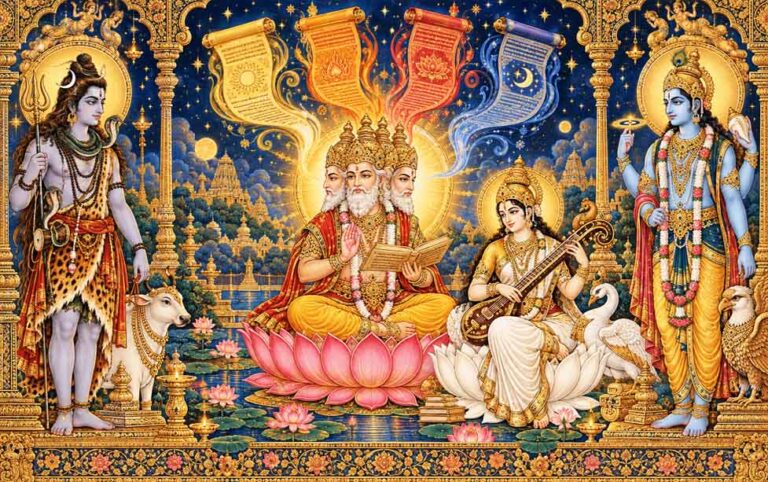
Brahma had granted it. The conditions were airtight.
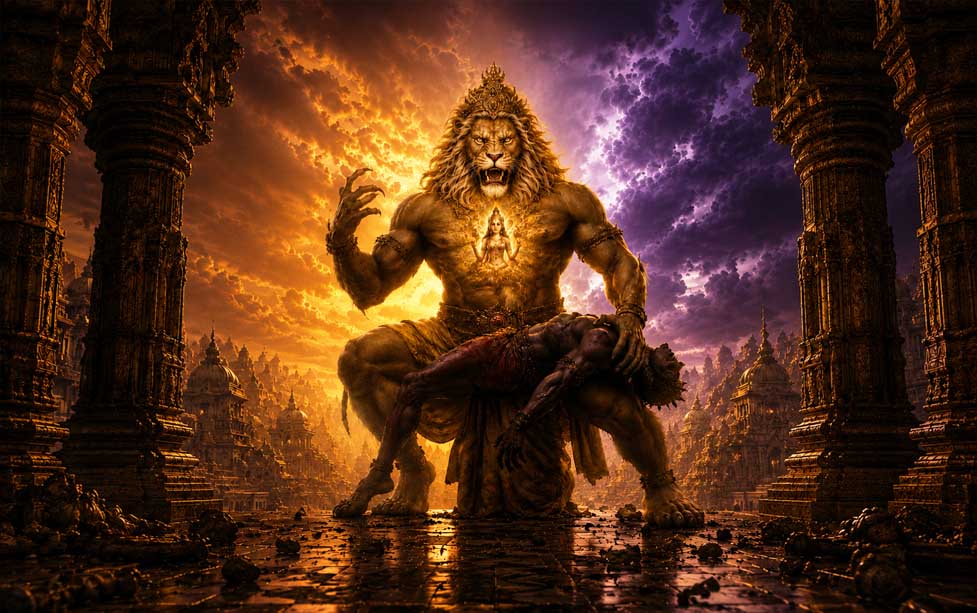
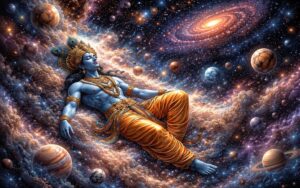
When the devas came to Vishnu with their problem, he already understood the solution. He could see the form he would need to take. Half man, half lion. Neither fully one nor the other. He could see the hour: dusk, the threshold between day and night. He could see the location: the doorway, neither inside nor outside. He could see the method: his own thighs, neither ground nor sky. His nails, neither weapon nor bare hand.
The form existed. What Vishnu did not yet have was the power to hold it.
Why Vishnu Needed the Devi
The Narasimha form is not a costume. It is not Vishnu stepping into a lion mask for the duration of the task.
It is a rupture. A being that the cosmos has no category for, sustained at the exact intersection of every impossible condition simultaneously. To hold that form required an energy that Vishnu alone did not carry.
The Devi Bhagavatam is explicit about this. Vishnu is the preserver. His nature is equilibrium, patience, the long view. The Narasimha event demanded something different. It demanded a force that stands outside every rule, including the rules of form itself.
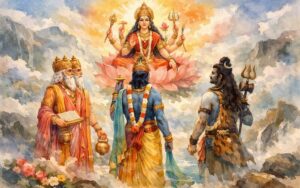
That force was Shakti. Vishnu went to the Devi.
What She Gave Him
She did not hand him a weapon. She did not offer a blessing the way one deity favors another.
She entered him.
The Devi, who the Bhagavatam identifies as Bhuvaneshwari, the one whose body is the world itself, poured her shakti into Vishnu the way fire enters dry wood. She became the energy behind the impossible form. The heat inside the lion throat. The precision inside the claws.
This is the theological core of the Shakta reading. The avatara is not independent of the Devi. It is her instrument. Vishnu provides the intention. The Devi provides the power to execute it.
Without her, the pillar stays whole.
The Killing Was Hers
Narasimha emerged from the pillar at dusk. The roar that came out of him was older than Vishnu’s voice. It came from the place before creation, from the Devi’s own shakti housed inside the lion form.
He carried Hiranyakashipu to the threshold of the palace. He placed the demon king across his thighs at the hour when day no longer holds and night has not yet arrived. He tore open the demon’s chest with his nails.
Related story: Devotion Triumphs Over Evil: The Miraculous Tale of Bhakta Prahlada
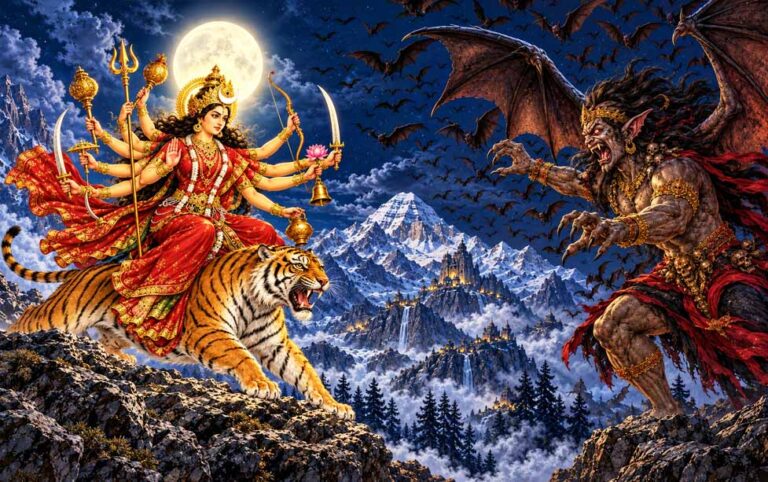
Every condition of the boon was satisfied. Not because Vishnu found a loophole. But because the Devi, who exists outside all conditions, had made the impossible form possible from within.
The Devi Bhagavatam draws the line clearly. The form was Vishnu’s. The strength was hers.
The Rage That Prahlada Ended
When Hiranyakashipu was dead, Narasimha did not return to calm.
He crouched over the body, eyes blazing, and the gods fled. Brahma could not approach. Indra turned back. Lakshmi herself stopped at a distance.
The Shakta telling explains this differently from other Puranas. The fury that kept Narasimha burning after the killing was not Vishnu’s. Vishnu does not rage. The fire still consuming the form was the Devi’s shakti with nowhere left to go. The task was done. The energy had not yet withdrawn.
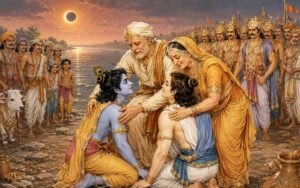
It was Prahlada who approached. A child who had survived his own father’s repeated attempts to kill him. He placed his head against Narasimha’s knee and wept.
The Devi recognized devotion without fear. She drew her shakti back. Narasimha grew quiet. The gods returned.
What This Story Is Actually About
The Devi Bhagavatam uses the Narasimha episode to make a specific argument.
When the three worlds were in crisis and only a god could solve it, that god required the Devi’s power to act. This applies not just to Narasimha but to every avatara. Every intervention that Vishnu makes in the world, the Shakta tradition holds, is downstream of Shakti.
The avatara is the arrow. The Devi is the bow.
This reading does not diminish Vishnu. It locates the source of all divine action in the Devi, which is exactly what the Devi Bhagavatam sets out to do from its opening verse.
Frequently Asked Questions
What is the Devi Bhagavatam?
The Devi Bhagavatam, also called the Devi Bhagavata Purana, is the central scripture of the Shakta tradition. It establishes the Devi as the supreme cosmic principle behind all creation and all divine action.
What makes the Devi Bhagavatam’s Narasimha story different?
Most Puranas present Narasimha as a direct manifestation of Vishnu’s will. The Devi Bhagavatam argues that Vishnu required the Devi’s shakti to sustain the Narasimha form and complete the killing of Hiranyakashipu, making the act ultimately hers.
Who calmed Narasimha after the killing?
In the Shakta telling, the rage that remained after the killing was the Devi’s own shakti still burning inside the form. It was Prahlada’s grief-soaked devotion that drew the Devi back, allowing the fury to subside.
Why did Vishnu need shakti to become Narasimha?
The Narasimha form exists at the intersection of impossible conditions. Sustaining it required a power that transcends the ordinary limits of divine form. The Devi Bhagavatam identifies that power as Shakti, which operates outside every cosmic category.

 By
By