
 By
By 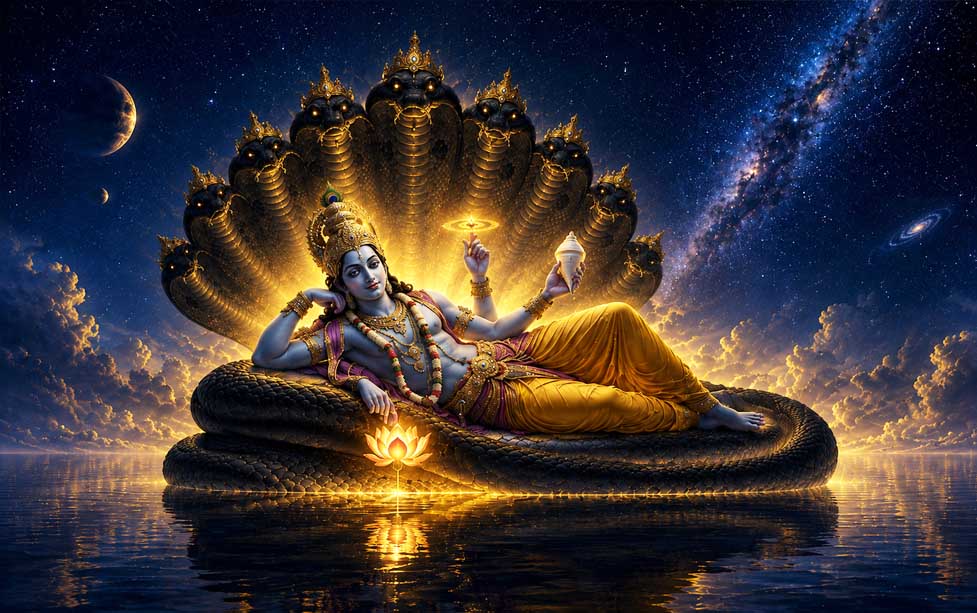
Tune in on Spotify for a deeper exploration of this story in Hindi & English.

Shesha's name means "the one who remains," the eternal serpent who outlasts every cycle of creation, holding up a sleeping universe long after time itself has stopped.

Every yuga ends. Every universe Brahma dreams into shape eventually folds back into stillness. Mountains crumble. Oceans dry. Gods themselves return to the source they came from. But Hindu cosmology insists on one exception. When everything else has dissolved, when creation has been swallowed whole by Pralaya, something still floats on the dark water.
A serpent, coiled, patient, because for him the end of the world is just another moment, not a crisis.
That is the entire idea of Shesha in one image. He is not eternal in the abstract, theological sense people use when they don’t want to explain something. He is eternal in a very specific, almost mathematical sense. Subtract everything else from existence and he is the remainder.
Born Into the Wrong Family
Shesha’s origin story starts ordinarily enough, then turns strange fast.
He was born to Sage Kashyapa and his wife Kadru, one of a thousand serpent sons. His brothers included Vasuki, who would later wrap himself around Mount Mandara during the churning of the ocean, and Takshaka, whose name shows up centuries later in the story of King Parikshit’s death. A family of serpents, prone to pride, rivalry, and the kind of casual cruelty siblings specialize in.
Shesha watched all of it and wanted none of it.
The Puranas describe him growing disgusted with his brothers’ constant scheming and curses against each other. Most stories don’t give their protagonist this kind of disillusionment so early.
Usually the hero has to go through hardship first. Shesha just looked at his own family and decided he’d rather leave.
So he did. He went to the Himalayas and stopped eating. He lived on air alone, the kind of penance that Hindu texts use as shorthand for total renunciation. His body wasted down to almost nothing. He kept going anyway.
What Brahma Offered Him
Tapas this severe doesn’t go unnoticed in Hindu cosmology. Brahma himself eventually showed up.
When a god grants a boon, the receiver usually asks for power, wealth, or victory over an enemy.
Shesha asked for something stranger. He asked for permanent, unshakeable control over his own mind. Not strength over the world. Strength over himself.
Brahma granted it, and then asked a favor in return. The earth needed something to rest on. Would Shesha hold it?
It’s worth sitting with how the story is built. Shesha didn’t seek out a cosmic job. He sought solitude and self-mastery, and the job found him anyway, as a kind of natural consequence of who he had become. He went down into Patala, the netherworld, and took the entire planet onto his hood. He has been holding it since.
The Bed Beneath the Dreamer
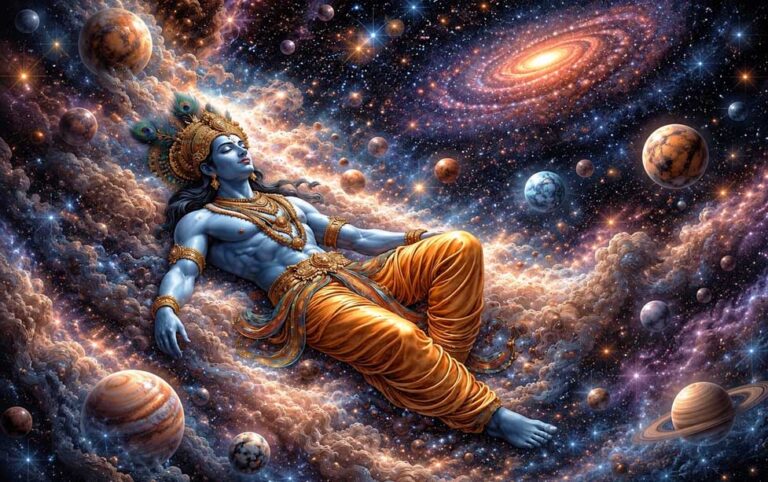
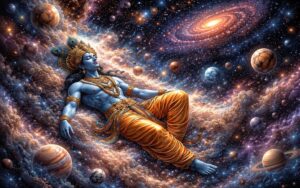
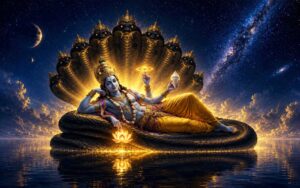
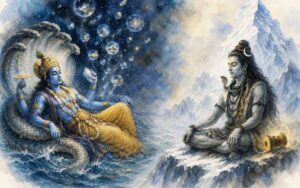
The image most people know Shesha from is different. Not the ascetic in the mountains, but the serpent floating on the Ocean of Milk with Vishnu reclining across his coils, half asleep, dreaming the universe into existence.
This isn’t a decorative detail. It’s the load-bearing structure of Vaishnava cosmology. Vishnu doesn’t rest on water. Water has no shape, no stability, nothing to hold weight. He rests on Shesha, who rests on nothing at all, who simply persists by being the thing that persists.
There’s a quiet logic here that’s easy to miss. Vishnu is the preserver, the one who sustains the universe through its long middle stretch between creation and destruction. But even the preserver needs a foundation. And the foundation isn’t another god. It’s time itself, coiled into serpent form, patient enough to hold a sleeping universe without complaint.
When the Serpent Uncoils, Time Begins
One detail from the tradition deserves more attention than it usually gets. Shesha’s body isn’t static in these stories. He coils and uncoils.
When he stretches out, creation begins. When he draws back into himself, dissolution starts. He isn’t watching time happen from the sidelines. He is, in some real sense, the mechanism of it. Expansion and contraction, the two motions every cycle in the universe seems to repeat, are literally his body moving.
This is where the name stops being poetic and starts being structural.
“The one who remains” doesn’t just mean he survives the end. It means the end and the beginning are both just different positions of the same unmoving figure.
A Reputation That Outgrew One Story
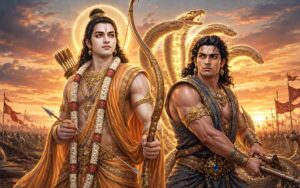
Tradition holds that Shesha didn’t stay confined to one form across the yugas. In Treta Yuga, he is said to have taken birth as Lakshmana, Rama’s brother, whose loyalty asked for nothing in return. In Dvapara Yuga, tradition places him as Balarama, Krishna’s elder brother, associated with the plow, with grounded strength, with the kind of steadiness that doesn’t seek the spotlight. Later tradition extends this further, connecting him to figures like the sage Patanjali, who systemized the practice of yoga.
Worth being clear here: these links come from devotional and sectarian tradition rather than a single unambiguous scriptural statement, and different lineages treat them with different degrees of literalness. But the pattern across all of them is consistent enough to notice. Whatever form Shesha is said to take, it’s never the warrior who claims the throne. It’s always the one standing slightly behind, holding something steady so someone else can act.
The Serpent Inside the Body
Hindu yogic tradition draws one more line from Shesha, this time inward rather than cosmic.
Kundalini, the dormant energy said to lie coiled at the base of the human spine, is described using the same serpent imagery. When it rises through the body’s energy centers, it’s said to awaken toward the Sahasrara, the thousand-petaled crown center. Shesha’s traditional depiction with a thousand hooded heads maps onto this almost too neatly to be accidental.
Read this way, Shesha isn’t only out there, holding up planets in some distant netherworld. He’s also a description of dormant potential inside a person, coiled and waiting, capable of supporting an entire inner universe once it’s recognized.
What the Stillness Is Actually Saying
It would be easy to read Shesha as a passive figure. He doesn’t fight demons. He doesn’t speak in long philosophical verses like Krishna does in the Gita. He just holds things.
But look again at what he holds. A planet. A sleeping god. The gap between one universe ending and the next one beginning. None of that is small work, and none of it would survive a moment of impatience.
Shesha’s entire story argues for a kind of strength that doesn’t announce itself. The world’s weight sits on a being who asked for nothing except mastery over his own mind, and got a planet to carry as a side effect of having earned that mastery in the first place.
Frequently Asked Questions
What does the name Shesha mean?
Shesha means “that which remains.” It refers to his role as the one constant that survives every cycle of creation and dissolution in Hindu cosmology.
Why does Vishnu rest on Shesha Naga?
Shesha forms the resting bed for Vishnu on the cosmic ocean because he represents the stable, eternal foundation beneath the ever-changing universe. Vishnu sustains creation, but Shesha is what makes that sustaining possible in the first place.
Is Shesha Naga the same as Ananta?
Yes. Ananta means “endless,” and it’s used as another name for Shesha, emphasizing the same idea of infinite, unbroken existence.
How is Shesha Naga connected to Kundalini energy?
Yogic tradition compares the coiled, dormant Kundalini energy at the base of the spine to Shesha’s serpent form, and his thousand heads to the thousand-petaled Sahasrara chakra at the crown.
Who were Shesha’s parents and siblings?
He was born to Sage Kashyapa and Kadru, and was the eldest among a thousand serpent sons, including well-known figures like Vasuki and Takshaka.
Shesha never asked to hold up the world. He asked only to master his own mind, and the world followed as a quiet consequence.
Maybe that’s the real lesson coiled inside this serpent: stillness, done completely enough, ends up carrying everything else.
Everything has a consequence.
Every thought word and action.
Every boon curse and….. the state of oneness.
The consequence is already defined, the rest rests in us 🙏
The Shesha Naag story … a beautiful n lucid exposition … “The one who remains” is the main takeaway for me pl …