Banasura ruled Shonitapura as the eldest son of Mahabali and the grandson of Prahlada. He was also Shiva’s devotee, and a sincere one.
During Shiva’s tandava, Banasura used his thousand arms to play instruments for the dance, all at once, and Shiva was pleased enough to grant him a boon.
Banasura asked Shiva to stay and guard his city himself. Shiva agreed.
That should have been the end of a good story. Instead, power went to Banasura’s head. He complained to Shiva that no warrior in the three worlds could match him, that elephants fled at the sight of him, that his arms ached for a real battle.
Shiva warned him plainly: the day his pride broke, he would meet an opponent equal to Shiva himself. Banasura took this as a promise of glory, not a warning.
A Dream, a Portrait, and a Kidnapping
Banasura’s daughter Usha dreamed of a young man with a dark complexion and lotus eyes, dressed in yellow. She woke up in love with someone she couldn’t name. Her friend Chitralekha, gifted in both art and yogic power, sketched portrait after portrait of the Vrishni princes until Usha recognized him: Aniruddha, son of Pradyumna and grandson of Krishna.
Chitralekha didn’t stop at drawing him. She used her powers to bring Aniruddha from Dwaraka to Shonitapura in secret. Usha kept him hidden in her chambers, and for a while, neither of them counted the days. Banasura found out when he walked in on his daughter with Aniruddha and had him bound with Varuna’s mystical ropes.
Word reached Dwaraka through the sage Narada. Aniruddha had been gone four months. Krishna, Balarama, and the Yadava army marched on Shonitapura with twelve akshauhinis and surrounded the city.
Two Gods on One Battlefield
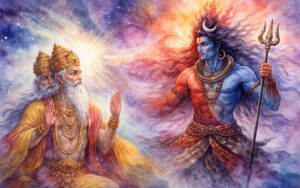
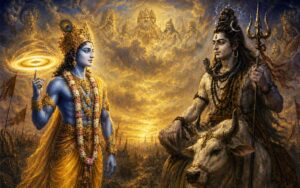
This is where the story stops being a rescue mission and becomes something larger. Shiva had promised to guard Banasura’s city, and he kept that promise. He arrived riding Nandi, with Kartikeya beside him, to fight for his devotee against Krishna.
The battle split across the field. Balarama fought Banasura’s commander. Pradyumna faced Kartikeya and forced him to retreat. Samba took on Banasura’s son. And at the center of it, Krishna and Shiva fought each other directly, weapon for weapon: brahmastra against brahmastra, wind against mountain, fire against rain, until Krishna’s narayanastra met Shiva’s own pashupatastra.
Shiva sent Jvara, the fever born of his own body, three-headed and burning, against Krishna. Krishna answered with a Jvara of his own, cold instead of hot. The two fevers fought until Shiva’s Jvara surrendered and withdrew. Slowly, Shiva’s side gave ground.
Banasura entered the fight himself and rode at Krishna directly. Krishna’s conch shattered his chariot before the two even closed in properly. When Banasura’s mother tried to stop the killing blow by standing before Krishna, he simply looked away and let her son escape into the city, a small mercy in the middle of a war he was clearly winning.
Krishna Cuts, Shiva Asks, Krishna Grants
The final exchange happened at close range. Krishna began cutting off Banasura’s arms one by one, working through the thousand Shiva had granted him. Shiva, watching his devotee lose limb after limb, came back to himself and spoke to Krishna directly. He praised Krishna’s supremacy and asked him not to kill Banasura, reminding him that fearlessness had been Shiva’s own gift to this king.
Krishna answered that he had never intended to kill Banasura. Banasura was Bali’s son and Prahlada’s grandson, and that lineage meant something to him. He stopped the slaughter, leaving Banasura alive with a handful of arms remaining.
What makes this the real center of the story isn’t the war. It’s this exchange. Shiva doesn’t demand anything from Krishna. He extols him. And Krishna, who was never actually trying to destroy Banasura, simply confirms what he’d intended all along. Two gods, ostensibly on opposite sides, turn out to have wanted the same outcome the entire time.
Banasura bowed to Krishna, arranged a wedding chariot for Usha and Aniruddha, and sent them off to Dvaraka with Krishna’s blessing.
FAQ
Why did Shiva fight against Krishna in the Banasura war?
Shiva had granted Banasura a boon earlier, promising to personally guard Shonitapura. When Krishna’s army besieged the city to free Aniruddha, Shiva was bound by that earlier promise and fought on Banasura’s side.
Who won the war between Shiva and Krishna?
The Bhagavata Purana describes an intense exchange between the two, with Krishna’s forces gaining ground and Shiva’s Jvara eventually withdrawing from the field. Rather than framing this as one god defeating another, the text presents it as Shiva recognizing the moment and stepping back, choosing to intervene on Banasura’s behalf instead of continuing the fight. The episode reads less like a contest with a winner and more like two deities arriving at the same outcome from different directions.
What happened to Banasura after the war?
Krishna spared his life at Shiva’s request, out of respect for Banasura’s grandfather Prahlada and great-grandfather Bali. Banasura lost most of his thousand arms but survived, and gave his blessing for Usha and Aniruddha’s marriage.
Where is this story found in the Puranas?
It’s told in the Bhagavata Purana, Canto 10, Chapters 61 through 63. Versions and elaborations also appear in the Harivamsa and, more briefly, the Shiva Purana.

 By
By 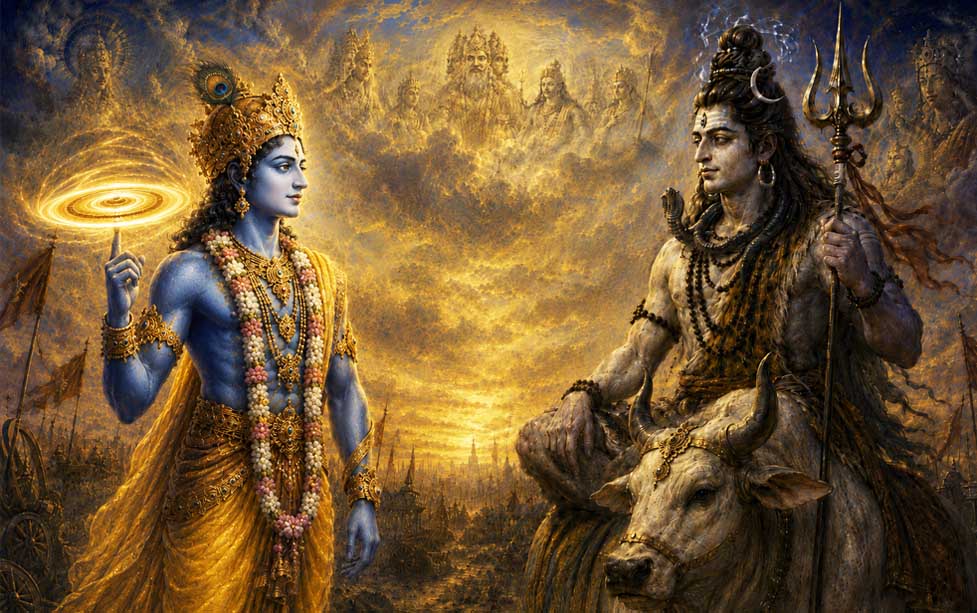


All we have to remember is,
The Divine power is always there to protect us, it’s only we who don’t know what is to be protected